Saturday, July 22, 2006

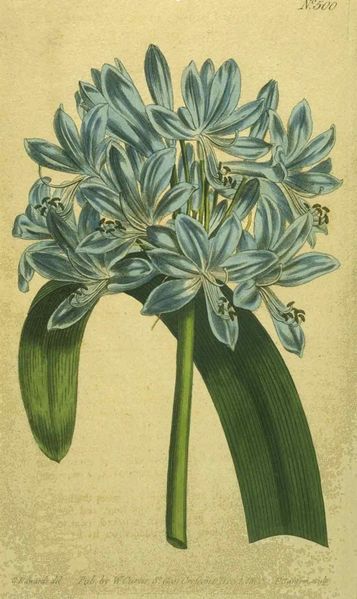
Mary Magdalene's Flower: Agapanthus


In honor of the feast day of MaryMagdalene, I've chosen the flower associated with her:
the agapanthus umbellatus, also known as African Lily and Lily of the Nile.

The plant originates in South Africa, so it’s doubtful that Mary Magdalene ever came in contact with it, but it does have fragrance, and, of course, she has long been associated with perfume, along with other sensual pleasures. It is also blooming on her holiday.


I remember this plant fondly from my southern California childhood but it prefers warm climates and I rarely see it in Seattle.

Illustration:
From Curtis’s Botanical Magazine (1800). reproduced with permission from the National Agricultural Library, ARS, USDA, found at Wikipedia

http://www.nal.usda.gov/curtis/500jpg/shtml

Wednesday, July 19, 2006

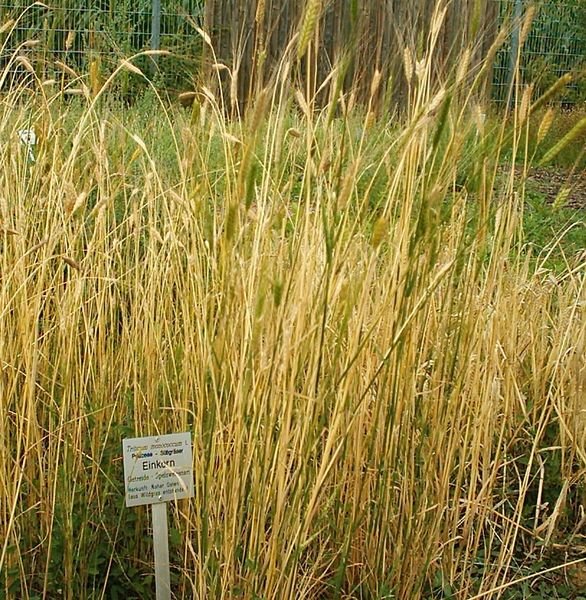
Einkorn Wheat


Today is the first day of Thermidor (from thermos meaning heat) in the French Republican calendar. The creators of the calendar sought to do away with the old religious and political associations of the calendar by assigning each day a plant, animal or tool. Today's plant is Einkorn Wheat, one of the ancestors of wheat, a wild grass that was partly responsible for the development of civilization as we know it

Here are a few of the interesting facts I learned while researching Einkorn:

  • Einkorn was the first cultivated grain.
  • The oldest evidence for the cultivation of this type of wheat comes from the slopes of a volcano in southeast Turkey, although it may have been developed in other places in the Fertile Crescent, including Syria, Palestine or Jordan.
  • Civilizations first arose in these areas where people began cultivating wheat and other crops.
  • Einkorn has more nutritional value than our modern varieties of wheat. However, it doesn't make good bread. It has the advantage of storing well (the husk is tough and prevents insect damage) but needs to be milled (to get rid of the husk) to be used in cooking.
Here are some interesting facts about wheat from an article on Wheat and Population Growth by Paul Ehrlich in the Economist:
http://www.economist.com/science/displaystory.cfm?story_id=5323362

Most wheat has six copies of each gene, where most creatures have two. Thus its 21 chromosomes contain 16 billion base pairs of DNA, 40 times as much as rice, six times as much as maize and five times as much as people.

Wheat is incapable of sowing itself and must rely on people to sow it.

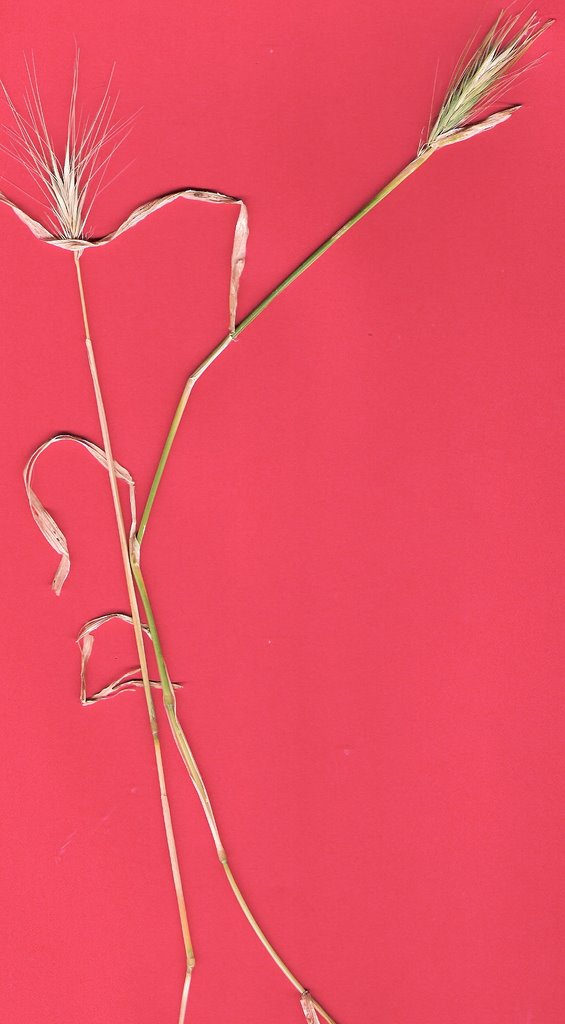
All day today I've been admiring the wild wheat on my block which has sown itself quite capably and offering it praise for the many gifts it has given us. I scanned a picture of the plants I found on my morning walk.

The top picture of Einkorn Wheat comes from Thomas Springer and was released by him into the public domain. I found it in on Wikipedia
http://en.wikipedia.org/wiki/Einkorn_wheat

Sunday, July 16, 2006

Wild Flowers

I don’t think I realized how much this Flower of the Day plant blog has taken over my life until I went on a yoga retreat led by my yoga teacher, Denise Benitez, at this wonderful place:
http://tierralearningcenter.org/

We spent most of our time doing yoga and eating delicious food but in my free time I wandered around through the grounds looking at wildflowers. I was surprised by how much more vibrant the wild flowers were in their presence than the tame flowers in my garden and around my block. They seemed to call out for my attention. It reminded me of the story Stephen Harrod Buhner told in his book on Sacred Plant Medicine about how plants called out to the people who needed them.

I found a field guide published by the Audubon Society that was supposed to help me identify wildflowers but in order to use the key, I had to learn many botanical terms, like corymb, calyx, pinnate, panicles, bilaterally symmetrical. I drew pictures of the plants I found. And every time I closed my eyes, in meditation, during savasana, or when I went to sleep at night, I saw parts of flowers.

On Sunday, I found a lovely moneywort (which I featured way back on June 8) growing next to the waterfall under the lodge. I also found chia (salvia columbaria) although it’s supposed to only grow in Southwestern deserts, but it’s possible it would grow in Leavenworth where the retreat center is located because I also found a California corn lily (very poisonous, but so pretty with its creamy panicles). I also found chicory and fireweed in the area around the cabin. But I’ve yet to identify the small plant with tiny purple blossoms that smells so sweet and I’m still looking for veronica. I know I will find it eventually. I think I've found everything I've written about so far.

Tuesday, July 11, 2006

Angelica


Contagious air engendering pestilence,
Infects not those who in their mouth have taken
Angelica, that happy Counterbane.
Sent down from heaven by some Celestial scout
As well the name and nature both avowed.
DuBartas

The plant for the day in the French Republican Calendar is the lovely haricot (or green bean) and I certainly applaud you if you decide to celebrate the bean. But I have chosen to focus on the flower of the day from Flora’s Dial, angelica, inspired by Stephen Harrod Buhner’s description of his relationship with this herb.

In his wonderful book, Sacred Plant Medicine, Buhner describes how he became acquainted with the herbs, by spending time with them, listening to them, and studying the way indigenous healers learned about plants. Angelica was one of the first herbs that really made a strong impression on him and is one of his major plant healers. He writes: “Coming upon angelica, I am always struck by the feeling of femaleness and strong purity of spirit that the plant emanates….In sitting meditation with the spirit of angelica is it clear that the plant sits in balance between Heaven and Earth….Many shamans have carried the stem of angelica as a staff to help them maintain balance when traveling in spirit worlds. ….The spirit of angelica is strong and may offer help to women who have an empty place within them (like angelica’s stem). Go and sit with the plant and after making relationship with it ask (with the part of you that is empty) that it come into that place and reside there as an ally.”

I was particularly moved by Buhner’s devotion to angelica because there used to be an angelica plant in my garden. It was a magnificent plant, taller than most people and situated along the main garden path. Everyone who came into the garden remarked on it or asked about it. It has been gone for almost two years but I still think of it every time I pass that spot so I know how strong the spirit of the plant is.

Now that I've learned more about the plant I realize it disappeared after two years because it is a bienniel. The first year it puts up an amzaing stalk (up to six feet high) and it has a wonderful aroma (frequently described as complex) which is quite noticeable. The second year it will produce white flowers on umbels, then go to seed and die. If you cut down the blooming stems, you can keep it going for much longer.

The common names of angelica include high angel, archangel and masterwort, all indicating its powerful spiritual qualities. Its botanical name is Angelica archangelica and several experts claim this is because it blooms on May 8, the feast day of St Michael the Archangel, but that seems unlikely as most of my sources say it blooms in June and July. It is a herb of the Umbelliferae family which includes fennel, parsley, carrots, caraway, and chervil. It resemble the very poisonous water hemlock so be certain of identification before using any part of the plant.

It has many medicinal and culinary uses. Check out this website for some fascinating recipes, including one that requires a broth made of reindeer bones:
http://www.henriettesherbal.com/archives/best/1996/angelica.html

I also found this recipe for Niort angelica a la sybarite in The New Larousse Gastronomique:

Have ready a dozen or so best quality butter brioches (kept hot), a fruit dish filled with sticks of candied angelica, a bottle of angelica cream, a carafe of iced water, a packet of Egyptian cigarettes. Light a cigarette, sip the ice water, crunch a piece of angelica with a bite of hot brioche, sip, breathe and savor a few drops of angelica liqueur and then repeat the whole process.

Austin de Croze who created this recipe also recommends spraying the room with a fresh light perfume of verbena or southernwood. I think I published it because I still miss my clove cigarettes (it's been over 14 years since I smoked). Id' substitute croissants for the brioche. And I was never one to smoke and eat at the same time, but still it sounds quite sybaritic. The angelica liqueur seems easiest to produce. Simply put some angelica stems in brandy and let it sit for a month.

References:
Buhner, Stephen Harrod, Sacred Plant Medicine, Treasure Chest Books 1996
Montagné, Prosper, The New Larousse Gastronomique, Crown 1960
Preus, Mary, The Northwest Herb Lover’s Handbook, Sasquatch Books 2000
Simmons, Adelma Grenier, Herb Gardening in Five Seasons, Penguin 1990

Illustration is from Mrs Grieve’s Modern Herbal at
http://botanical.com/botanical/mgmh/a/anegl037.html

Saturday, July 08, 2006

the Park


My daughter took her dog to her boyfriend's apartment yesterday and so I woke up this morning for the first time without a dog in my house. Very strange, although the cat did her best to pretend she was a dog. She even rolled around and showed me her belly (but wouldn't let me pet it). Normally I am feeling the pressure of dog desires (and needs) to get outdoors and my day always starts with a walk around the block. Now I have no excuse to even go outdoors (where it is blazing hot).

In the French Republican Calendar, Messidor 20, like all days that end in 0, is associated with a tool, in this case: the park (parc). It seems like a strange concept for the French Revolutionaries to celebrate as the earliest parks were open spaces set aside by nobles for hunting. Later they came to mean spaces set aside by the public for recreation but this concept of the park was probably just beginning at the time of the development of the French Republican Calendar in late 1793.

The Parc Monceau, shown in this painting by Monet, is a case in point. It was established in 1768 by Philippe d’Orleans, Duke of Chartres, a cousin of the King, who wanted to create an English style garden in the middle of Paris. In 1793, the Duke was executed on the guillotine and the park was taken into public ownership.

Curious about my local park, Volunteer Park, I did some research online (Wikipedia was a better source than the Seattle parks department). I found out that it was named Volunteer Park for the Volunteers who fought in the Spanish-American war. I also learned something about the design philosophy of the Olmstead Brothers who designed the park in 1904-1909 (they also designed the University of Washington campus, Central Park, the White House and Capitol grounds and Yosemite, among others). Here's a photograph I took of Volunteer Park at Summer Solstice in 1998 when I was taking photographs on each of the seasonal holiday for my annual creative pledge.

I've spent a lot of time at this park with with Chester the Dog. When my daughter and I first adopted him, we promptly took him to the park for an outing and let him off his leash (this was his second leash—he had chewed through the first while we were waiting for the bus outside the animal shelter where we adopted him). Chester promptly ran over and bit a beige-colored terrier-dog walking byh with her owner. We were mortified but luckily no damage was done.

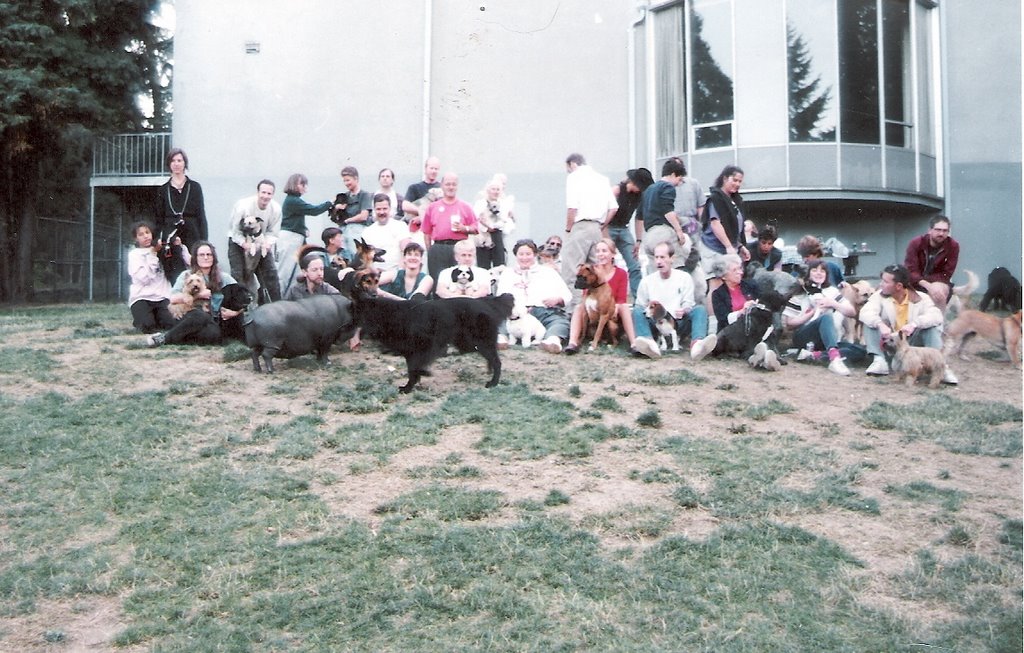
Chester was much better behaved, years later, when we started attending the Doggie Club, an informal meeting of dog owners which happened outside the Art Museum. The dogs loved to run and play with each other while their owners sat and talked. Here's a picture of the Doggie Club--I'm guessing this is around 1993. Shaw is over on the far left in a pink sweatshirt holding Chester on her lap--I'm standing behind her in a black jacket. Yes, there is a pot-bellied pig in the picture (to the left of the black dog in front).

Then an obnoxious woman who was afraid of dogs started complaining and the police started handing out $100 tickets to owners of dogs they found off-leash. A local group called COLA (Citizens for Off Leash Areas) formed and successfully lobbied to create special fenced dog areas in local parks. (http://www.coladog.org/)

Unfortunately, once the dogs were confined in a small area, it became a muddy, unsightly mess and eventually was removed from Volunteer Park (although creative spaces were found in other parks). Unfortunately, Chester hated being confined so much that he spent all his time trying to find a way to get out of the fence instead of playing, so we had to stop taking him to the Park.

I'm going to the park this weekend to honor Messidor 20 but it will be sad to be there without Chester.

Thursday, July 06, 2006

Hairy Vetchling


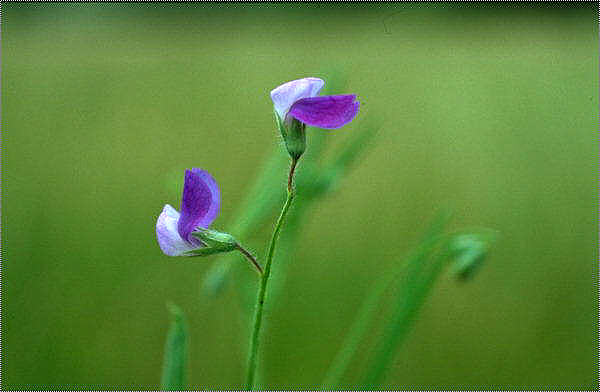
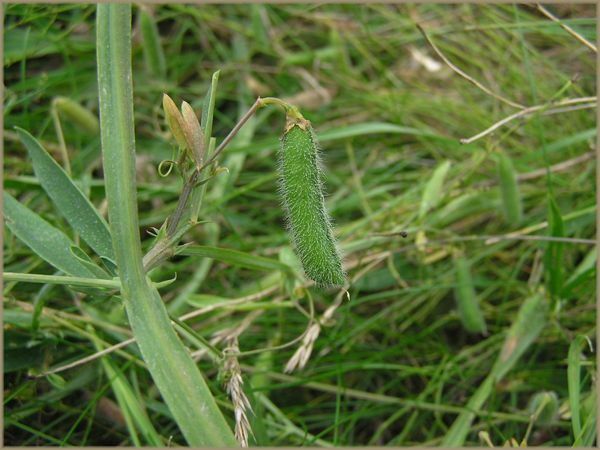
Today in the French Republican calendar is Messidor 18 and the plant of the day is the Gesse or Hairy Vetchling. In my quest to find a way to share my love of fllower folklore with others, I’ve thought of many methods of presentation, and one is the idea of a book of Birthday Flowers. But who wants to be born on the day of the Hairy Vetchling (as a blogger whose blog I ran across while googling hairy vetchling so poignantly asks)?

The hairy vetchling seems to be a rare wild relative of the garden Sweet Pea. It seems to be much appreciated and sought after in England (I’m not sure it exists in North America). Ralph Hollins in his Nature Diary (http://www.havnn.net/Diary.htm), describes it in an entry for June 16:
"The plant is a scrambler with very distinctive pairs of erect leaves looking somewhat like Hare’s ears, and with very long stalked flowers (two or three on each stem). The leaves are about 5 or 6 cms long but narrow and folded so that the sides almost meet above the central vein (or ‘keel’). The flowers are similar in size to those of Grass Vetchling but are distinctively two tone in colour with a reddish-purple standard and creamy wings and keel. "

Other common names for the hairy vetchling include Austrian winterpea, caley pea and singletary pea. According to the American Heritage Dictionary, the name vetch comes from the same root word as weak and wicker, and refers to the pliable, twining nature of the plant. Its Latin name Lathyrus, which applies to all members of the pea family, comes from an Akkadian word ladiru, which refers to a certain type of plant (presumably the pea). That’s a great pedigree.

Vetch has been grown as a food and forage crop for centuries in the Mediterranean and India, although some species (and hairy vetchling appears to be one) have a neurotoxin in their seeds which can cause paralysis in humans with heavy consumption.

The hairy vetchling reminds me a bit in looks of some of the wild sweet peas that grow in my neighborhood which are just now beginning to put forth their seed pods. I will take a closer look at them today on my way to work to see if they are hairy. According to my Northwest Weeds book, they are probably a naturalized sweet pea (lathyrus tingitanus) rather than the hairy vetchling.

The best known member of the lathyrus family is lathyrus odoratus (the sweet pea). They are just now beginning to bloom in my garden and I have some lovely old-fashioned, fragrant ones that are purple and pink. My Irish great-great-grandmother, Bridget Banks Fitzgerald, was famous for her sweet peas which grew along the fence all the way down the drive to the farmhouse in Hartland, Minnesota. I like to say that I grow my sweet peas in memory of her. They are also the quintessential summer solstice flower for me as we have used them to mark the edges of our circle for years of summer solstice bonfires at Golden Gardens.

If you can't find a hairy vetchling, or its close relative, in your neighborhood, find some sweet peas instead.

References:
Martin, Laura C., Garden Flower Folklore, Globe Pequot Press 1987
Taylor, Ronald J, Northwest Weeds, Mountain Press Publishing Company 1990

Photographs:
Of hairy vetchling flower
http://www.dijon.inra.fr/hyppa/hyppa-a/lthhi_ah.htm#Adult plant
Of hairy vetchling seed pod
http://www.s-weeds.net/familjer/rosales/fabaceae/lathhirs.html

Tuesday, July 04, 2006

Strawberry


Strawberry

The flower of the day (Messidor 16) in the French Republican calendar is Tabac (tobacco) which does seem like a quintessentially American plant to feature on the Fourth of July.

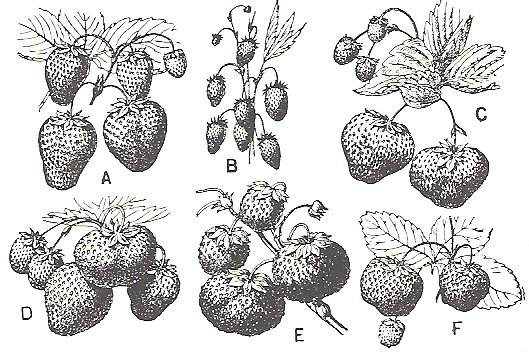
However, I’ve decided to feature the strawberry, not the bloom but the fruit, as I always associate strawberries with Fourth of July. I have a wonderful strawberry plant in my garden, given to me by a friend last summer, which has been producing incredibly delicious fruit for the past three weeks. Larousse Gastronomique says “Strawberries must be eaten freshly gathered because they do not keep.” That is true—I have not managed to get any back to my house yet.

Strawberries are members of the rose family, and belong to the genus Fragaria, from the same Latin word as fragrance, for its wonderful scent. The derivations of the common name strawberry seems fairly obvious. Mrs. Beeton says it was so called because straw was used as a mulch to keep the berries off the ground. But Mrs.M. Grieve, says it was originally the strew berry because of the way the plant grows (putting forth runners which tangle along the ground). The strawberry has an aggregate fruit, according to the American Heritage Dictionary, consisting of a red fleshy edible receptacle and numerous seed-like fruitlets (doesn’t make it sound quite so appealing, does it?)

Strawberry History
For everything you want to know about strawberry history, see this site:
http://www.vegparadise.com/highestperch45.html

Strawberry Medicine
The 17th century herbalist Culpeper says they are cool and dry when green, but cool and moist when ripe. He used them to cool the liver, blood and spleen, to calm an upset stomach and to refresh the spirit. Judging by the number of conditions for which he used them, they were associated with bright red problems, like inflamed red eyes and blisters of the skin. They could also bring rosiness back to the complexion of someone with jaundice.

Gerard, the Elizabethan herbalist says “the leaves boiled and applied in the manner of a poultice take away the burning heat in wounds.” Gerard also recommended “The distilled water drunk with white Wine” as “good against the passion of the heart, reviving the spirits and making the heart merry.” This use of strawberries coincides with that of the Naragansett Indians who called it "wuttahimneash" which translated as heart-seed berry.

According to Mrs. Grieve a cut Strawberry rubbed over the face immediately after washing will whiten the skin and remove slight sunburn. For a badly sunburnt face she recommends rubbing the juice well into the skin, leaving it on for a half hour, then washing it off with warm water to which a few drops of simple tincture of benzoin have been added; no soap should be used. This recipe may come in useful if you are out in the sun all day on Fourth of July.

Strawberry Folklore
According to Funk and Wagnalls, the strawberry was sacred to Frigga, who concealed children who died as infants in strawberries and smuggled them into heaven. Culpeper calls it a plant of Venus. It was later associated with the Virgin Mary.

I haven’t seen a reference for this bit of folklore but it makes sense to me. Sharing a double strawberry with someone else means you will fall in love. Also according to this website (http://strawberry.ifas.ufl.edu/Productioncosts.htm) in France, newlyweds were served a soup of thinned sour cream, strawberries, borage (a European herb whose flavor is reminiscent of cucumber) and powdered sugar as an aphrodisiac.

Strawberry Recipes
Here's my favorite strawberry recipe: cut strawberries into halves (or quarters if large) and toss lightly with rosewater and a hint of sugar. Allow to marinate for two to four hours, stirring occasionally (perhaps once an hour). The rosewater adds an interesting flavor and dimension to the strawberries. I got this idea from Aroma, a wonderful resource on using essential oils in aromatherapy and cooking by Mandy Aftel and Daniel Patterson.

References:
Aftel, Mandy, and Daniel Patterson, Aroma: The Magic of Essential Oils in Food and Fragrance, Artisan 2004
Beeton, Mrs. Isabella, Book of Household Management, London 1861, First Edition Facsimile, Farrar, Straus & Giroux 1977
Funk & Wagnalls Standard Dictionary of Folklore, Mythology and Legend, edited by Maria Leach, Harper & Row 1972
Grieve, Mrs. M, Modern Herbal, 1931 www.botanical.com
Montagne, Prosper, The New Larousse Gastronomique, Crown 1977

Illustration is from Larousse Gastronomique

Monday, July 03, 2006

Cherries


Cherry

in honor of the abundance of ripe cherries that I got to sample at my local farmer's market yesterday, I decided to make this the day of the cherry. It also seems like a quintessential Fourth of July food. And to my surprise, I found out that my choice coincides with the National Cherry Festival held in Traverse City, Michigan on the first weekend in July.

The wild cherry originated in Persia and Armenia and provides the rootstock for most of the flowering cherries which need to be grafted. The fruits are called drupes, which is the name for any fleshy fruit with a hard stone enclosing a seed, like peaches and apricots. Here’s a web site that shows pictures of several cherry varieties:
http://www.calcherry.com/consumer.cfm?varieties=1
This web site has a great history of cherries, explaining the many varieties that flourish in various parts of the United States and how they got their names:
http://www.cherrymkt.org/media/background_info.html

Culpeper makes the cherry a tree of Venus. He recommends tart and sweet cherries for various medicinal purposes. According to nutritional writer, Mark Anthony, scientists are discovering that cherries are high in both antioxidants and anthocyanins, which help reduce inflammation and thus recommended for treating arthritis.
http://www.foodprocessing.com/articles/2006/083.html

Culpeper also recommends using the gum of the tree to ease coughs. Scottish children used to chew it like chewing gum. Funk and Wagnalls says cherry gum in wine is still used for treating coughs (think Ludens Cherry-flavored cough drops). Mrs. Grieve recommends using cherry bark for treeating coughs:
http://www.botanical.com/botanical/mgmh/c/chewil56.html

The Cherry Tree Carol is a famous English ballad carol based on an Apocryphal story from the Gospel of Pseudo-Matthew. Mary and Joseph were walking through a garden or orchard of cherry tress when Mary was pregnant and Mary asked Joseph to pluck her a cherry. He refused whereupon the unborn Christ Child in her womb bade the tree to bend down before his mother, which it did. In other European countries the same story exists but often told about other fruits, for instance, dates, figs, apples, etc., depending on the country. There is a similar story in the Kalevala about Marjatta, a maiden who notices some scarlet berries growing on a tree as she is walking out to milk the cows. The tree invites her to gather the fruit but she can’t reach it. At her command, a berry jumps down into her lap, and then into her mouth. She later became the mother of Ilmori, the Air. So it seems that cherry fruit has something to do with pregnancy. Could it be related to the idea that swallowing a cherry stone means it will sprout in your stomach?

In Switzerland, according to Funk and Wagnalls, the first fruit of a cherry tree is given to a young mother to eat, preferably one who has just given birth to her first child. This will insure an abundance of fruit. In some parts of France, cherry orchards are wassailed the way apple orchards are in England.

References:
Anthony, Mark, “Nutrition Beyond the Trends: Pie in the Sky,” http://www.foodprocessing.com/articles/2006/083.html
Funk and Wagnalls Standard Dictionary of Folklore, Mythology and Legend, edited by Maria Leach, Harper and Row 1972
Hageneder, Fred, The Meaning of Trees, Chronicle Books 2005

And in case you’re still hungry for more, this website has everything you ever wanted to know about cherries:
http://www.vegparadise.com/highestperch56.html
including the lyrics to Life Is Just a Bowl of Cherries.

The photo comes from this website:
http://www.hort.purdue.edu/ext/senior/fruits/cherry1.htm

Sunday, July 02, 2006

Lavender


The flower for Messidor 14 in the French Republican calendar is Lavender, one of my favorite of all flowers. It was the plant ally I adopted many years ago during an herb course I took from EagleSong at Ravencroft garden and ever since, it has been a welcome friend. I could write about it forever and in fact, I often have. It was featured in my last newsletter
http://www.schooloftheseasons.com/news.html

Most writers explain the name of lavender as coming from Latin, lavare, to wash, explaining that the herb was used in washing. But the American Heritage Dictionary (my favorite) derives it from Latin lividus, meaning bluish, which comes from the Indo-European root, sleia—which also shows up in sloe, slivovitz and livid. This makes more sense to me.

Lavender is a member of the Labatiae or Mint family. This was the only web site I could find that offered pictures of the various lavender varieties for which I'm so grateful I'm planning to place an order with them:
http://www.mountainvalleygrowers.com/lavendercareandtips.htm

Lavender has been a popular element in cooking for centuries. On the web, I found a recipe for chicken with lavender, prepared by Anahita from a 13th century Andalusian recipe:
http://home.earthlink.net/~lilinah/Food/2002_Feasts/2002-thumiyya.html

For more contemporary interpretations of lavender, this web site has quite a list including grilled pork chops with lavender, lavender crème brulee and lavender jelly at:
http://whatscookingamerica.net/Lavender.htm

And my friend Kathy Gehrt’s blog features recipes for lavender nougat, lavender poached pears and bleu cheese and lavender honey on crackers:
http://discoverlavender.blogspot.com/

For the past two weeks, I’ve been enjoying lavender vodka tonics, made from a recipe from this web site:
http://www.npr.org/templates/story/story.php?storyId=4754257

For instructions on making lavender wands, see the supplemental pages for my Lammas packet which can be downloaded and printed:
www.schooloftheseasons.com/pdfdocs/lammassample.pdf

In the Middle Ages, lavender was considered a herb of love. Kate Greenaway in Language of the Flowers says it means distrust. But another source (from before the days when I became scrupulous about writing down bibliographic information) says it means constancy and loyalty, sweetness and undying love, "fervent but silent heart," and good luck. That's how I feel about it.

References:
Greenaway, Kate, Language of Flowers, Averill Books

Illustration from Mrs. Grieve’s Herbal
http://botanical.com/botanical/mgmh/l/lavend13.html

Friday, June 30, 2006

Fairy Flower: Foxglove


Foxglove, Foxglove,What do you see?"
The cool green woodland,The fat velvet bee;
Hey, Mr Bumble,I've honey here for thee!
"Foxglove, Foxglove,What see you now?"
The soft summer moonlight
On bracken, grass, and bough;
And all the fairies dancing
As only they know how.
The Song of the Foxglove Fairy
Cecily M. Barker

During the time of Midsummer when the fairies are active, I wanted to feature a flower frequently associated with them: the foxglove, which is blooming now in my neighborhood. Like hollyhocks and snapdragons, the foxglove has been a favorite toy of children for centuries (although it is poisonous and thus its use must be supervised). The bell-shaped flowers fit on a child’s fingers like a glove.

The name foxglove may be a corruption of Folks Glove (meaning the gloves of the Folk or fairies) although there is a story that the fairies gave foxgloves to foxes so that they could wear them on their feet and slip into henhouses more quietly. The common name in Norwegian is Revbield, or foxbell.

Other names for the plant include Witches' Gloves, Dead Men's Bells, Fairy's Gloves, Gloves of Our Lady or the Virgin’s Gloves (in France). Bloody Fingers, Fairy Caps (in Ireland), Fairy’s Petticoats (in Cheshire), and Fairy Thimbles. The more negative names may come from a recognition of the poisonous nature of the plant, or from its mottled appearance.The German name is Fingerhut which means “thimble” which is why Fuchs, the 16th century German herbalist, gave it the Latin name of digitalis (for digit, that is finger).

In Scotland, it is the badge of the Farquharsons. Often medieval knights wore a sprig of a plant as a token to indicate their fealty. The Plantagenet kings used a sprig of genesta. The Stuarts had a thistle as an emblem. Do you know the floral badge of your family?

Medieval herbalists used the leaves externally and the Welsh rubbed the leaves on the stone carvings of their floors to bring out the design, But the foxglove has become most famous for its internal use as digitalis, a powerful heart medicine. Rodale’s tells the story of how Dr. William Withering discovered its efficacy in 1775. He had visited a woman with dropsy and found her so ill that he expected her to die within days. When he heard that she had fully recovered by drinking a herbal tea, he studied the tea and identified the active ingredient, foxglove, responsible for her recovery. In 1785, he published his findings in a report called An Account of the Foxglove, which encouraged other doctors to prescribe the plant. According to Martin he eventually married a young woman who he was able to cure of heart disease with foxglove.

As usual Mrs. M. Grieve provides a comprehensive look at the plant:
http://botanical.com/botanical/mgmh/f/foxglo30.html

Foxglove is a biennial which means it will not bloom the first year it is planted. Instead it produces a rosette of fuzzy leaves. In the second year, it sends up a stalk which in June and July features the long, bell-shaped flowers.

Foxgloves thrive in areas with high concentrations of iron and coal. In the Soviet Union, prospectors looking for coal fields would simply look for masses of foxgloves.

Martin writes that in the language of flowers, foxglove means insincerity, but Seaton lists the following meanings: salubrity, youth and a wish.

References:
Martin, Laura, Garden Flower Folklore, Globe Pequot Press 1987
Rodale’s Illustrated Encyclopedia of Herbs, edited by Claire Kowalchik and William H. Hylton, Rodale 1987
Seaton, Beverly,The Language of Flowers: A History, University of Virginia Press 1995

Illustration:
The foxglove fairy comes from Prints with a Past:
http://www.printspast.com/pwap1001030012.htm

Thursday, June 29, 2006

Yellow Rattle

The flower of St. Peter who, along with St. Paul, is honored on this day, a national holiday in many countries and especially in Rome, according to Wilson's Almanac.
http://www.wilsonsalmanac.com/book/jun29.html

In French, yellow rattle is called Crote-de-Coq or Cock’s Comb (because the bloom resembles the wattle of a rooster?) which may be one of the reasons it is assigned to St. Peter, who denied Christ three times before the cock crowed.
http://www.botanical.com/botanical/mgmh/r/ratyel07.html

Here’s a picture of yellow rattle and a short description of it. This is one of those plants that is an agricultural marker: when the seeds rattle, it’s time to cut the hay. It’s also a great plant for re-establishing hay meadows.
http://www.northumberland-national-park.org.uk/VisitorGuide/TheNationalPark/Wildlife/haymeadow/yellowrattle.htm

In medieval England, this was the day when rushes, or new-mown hay, were brought into the church to be spread on the floor, according to Kightly. Great carts of plaited rushes, decorated with flowers were brought in procession to the churches. Possibly an offering of thanks given for a successful hay harvest? Is hay being harvested where you live?

References:
Kightly, Charles, The Perpetual Almanck of Days, Thames & Hudson 1987

Wednesday, June 28, 2006

Mimosa (Silk Tree)


Mimosa

In one of my Living in Season newsletters, (you can sign up to get them at http://www.schooloftheseasons.com/) I asked my readers to nominate a birthday flower, that is a flower that blooms on your birthday. Linda Massey nominated the mimosa, which always bloomed in Valley Forge, Pennsylvania around her birthday, June 28.

I don’t know mimosa at all, except for the drink, but I like being able to feature flowers that are blooming in other areas. That’s why it’s so hard to develop a flower calendar. Not only are the flowers different in different parts of the world, but their names are different and their bloom dates vary from year to year.

I was confused when I went looking for mimosas as apparently this name is applied to many different flowers. There are yellow mimosas that are really acacias that bloom in early winter (January and February) and smell incredibly fragrant.

But I believe the mimosa that Linda knows is also called a silk tree (Albizia julibrissin). It’s a member of the Pea family and produces fragrant pink flowers in June, which look like little fireworks. It’s native to Iran, Japan and China. Here’s a web site that features many wonderful photos and a thorough description of the silk tree:
http://www.hiltonpond.org/ThisWeek060601.html

This article features the Mimosas of Texas with great photographs:
http://uts.cc.utexas.edu/~harms/mimosa-dif.html

And here’s a mimosa-like flower preserved in amber from about 20 to 25 millions years ago:
http://3dotstudio.com/mimosa.html

You never know what you’re going to find on the web while looking for mimosa. I found a web site for Jeanne Rose, who was the author of the first contemporary book of herbal lore that I read (I have a copy from 1978 of her Herbs & Things.). Apparently she teaches classes in aromatherapy and herbal studies.
http://www.jeannerose.net/index.htm

I got the illustration of a humming bird feeding on a mimosa (but which one?) from this website:
http://www.emblibrary.com/EL/new.aspx?date=032603

Tuesday, June 27, 2006

Wormwood


Messidor 9

What savor is best, if physic be true,
For places infected than wormwood and rue?
It is as a comfort, for heart and the brain,
And therefore to have it, it is not in vain.
Thomas Tusser

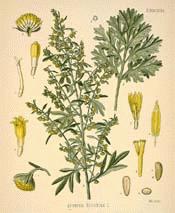
The plant of the day in the French Republican Calendar is Absinthe or Wormwood. One of my favorite herbs--it has such a pungent scent and such a sinister reputation. And it fits with my theme, as it is bitter indeed to get used to living without Chester the Dog.

Wormwood is a member of the Compositae family (same as the Daisy and Aster), and a member of the genus, Artemisia, which includes Mugwort, Tarragon and Southernwood. The name comes from Artemis, the goddess of the hunt and the wood, who is said to have discovered them and recommended their use to the centaur, Chiron. Jeanne Rose says one of its common names is Old Woman.

According to Rodale’s, the first mention of wormwood comes from an Egyptian papyrus from 1600 BCE when it was recommended to rid the body of worms, which may be how it got its name. The 17th century herbalist Culpeper says that women give the seeds to their children to get rid of worms. He also makes it an herb of Mars, and says it is often found near forges and iron works. The taste of the plant is very bitter.

Adlema Grenier Simmons, one of the great American herbalists, loved artemisias and featured them as the plant of Autumn in her book, Herb Gardening in Five Seasons. The plant has grey foliage and grows to about 2 to 4 feet tall. It is harvested in July and August when it is in flower—take the tops and the flowers on a dry day when the sun has dried off the dew.

Simmons says it is is the key ingredient in Absorbine Junior. Rubbed on the skin in a salve, it was used to dispel headaches and bring down fevers. Wormwood was strewn on floors to repel insects like fleas, put into bedding for pets and tucked away among clothes to scare away moths.
Culpeper goes on an interesting astrological rant in his description of wormwood, in which he says that wormwood is a remedy for the bites of rodents, for mushroom poisoning, for bruises caused by beatings, for diseases of the throats, for sore eyes, for bites of stinging insects like bees and hornets, for colic, for overindulgence in alcohol, etc. Mrs. Grieve recommends wormwood tea for settling the stomach, but the active ingredient of thujone can be toxic in large quantities.

These for frenzy be
A speedy and a sovereign remedy
The bitter wormwood, sage and marigold.
Andrew Fletcher

Jeanne Rose says that mixed with rum it allays feverish excitement, helps heal bruises and sprains, and is said to cure flat feet, fallen arches and bad ankles if rubbed on them. An ounce of the flowers put in a pint of brandy and steeped for 6 weeks cures gout if taken one tablespoon before meals and bed. Poultices of wormwood simmered in wine relieved swelling of the joints.

This article has some interesting references to the way wormwood has been used by Native American peoples:
http://www.geocities.com/Athens/olympus/6581/goddessgarden9.html

Wikipedia has a great and what seems like a thorough article on absinthe, the drink made from wormwood (usually combined with fennel and anise) and its history, at:
http://en.wikipedia.org/wiki/Absinthe
Simmons quotes Dr John Hill who says the Germans drank a wine made with Roman wormwood, that helped them eat for hours without sickness or indigestion. The English used wormwood in place of hops in making ale and also used it to flavor wine. This website (comments on Pepy’s Diary) has some enthusiastic and amateur comments on wormwood and its use:
http://www.pepysdiary.com/p/1784.php

The use of wormwood in alcohol is similar to the use of vermouth. Simmons knew an elderly man who said he drank three wineglasses a day of wormwood (one assumes wine flavored with wormwood) and attributed his old age and good health to this practice. Simmons tried it herself but found she was unable to eat and gave it up. She comments that wormwood in small doses revives the appetite but in large doses has the same effect as absinthe on the addict, of making food seem unpalatable.

References:
Culpeper’s Complete Herbal, Wordsworth 1995
Rodales’ Illustrated Encyclopedia of Herbs, edited by Claire Kowalchik and William H. Hylton, Rodale 1987
Rose, Jeanne, Herbs & Things, Grosset and Dunlap 1978
Simmons, Adelma Grenier, Herb Gardening in Five Seasons, Plume/Penguin 1990

Illustration from Mrs. Grieve’s herbal:
http://botanical.com/botanical/mgmh/w/wormwo37.html
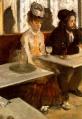
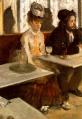
The Absinthe Drinkers by Edgar Degas from
http://socrates.uhwo.hawaii.edu/SocialSci/spelowsk/psy403syllabusfall04.htm

Sunday, June 25, 2006

Hollyhock


Messidor 7

The plant of the day in the French Republican calendar is the cucumber. I am not a big fan of cucumbers (I pick them out of my salads) and we can’t easily grow cucumbers here in the Northwest, so I’m honoring the flower of the day in Rosa’s Dial: the glorious hollyhock.

The hollyhock belongs to the family Malvaceae, which also includes the marsh mallow and the hibiscus. It from the genus Althea (which means “healer”), species rosea. (There is a Grateful Dead song that addresses a woman named Althea and the Cavalier poet Richard Lovelace also wrote a poem to Althea in 1649—both can be found at this interesting web site:
http://arts.ucsc.edu/GDEAD/AGDL/althea.html
Laura Martin says the name hollyhock comes from the Anglo-Saxon for holy hock (a name for Mallows) and that it was considered holy because it grew plentifully in the Holy Land--supposedly the Crusaders brought it back with them). That sounds like a spurious explanation to me, that is an explanation made up to explain the name.

Hollyhocks originated in China where they were grown in gardens but also used for food: the leaves were cooked for spring greens and the flower buds were a delicacy. The The Romans also ate hollyhock leaves and used it as a strewing herb.

The juice of the plant was considered a demulcent and used in cough syrups and as a gargle for any problems with the mouth and throat. The flowers have been used to make dye. Jeanne Rose says the violet flowers produce a lovely pale periwinkle blue.

Denise Diamond in her book Living with Flowers suggests sandwiches made with hollyhock blossoms, sliced avocado and mile cheese, topped with alfalfa sprouts.

I do not know how to make hollyhock dolls because there were no hollyhocks around where I was growing up (the San Fernando Valley). If you are deprived like me, here are some instructions:
http://www.almanac.com/garden/crafts/hollydoll.php

Chelsie Vandaveer in her great web site on plant lore tells the legend of Priscilla’s hollyhock which grows in Oklahoma:
http://www.killerplants.com/herbal-folklore/20020429.asp

Mrs. Grieve has very little to say about hollyhocks but much to say about mallows:
http://www.botanical.com/botanical/mgmh/h/holhoc30.html

In the language of the flowers, hollyhock means abundance, fertility, mother of the family, and in some versions, ambition, particularly female ambition. Makes you think doesn’t it? What is the difference between female ambition and male ambition?

Do you know of the wonderful retreat center called Hollyhock? Someday I hope to take a class there (or teach one—even better!).
http://www.hollyhock.ca/

And Frank Lloyd Wright designed a house in LA called Hollyhock House:
http://www.galinsky.com/buildings/hollyhock/index.htm

The illustration comes from Mrs. Grieve’s herbal at this website:
http://www.botanical.com/botanical/mgmh/h/holhoc30.html

References:
Jeanne Rose, Herbs & Things, Grosset & Dunlap 1972
Martin, Laura C, Garden Flower Folklore, Globe Pequot Press 1987
Seaton, Beverly, The Language of the Flowers: A History, University Press of Virginia, 1995 f

Saturday, June 24, 2006

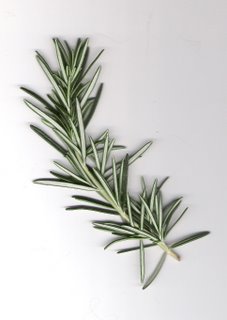
Rosemary


Rosemary

The flower for Messidor 6 on the French Republican Calendar is Rosemary (Romarin in French). I’m not sure this is the right place for Rosemary—I think of it as a plant of winter, when it features prominently in Midwinter revels, plus it blooms in April and May in Seattle (and I think it will bloom again in December). Still it’s an easy plant to like and gives me another chance to remember Chester the Dog.

“There’s rosemary, that’s for remembrance! Pray, love, remember.” The famous line from Hamlet. And we will remember Chester tomorrow when we celebrate his wake, with toasts and stories about the exploits of the Demon Dog from Hell (one of his nicknames).

The name “rosemary” comes from Latin rosmarinus, meaning the rose of the sea, which is supposedly due to the blue color of the flowers, or, according to Jeanne Rose, because it grows by the sea. There are also legends which associate this blue color with the Virgin Mary by saying that she threw her cloak on the plant while fleeing Herod (with the Baby Jesus) and the flowers which were formerly white turned as blue as her cloak. Its other common names polar plant and compass weed are not explained. In Spain, it is called “Romero,” the pilgrim’s flower. In Germany, it was called "elf leaf" [F&W].According to Mrs. Grieve it’s sometimes called “incensier” in France because it was burned as incense.

Rodale’s says that perfumers in the 16th century would bet rosemary leaves and sugar together, put the mixture in a perfuming pan and heat it over hot coals to create a pleasant scent in the air. Rosemary branches were burned in Europe during the 14th and 15th centuries to keep away plague. And more recently, rosemary leaves and juniper berries were burned in French hospitals during World War II to kill germs. According to Rodale’s, scientists have verified that rosemary has antibacterial qualities.

Mrs. M. Grieve has a thorough discussion of rosemary. http://www.botanical.com/botanical/mgmh/r/rosema17.html

She quotes Thomas More:
“As for Rosmarine, I lett it runne all over my garden walls, not onlie because my bees love it, but because it is the herb sacred to remembrance, and, therefore, to friendship; whence a sprig of it hath a dumb language that maketh it the chosen emblem of our funeral wakes and in our buriall grounds.” This refers to a custom, still common in Wales according to Mrs. Grieve, of distributing rosemary at funerals so each mourner can hold a sprig and toss it into the coffin, as a pledge of remembrance.

Rosemary also was frequently added to bridal bouquets. Mrs. Grieve writes “a Rosemary branch, richly gilded and tied with silken ribands of all colours, was also presented to wedding guests, as a symbol of love and loyalty.” Sounds like a lovely custom to revive. William Langham said of it in The Garden of Health: “See thee much rosemary and bathe thee therein to make thee lusty, lively, joyful, likeing and youngly.”

Gerard wrote that “Rosemary comforteth the braine, the memorie, the inward sense,” and Roman students supposedly wore wreaths of rosemary while studying for exams to enhance their mental abilities. Modern research verifies that rosemary improves circulation and stimulates the brain.

Mrs. Grieve mentions the use of rosemary in Hungary Water. It was prepared by putting 1 1/2 lb. of fresh Rosemary tops in full flower into 1 gallon of spirits of wine, this was allowed to stand for four days and then distilled. Legend says it was given to a Queen of Hungary by a hermit who told her it would preserve her beauty.

I went rattling around the Internet for a while, looking for a recipe for Hungary water and finally found this scholarly article which convinced me that most of the recipes you will find online are not authentic but that you can create a reasonable facsimile:
http://www.gallowglass.org/jadwiga/herbs/hungarywater.htmlOn this web site

Contemporary herbalist Rosemary Gladstar created her own version, using fresh herbs and vinegar. I found the recipe at this web site: (http://www.care2.com/channels/askannie/2000/09/11)

6 small handfuls lemon balm
5 small handfuls calendula flowers
4 small handfuls rose petals
3 small handfuls comfrey
1 small handful each rosemary, lemon peel, and sage
organic apple cider vinegar, as needed
rose water or witch hazel extract, as needed

Place the herbs in a large glass jug that will hold at last a gallon of liquid. Cover the herbs completely with organic apple cider vinegar, leaving about 2 inches to spare in the jar. Screw the lid on tightly. Let it set for 4 to 6 weeks. Strain. Divide the mixture into smaller jars, and dilute to half its strength with rose water or witch hazel extract. Dab some on your fingers, and massage into your face. Make sure to avoid your eyes. Rinse with warm water if desired.

You can also make rosemary vinegar by putting a few sprigs of the herb in a jar of apple cider vinegar and leaving it out in the sun for a day or so. Mary Preus recommends using this for a hair wash, pouring it into your bath, or using it to marinate chicken or add flavor to fried potatoes. One of my favorite local restaurants, 22 Doors, http://www.twentytwodoors.com/
serves a wonderful plate of fries that come scattered with rosemary leaves and accompanied by a tartar sauce containing snipped rosemary leaves. The Welsh make cooking spoons out of rosemary wood as they make everything more nutritious.

Mrs. Grieve recommends Rosemary Tea, for headache, colic, colds and nervous diseases. And a conserve of Rosemary, made by beating up the freshly gathered tops with three times their weight in sugar, which will relieve nervous depression. I think I will try making both today.

I’ve been told (I believe in a novel by Elizabeth Goudge) that you should never buy rosemary but receive it as a gift. That's why I didn't have any rosemary for years. Finally when I got a plot in my local community garden, I found the previous gardener had left a thriving rosemary behind (they do love our climate here in Seattle). Alas, this summer I moved plots and had to leave the rosemary behind. Folklore also says that wherever rosemary thrives, the mistress is master.

Good article on growing rosemary and cooking with rosemary:
http://www.gardenaction.co.uk/fruit_veg_diary/fruit_veg_mini_project_july_3_rosemary.asp
includes a page on folklore:
http://www.gardenaction.co.uk/fruit_veg_diary/fruit_veg_mini_project_july_3_rosemary_folklore.asp

References:
Funk & Wagnalls Standard Dictionary of Follore, Mythology and Legend, edited by Maria Leach, Harper & Row 1972
Preus, Mary, The Northwest Herb Lover’s Handbook, Sasquatch Books 2000
Rodale’s Illustrated Encyclopedia of Herbs, edited by Claire Kowalchik and William H. Hylton, Rodale Pres 1987
Rose, Jeanne, Herbs & Things, Grosset and Dunlap
Dog Rose


June 23

I didn’t post my usual flower of the day entry yesterday because my dog, Chester, died at 10 am in the morning. In his honor, I’m naming the dog rose, the flower of the day for June 23. The French Republican calendar honors the mule on this day since it’s the 5th of Messidor, while Rosa’s Dial assigns the pasque flower to this day, which seems odd since it’s usually associated with spring.

The dog rose is rosa canina, described in wikipedia http://en.wikipedia.org/wiki/Dog_Rose
as a scrambling rose, and I love that for Chester was a scrambling dog. He loved to break loose and go on rampages, running through the neighborhood, chasing birds, squirrels and cats and eating garbage. I knew he was getting old (he was 15 when he died) because twice in the last few months, his collar slipped off over head while we were on a walk and he didn’t take off either time.

The dog rose is also called the sweet briar, briar rose, dogberry, wild briar and witches briar. It was the rose that grew up around Sleeping Beauty’s castle. The flowers vary in color from white to deep pink but are generally pink flowers, very thin and flat. The dog rose has lots of tiny thorns that help it grow, and produces bright red rose hips in the autumn. The rose hips are a great source of Vitamin C and can be made into syrup, jelly, jam, vinegars, soup (especially in Scandinavian cuisine), pies, tarts, quick breads, muffins, tea and wine. Rodale’s recommends substituting them for cranberries in recipes. During World War II, it was frequently planted in victory gardens in America. According to Laura Martin, gathering rose hips became a national pastime and the dog rose a patriotic symbol.

Mrs. Grieve has much to say about it in her herbal http://botanical.com/botanical/mgmh/r/roses-18.html
but you must page down past the rosa gallica and rosa centifolia to get to the dog rose. Hildegard of Bingen recommended rose hip tea as the initial treatment for just about every illness [Castleman]. Gerard, the Elizabethan herbalist says “The fruit when it is ripe maketh most pleasant meats and banqueting dishes, as tarts and such like; the making whereof I commit to the cunning cooke, and teeth to eate them in the rich mans mouth.”

Mr.s Grieve gives two explanations for the common name “dog rose.” One is that Pliny recommended it for dealing with dog bites. (Chester only bit other dogs, and he only bit light-colored terriers—we never figured out why. Maybe he knew that Waverly really wanted a Wheaten Terrier more than she wanted a Chester dog—that is a dog of dubious pedigree. The best we can figure out is that he was half spaniel and half black lab). The other explanation is that the name comes from dag, meaning dagger, referring to the thorns.

Here’s the poem my daughter wrote in honor of Chester:

Chester, my first dog,
You were never what we expected
But you were always you.

People think they own their pets
But in the end their pets own them.

Bouncing, bright, black dog, mischief maker,
You stole my boot; we never found it.

The boot and you are eternal.
Somewhere on a sandy shore
You will steal that boot forever.

Shaw Fitzgerald
June 23, 2006

References:
Castleman, Michael, The Healing Herbs, Rodale Press 1991
Gerard’s Herbal, edited by Marcus Woodward, Senate 1994
Martin, Laura C, Garden Flower Folklore, Globe Pequot Press 1987

Thursday, June 22, 2006

Passion Flower


Passionflower

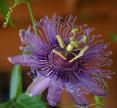
The flower of the day in the French Republican calendar is veronica or speedwell but the plant of the day on Rosa’s Dial is the passionflower and I decided to write about that since my daughter is growing a magnificent passionflower inside our house. She got the seeds from a fruit on a plant that was growing around the corner on our city block and sprouted them by putting them into dirt. She got two viable plants and gave me one which I planted in my garden but it didn’t succeed. However, the one she planted in a pot in the house has climbed up and down and up again on a string she attached to the ceiling. It’s been wonderful watching it grow. The tendrils stretch out toward the sun but then curl back around looking for something to cling to.

Although I went to one web site that tried to convince me that passion flowers could be used in spells to incite passion in your lover, I was not convinced. The plants were named by Spanish missionaries in South America, where the passion flower is a native, and used to illustrate the aspects of the passion of Christ (not a very sexy topic). Medicinally they have been used as sedatives and sleep aids. In the language of the flowers, they have various meanings including: belief, violent pain of love, faith, religious superstition and susceptibility.

Because I found so many great web sites with information about passionflowers I’m going to refer you to them, rather than try to write about them myself:

Here’s Chelsie Vandaverert’s article on the plant:
http://www.killerplants.com/plant-of-the-week/20010730.asp
She also has an article about how passionflowers fool the butterflies that help them reproduce:
http://www.killerplants.com/renfields-garden/20010801.asp

Here’s a whole site devoted to passionflowers, which includes links to what looks like every scholarly article ever written about passionflowers plus much more:
http://www.passionflow.co.uk/

Mrs. M. Grieve has a little bit of information:
http://botanical.com/botanical/mgmh/p/pasflo14.html

The photograph comes from Darcey at Desert Medicine Woman, a web site I heartily recommend:
http://www.desertmedicinewoman.com/plants.html

Wednesday, June 21, 2006

Onion


Messidor 3

The plant for today in the French Republican calendar is the onion. I love it that the French Republican calendar features a wide variety of plants, mostly useful ones. And I’m also impressed by how closely the plants chosen by the French revolutionaries align with their season in my neighborhood. Lindens which I featured a few weeks ago are now in bloom and, according to Steve Solomon, our local vegetable-growing expert, this is the month the overwintered bulb onions are ready to eat.

Onions belong to the Allium family (which also contains lilies), and are related to shallots, scallions, leeks and garlic. I’ve never had much luck growing them, but I realize after some preliminary research for this entry that there are many different kinds of onions, each one well adapted to a certain area, and I’ve not been growing the easiest onions to raise in my region.

The onion is a plant with a long history and a lot of folklore. It is believed that the onion originated in the steppes of Asia and probably grew wild all over the world. They are first mentioned in Egypt where they were fed to workers on the pyramids, and depicted in paintings as offerings to the gods. In Greece, athletes consumed onions to balance the blood and in Rome, they were rubbed on the skin of gladiators. Perhaps they recognized their antibacterial qualities and thus protected themselve from infection. Ibn al-Jamil, Egyptian 12th century physician, recommended onion juice rubbed on the penis as a contraceptive. One wonders if this is effective.

Although onions were used in cooking in Greece and Rome, they were also valued early on for their medicinal qualities. It was believed that onions could draw out putrefaction so they were rubbed on sores or warts, then thrown away or fed to the pigs. A country remedy mentioned in Funk & Wagnalls is made by hollowing out an onion, filling it with treacle (molasses?) and roasting it under embers, then smearing a paste of the outermost skins on plague or sores.

The fiery nature of the onion means it can be used to create heat. The Elizabethan herbalist Gerard writes “The juice of Onions snuffed up into the nose, purgest the head and draweth forth raw phlegmatic humors.” [I should think so, she says shuddering.] He also recommends anointing a bad head in the Sun with onion juice, which will “bringeth the haire again very speedily.”

The 17th century English herbalist Culpeper writes that they are plants of Mars. “They do provoke appetite, increase thirst, ease the belly and bowels, provoke women’s courses, help the biting of a mad dog, and of other venomous creatures, to be used with honey and rue, increase sperm. Being roasted under the embers, and eaten with honey or sugar and oil, they much conduce to help an inveterate cough and expectorate the tough phlegm.”

Funk and Wagnalls mentions several similar folk remedies. Onion syrup, made by boiling equal parts of onion and sugar over the teakettle, and swallowed slowly a teaspoonful at a time, is good for colds, phlegm in the throat, etc. While hot onion poultices, applied to the chest or tied to the soles of the feet, were used to get rid of chest colds and croup.

Onions were also used as protection charms. In some parts of the United States, black folks carried a red onion in the left hand or left pocket to ward off disease. In South Carolina, a necklace of small crushed onions was put around the neck of a child with diphtheria to overpower the disease. (This reminds me of the way garlic is used to ward off vampires.)

New England settlers hung a string of onions over the door to absorb germs and prevent them from harming the residents. These onions could never be eaten. The Shinnecock Indians of Long Island would put an onion in the sick room to draw the fever out; once having done so it would turn black. And scientists have confirmed the bactericidal effects of onion vapors.

It’s easy to braid onions to create one of these charms, just as it’s easy to braid garlics. Simply take a long piece of twine, tie it so that the two loose ends dangle down, then lay the stalks of the onion on top of the two pieces of twine and begin braiding as you would with any three part braid. As soon as the first onion is secure, braid in a second one.

Funk and Wagnalls records the belief that dreaming of an onion means good luck. African-Americans in Georgia create good luck by burning onion peels in the fire. And in the British Isles, young girls use them in love divinations. They scratch the names of four suitors on four onions and put them in the dark to sprout. The first one to sprout is the one she will marry. Putting an onion under your pillow on St Thomas Eve will also bring dreams of future spouse. Alas, St Thomas Eve is halfway around the Wheel of the Year at Winter Solstice.

Everything you’ve ever wanted to know about onions, plus links:
http://food.oregonstate.edu/v/onion.html

More onion information, including how to cook onions and recipes:
http://www.vegparadise.com/highestperch312.html

Culpeper’s Complete Herbal, Wordsworth Reference 1991
Gerard’s Herbal, edited by Marcus Woodward, Senate 1994
Funk & Warnalls Standard Dictionary of Folklore, Mythology and Legend, edited by Maria Leach, Harper & Row 1972
Solomon, Steve, Growing Vegetables West of the Cascades, Sasquatch Books 1989

The lovely photo is from the National Onion Association
http://www.onions-usa.org/

Tuesday, June 20, 2006

Wild Oats


The plant of the day (Messidor 2) in the French Republican calendar is Oats (Avoine in French).

I’ve been fascinated by finding representatives of the grains growing all around my block ever since I took up the practice of gathering wild grains on August 15th in honor of Our Lady of the Harvest. I learned to identify wheat, oats and rye, with the help of a verse from the folk ballad, “The Ripe and Bearded Barley,” which I included in my Lammas and Harvest holiday packets. Here's the relevant verse
The wheat is like a rich man,
It's sleek and well-to-do.
The oats are like a pack of girls
They're thin and dancing, too,
The rye is like a miser,
Both sulky, lean and small,
While the ripe and bearded barley
Is the monarch of them all.


I haven’t found any barley growing on my block but I have found wheat, rye and oats and of them all, the oats are most like dancing girls. They’re delicate, flexible and responsive to the slightest bit of wind or movement. Susun Weed says oats are best identified by their “hanging, swaying seed heads; large milky grain; the sigh the wind makes in her hair.” She quotes E. Anderson: “Their graceful open tassels shake in the wind…glisten in the sun…give the coastal breezes their distinctive sound…a rustle as of stiff silk petticoats.”

Interestingly enough, in all my books on herbs and plants, I only found three writers who write about oats: the inimitable Susun Weed, and two medieval herbalists: Gerard and Culpeper.

After Susun Weed harvest oats, she spreads them out to dry, but not in the sun where they will become brittle. She wants them to retain their green color and some of the green seeds. When dry, the stalks will snap easily. She stores it, as unbroken as possible, in brown paper bags and uses it to make tea. The hollow stalks are known as oatstraw while the seed heads are oats. But Weed says they have similar properties. Oatstraw is lower in calories and higher in vitamin A and C than the grain. Both are soothing and nourishing. Drinking the tea or eating oatmeal helps you develop a strong nervous system and a juicy endocrine system. They also ease cramps, reduce inflammation, strengthen the heart and liven up your libido (as in “feeling your oats” or “sowing wild oats”). Weed has a whole chapter about oats and oatstraw plus many recipes and an oat meditation in her wonderful book, Healing Wise, available from Ash Tree Publishing at:

Here are some ways to get familiar with oats:

Susun Weed suggests putting a handful of oatmeal into a fine cloth and soaking it in warm water (taking it into the bath with you will do, squeezing now and then until the milky white oat cream appears. This can be used as cleansing rub, skin softener, complexion treatment and itch reliever. A similar treatment was used in the 17th century for getting rid of freckles.

The 17th century herbalist Gerard recommends putting oatmeal into a cloth, adding a bit of bay salt and heating it in a frying pan. This takes away a stitch in the side.

And here’s my favorite recipe for morning oatmeal (I just went and set this up for tomorrow morning): Put one cup of oatmeal (the heartier the better—I think instant oatmeal would get too soggy if prepared this way—I use steel cut oatmeal) in a pan. Cover with two cups of water. Cover and leave out on the stove overnight. In the morning, bring to a boil and cook for about five minutes, then reduce heat and cook for five to ten minutes more until the oats have congealed. I like to embellish my oats with raisins, butter, brown sugar or cream (and sometimes all of the above) but you can add more healthful things as well, like the sesame seeds, plantain seeds and slippery elm that Susun Weed recommends.

Chelsie Vandaveer, as usual, has a good article on oats and links to a scholarly article on oats history and some wonderful photos from a Swedish site:
http://www.killerplants.com/plants-that-changed-history/20040323.asp

A great picture of oats compared to other grains:
http://members.shaw.ca/ron_hoggan/grains%20pic

Information and picture from Nebraska Agriculture in the Classroom:
http://www.nefb.org/ag-ed/oats.html

Wonderful photograph showing the delicacy and grace of oats:
http://www.stecf.org/~rfosbury/tmp/desktops/Oats.jpg

Monday, June 19, 2006

Mulberry

The flower of the day for Messidor 1 in the French Republican Calendar is rye, and I think that’s appropriate. There are many rye grasses with beautiful seed heads in my neighborhood and I love looking for evidence of the wild grains in my urban environment. But today I thought I would pick the plant from my other flower calendar source, Flora’s Dial written in 1853 by J. Wesley Hanson.

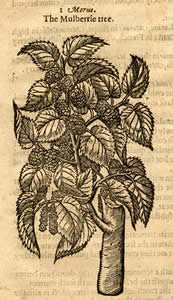
In Flora’s Dial, the flower of the day is the mulberry and that brings back happy memories of hours spent in the treehouse my father built in the mulberry tree in our backyard in Van Nuys, California. That mulberry never bore fruit, as far as I remember, although I do vividly remember it’s bark and the ants crawling up and down it. But when we went to the Lake Elizabeth Ranch Club for Fourth of July celebrations, we always spread out our tablecloths on picnic tables beneath a row of mulberries and those mulberries had fruit, small, tart berries which we ate with glee until our faces and fingers were stained purple

According to Hageneder, whose wonderful book on trees I am ordering, there are three species of mulberry (Wikipedia lists a lot more): White Mulberry (mora alba), Red Mulberry (mora rubra) and Black Mulberry (mora nigra). The white mulberry was the tree on which the Chinese grew silkworms, while the Italians used the black mulberry for the same purpose until the 15th century, when they switched to the white mulberry as well. I believe the tree in our back yard was a white mulberry, partly because I inherited my Dad’s Sunset Flower Garden Book from 1950 and it only lists a white mulberry and partly because I remember vividly the beige color of the bark. I also remember the beautiful heart-shaped leaves with a slightly tacky surface and lightly serrated edges but I don’t’ remember any berries. Doing my research for this article, I learned that the tree in our backyard was a male “fruitless” tree, which were popular in Southern California because they were quick-growing shade trees that didn’t create a mess by dropping berries which would stain clothing and pathways.

The Romans knew and appreciated the mulberry. Mrs. Grieve quotes from Pliny who wrote: “Of all the cultivated trees, the Mulberry is the last that buds, which it never does until the cold weather is past, and it is therefore called the wisest of trees. But when it begins to put forth buds, it dispatches the business in one night, and that with so much force, that their breaking forth may be evidently heard.” Horace recommended that mulberries be gathered before twilight and Ovid explained the dark red of the berries by saying that they were stained by the blood of Pyramus and Thisbe who were slain beneath a mulberry tree.

The berries are used to make wine, cordials, pies and jam. According to Jim Conrad, the Natchez Naturalist (who discovered the meaning of life under a mulberry tree), the Natchez Indians used the stringy fibers of the mulberry to make fabric, which they dyed fabric yellow and gold with the bark of the tree. For more information about making cloth and dye from mulberries, see this web site:
http://waynesword.palomar.edu/fruitid6.htm

The English herbalist Gerard recommends mulberries to treat sore throats, coughs and constipation. A juice of the unripe berries was used as a mouthwash. The Chinese used all parts of the White Mulberry for healing. The leaf was used to get rid of “wind heat,” thus clearing the liver and brightening the eyes. The fruit moistened and nourisheed yin while the twigs dispersed “wind” and promoted the flow of chi. The bark cooled and purged “lung heat.”

The Chinese World Tree was sometimes considered a hollow mulberry tree. A sacred mulberry grove, was planted outside the eastern gate of early royal capitals in China. The mulberry is also often found along Islamic sanctuaries or near pilgrimage routes in Arabia. According to Wikipedia, Mulberry Appreciation Day is celebrated on the last Tuesday of May.

Here are some nice images of mulberries from New York City:
http://www.newyorkcitywalk.com/html/images_MulberryTrees.html

Conrad, Jim, The Natchez Naturalist, May 11, 2003
http://www.backyardnature.net/n/03/030511.htm
Grieve, Mrs. M, The Modern Herbal,
http://botanical.com/botanical/mgmh/m/mulcom62.html
Hageneder, Fred, The Meaning of Trees, Chronicle 2005
Hanson, J. Wesley, Flora's Dial:
http://www.earthlypursuits.com/FlwrsPer/FlowerYear/FlwrYear06.htm
Wikipedia entry:
http://en.wikipedia.org/wiki/Mulberry

The illustration is supposedly from Gerard's herbal but I can't find it in my edition.