At the start of the year, our landlord decided to redo the landscaping of our apartment building. In January, he instructed his henchman (that would be the handy man) to cut down the beautiful cherry tree that grew beside the front porch. I tried to rally my neighbors to save it but I was too late. A few months later, all the other plants followed: the tulips and daffodils my upstairs neighbors had planted and the woodruff and iris I planted in the beds next to the building, a strip of useless grass (useless because no one could ever get to it because of the juniper border) and finally the prickly, hideous junipers that lined the sidewalk. I have to say we were all happy to see them go.
But I am not happy with the new landscaping. There are two Italian cypresses, each planted about halfway between the front door and the ends of the building. There are also two Japanese maples close to the porch, one on each side. And then a scattering of rhododendrons, hebes, sweet box and mountain laurel, all drowning in a sea of brown mulch. It’s the kind of soulless landscaping you could find on any block in Seattle.
Just as flowers and architectural styles go in and out of fashion, so does landscaping. In my neighborhood—which has a mix of housing including brick apartment buildings from the turn of the century, apartments from the Fifties and Sixties that look more like motels, a few houses and some brand-new condos—the landscaping is equally diverse. Yet you can always tell which properties are rentals and thus which yards are maintained by gardening services. They tend to have a generic feel.
The popularity of junipers I suspect dates from the Fifties and Sixties, at least that’s when my dad planted them all around our house in Southern California. I believe the mountain laurels. viburnums and rhododendrons were the choice of the Seventies in Seattle. This is probably the same era responsible for the ornamental St. John’s Wort which shows up everywhere as a ground cover. Then there’s the more modern landscaping that uses drought-tolerant, indigenous plants like salal, covering the area with low ground covers. It’s easy to maintain and environmentally sound but not particularly interesting.
I prefer the yards on my block where I can see an individual aesthetic at play. I still call one house the rose lady’s house, though she sold it years ago. Her front yard was completely covered with rose bushes and she kept it free of other plants, except for a few stray violas. The current owner has kept most of the roses but let some other flowers spring up and it looks a bit softer. There’s an apartment building around the corner where someone went crazy with herbs and I can find rue and wormwood, plus the more usual rosemary and lavender. Another householder really loves the little ground-covers. He has all the sedums plus some sea thrift and other tiny plants surrounded by neat white gravel and stepping stones of concrete blocks. I suspect the inside of his house would display the same tendency towards fussy order and clean lines.
A few months ago I visited my brother in Ventura. He lives in a house built in the Fifties, probably around the same time as our childhood home (it has a similar look and feel). The landscaping seems to date from that era as well: the front lawn, the bottlebrush in the front yard, the bougainvillea spilling over the back fence, the citrus tree with its fragrant flowers. It was great to be back in the landscape of my childhood.
Showing posts with label juniper. Show all posts
Showing posts with label juniper. Show all posts
Wednesday, July 18, 2007
Fashions in Landscaping
Wednesday, January 10, 2007
Juniper
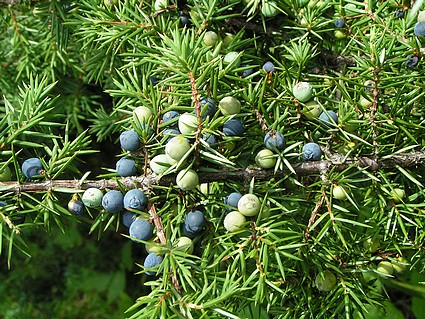
I was planning to write about one evergreen every week during the Winter and thought I'd start with the most ubiquitous evergreen in my neighborhood: the juniper.
Every old apartment building and many of the older homes in my neighborhood are surrounded by these scraggly, prickly bushes. Mine is no exception. For years, I plotted with my neighbors to tear them out, but none of us ever had enough nerve to tackle the job. Junipers are painfully prickly and that's what they're good for: protection. Then just a few months ago, the apartment building handyman pruned them back severely and suddenly they look like bonsai (in fact, juniper is the preferred bonsai plant). They're actually quite beautiful.
So now that I've come to appreciate them, I wanted to be able to identify them. And here, I ran into trouble again. All junipers are members of the Cypress family. They are all evergreens with scale-like leaves. In fact, if you look at a juniper branch closely, you will see that it seems very primitive, like the horsetail, with its overlapping scales.
According to Wikipedia, which has some wonderful photographs of junipers,
http://en.wikipedia.org/wiki/Juniper
there are between 50 and 67 varieties of junipers. The ones in front of my apartment
building are probably Chinese junipers, which seem to have been the favorite hedge plants many years ago. I know my father planted some around my childhood home in the Fifties, but the ones in my neighborhood are mostly in front of buildings that go back to 1905 and 1910, so who knows how old they are?
Chinese junipers have juvenile shoots that are spiky and as sharp as needles. The mature shoots have rounded tips, and some of the ones in my neighborhood are showing hints of yellow male flowers at the tips. Winter is when they typically flower; they throw their pollen in spring. My tree identification book says that Chinese junipers have a sour, resinous, catty scent. Another reason for my positive identification. I took some snippets of juniper to work with me and when I opened the envelope in which I had placed them, the scent was distinctly catbox.
But what of all the other juniper-like trees in my neighborhood? I found some wonderful trees outside the Safeway at John and 15th. They are twisted into marvelous shapes and peppered with the bluish berries that I think of as juniper berries, those berries that give the distinctive flavor to gin. If I felt confident they hadn't been sprayed (I'm not), I could gather them and use them to make schnapps using this recipe from my favorite schnapps website:
http://www.danish-schnapps-recipes.com/juniper.html
My tree book tries to distinguish between the different varieties of junipers, cypresses, cedars and thujas (all members of the Cypress family), all of which have similar foliage, by describing the scent of the leaves when crushed. So now I am wandering around my neighborhood pinching juniper leaves and sniffing them.
Does it smell like turpentine? Then it may be an incense cedar or a Nootka cypress (which will also be harsh to the touch when rubbed the wrong way)
A warm sweet scent like pencils? That would be a Hinoki cedar
A warm gingery scent? White cedar
Scent of old seaweed? Formosan cypress
Lemony? Monterey cypress
Rich scent of thyme and lemons? Gowen cypress
Grapefruit? Smooth Arizona cypress
No distinctive scent? Italian cypress or Mexican cypress
An aroma like new-mown grass? Bhutan cypress
Apples? Common juniper
Paint or kitchen soap? Pencil cedar or drooping juniper (which will also rustle in the hand)
Pineapple? Western red cedar
Rich fruit cake with plenty of almonds and a trace of lemons? Korean thuja
Glorious scent of lemon and eucalyptus? Japanese thuja
And I think I did find one of these, right next to the berry-bearing junipers outside Safeway.
I'm still looking for ones that smell like fruit cake, almonds and lemons. I will continue to do research and let you know what I find out. I am becoming enamored of these prickly plants, especially now that I am paying attention to their scent.
Reference:
Mitchell, Alan, The Trees of Britain and Northern Europe, Collins 1982
Photograph of juniper from the Danish Schnapps web site:
http://www.danish-schnapps-recipes.com/juniper.html
Subscribe to:
Posts (Atom)
