Monday, September 04, 2006

Amaryllis Belladonna (Naked Lady)

Amaryllis Belladonna

Last year I wrote about birthday flowers, the idea that one might associate a particular flower with each day of the year. You can read my newsletter at this link:
http://www.schooloftheseasons.com/newletters/news090505.html

My idea came from a floral calendar that I had found, which listed a flower for every day of the year, and which I later identified, thanks to the Internet as Flora’s Dial, written by J Wesley Hanson in 1853
http://www.earthlypursuits.com/FlwrsPer/FlowerYear/Floweryear.htm

Unfortunately my one dissatisfaction with Flora’s Dial was the flowers didn’t seem to be chosen with any attention to the season. In fact, they seemed to be written down in sporadic gusts of alliteration. As someone who’s been writing about the seasons for years, this offended me. And I thought one way to come up with a more useable calendar would be to invite my readers to submit nominations for birthday flowers, that is a flower that is blooming on your birthday. I got a few nominations, then about six months later I found the French Republican calendar with its very seasonal attributions of plants, and I am slowly working my way through those.

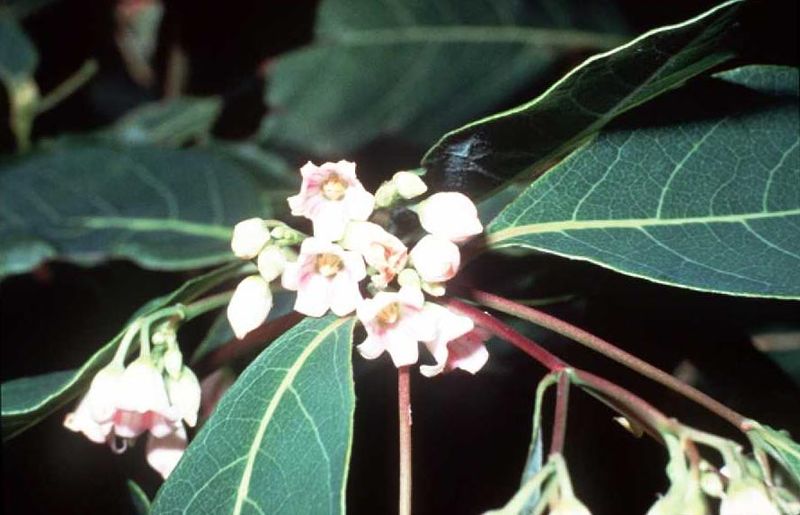
Today the plant of the day on the French Republican calendar is the buckthorn, which sounds interesting, but I’m going to focus on MY birthday flower, the naked lady or amaryllis belladonna, a fragrant flower that comes in pink, red and white and always blooms in Southern California around the time of my birthday. My mother received a bouquet of them after my birth and ever since the sight and scent remind her of that happy occasion. Unfortunately, they do not bloom here in Seattle. And I have not been able to find a photograph of one that is not copyrighted.

This lily is often called a naked lady, because it produces a flower before it has any leaves. The name belladonna means beautiful lady. It’s also called a March lily, I suppose, because in South Africa, which is where it comes from, it blooms in March.
This website
http://daviswiki.org/Naked_Lady
also mentions several other common names including: Jersey Lily in the UK., Bordão de São Jose (St. Joseph's Staff) in Portugal (it does resemble the flower sprouting from the pot next to St Joseph in this picture—however that flower is probably really a hippeastrum which blooms in spring), St Rosalina in Sicily (there is a saint Rosalia whose feast day is on September 4 so this may be a seasonal association), St Rosa or the Madonna Lily in Italy, and Meninas Para Escola in Spain (whatever that means--translation anyone?). The name amaryllis comes from the name of a shepherdess in one of Virgil’s Ecologues, the root word of her name means “sparkling,” according to the Wikipedia entry:
http://en.wikipedia.org/wiki/Amaryllis

You have to be careful with this flower. The flower most often sold as an amaryllis, often at Christmas time, is the hippeastrum. And on one web site, I found a flower essence that claimed to be a naked lady but was really an autumn crocus.

In the language of the flowers, the Amaryllis stands for pride, a coquette and splendid beauty. I'm not sure which species is meant.

Saturday, September 02, 2006

Lemon


The plant of the day for Fructidor 16 in the French Republican Calendar is the lemon.
So I am drinking a lemonade (with watermelon ice cube thanks to my experiment for Fructidor 11) as I write this.

The lemon is a citrus fruit, like limes, citrons, mandarins and oranges (Notice that most of these citrus fruits are also the names of colors.). It was probably first grown in India but reached Europe via Persia, Greece and Italy. The American Heritage Dictionary traces its name back from its first appearance in English in a customs document of 1420-1, through its journey from Old French limon from Italian limone, from Arabic laymun to its origins in India as a limun. Lemons have been identified in the ruins of Pompei. The first written description appears in an early tenth century Arabic treatise on farming.

I love reading the really clinical descriptions of these fruits, as they don’t really sound like anything I would want to eat. Would you consider eating a hesperidium, that is a specialized berry, globose to elongated, 4-30 cm long and 4-20 cm diameter, with a leathery rind surrounding segments filled with pulp vesicles? I didn’t think so, but that’s the definition of a citrus fruit provided by Wikipedia, in the article on citrus fruit,
http://en.wikipedia.org/wiki/Citrus
which also describes the plants, their fragrant flowers and their favorite growing conditions: warm. Florida, California and Arizona are their favorite places to grow in the United States. One type of lemon you can grow indoors, even in a cool climate like mine, is the Meyer lemon (it’s simply hardier). Chelsie VandaVeer has an article about Frank Meyer’s discovery of the lemon named after him which he found growing in a pot outside a door in China:
http://www.killerplants.com/weird-plants/20030206.asp

The Wikipedia article provided the great picture, plus the following information:
http://en.wikipedia.org/wiki/Lemon
Lemons are 5% citric acid, which gives them their sour taste, and also makes them good for science experiments like the one featured in Wikipedia: the lemon battery.
http://en.wikipedia.org/wiki/Lemon_battery
Lemons have various properties which make them useful in cooking. The acids in lemons, when squeezed on fish, neutralize the amines, converting them to nonvolatile ammonium salts. Lemon squeezed on fruits, like apples, prevents them from oxidizing (turning dark). Also when lemon juice is a marinade for meat it helps break down the tough collagen fibers in the meat.

Mrs. Grieve in her Modern Herbal (1931)
http://www.botanical.com/botanical/mgmh/l/lemon-16.html
writes “It is probable that the lemon is the most valuable of all fruit for preserving health.” English ships were required to carry an ounce of lemon or lime juice for every sailor to be taken daily to prevent scurvy. Mrs. Grieve says it is good for cooling fevers. Julia Morton (see below for citation) writes that it is widely known as a diuretic, antiscorbutic, astringent, and febrifuge. In Italy, the sweetened juice is given to relieve gingivitis, stomatitis, and inflammation of the tongue.

Whenever we are sick, my daughter and I both swear by the concoction we make by boiling lemon slices along with ginger slices and jalapeno peppers. Once this liquid boils down enough to get some color, we strain out the solids and drink it like tea. According to Ayurvedic medicine, a cup of hot water with lemon juice in it purifies and tones the liver. But several writers warn against daily use (or advise you to rinse your mouth after drinking lemonade) because it strips the enamel from your teeth.

According to Mrs. Grieve: “Lemon Peel yields its virtues to alcohol, water, or wine.”
The lovely liqueur Limoncello is one way the Italians capture the virtues of lemons. Here’s a recipe for it:
http://www.whats4eats.com/recipes/r_bev_limoncello.html

This article on the lemon in Fruits in Warm Climates by Julia Morton focuses on growing lemons commercially and includes a long and interesting list of the history of various lemon cultivates, through which one could, I think, create an interesting lemon family tree (I didn’t try):
http://www.hort.purdue.edu/newcrop/morton/lemon.html
It also includes some interesting suggestions for cooking with lemons including the mention of a lemon soup, popular in Colombia, made by adding slices of lemon to a dry bread roll that has been sautéed in shortening until soft and then sieved. Add sugar and a cup of wine to this mixture and bring it to a boil. For dessert after your lemon soup, you might like some candied lemon peel. Mrs. Grieve describes how to make it by putting the peels into boiling sugar syrup, then letting them dry until the sugar crystallizes.

Lemons are also used in house cleaning. This web site offers several suggestions for using lemons (along with other non-toxic common household items) for cleaning.
http://riri.essortment.com/organiccleaning_rase.htm

It’s going to be a hot in Seattle today. A perfect day for lemonade.

Thursday, August 31, 2006

Trout

Since it's a day that ends in a 5 (the 15th of Fructidor to be exact), the French Republican Calendar features an animal: the trout.

I've only had trout once, when one of my writing clients, novelist Curt Colbert (who's written a series of fabulous retro detective novels, including Rat City, Sayonaraville and Queer Street), brought me a trout as a bribe since he had gone on a fishing expedition instead of doing his writing. It tasted great but I just have a hard time eating anything with eyes.

Since I don't have much to say about trout, I thought I'd tell you my only fishing story. When I was about six years old, my family spent a week at Lake Arrowhead, where my aunt and uncle had a cabin. We went out in a rowboat on the lake and I caught a fish, probably a trout. We threw it in a bucket and took it back to the cabin and when we got there it was still flopping around so I insisted that it be put into a pot of water. I'm sure my parents thought it would be dead by morning but they agreed. But when we got up in the morning, I ran out the back door to check on my fish and found it swimming round in circles in that tiny pot. So in a long procession, with me clutching the pot, we went back to the lake and dumped the trout back in. That was the last time I ever fished.

There is a brief article on trout at Wikipedia. I had not idea they are members of the Salmon family:
http://en.wikipedia.org/wiki/Trout

Walnut


It’s Fructidor 14 in the French Republican calendar and the plant for today is the walnut.

I grew up in a suburban ranch house built in the San Fernando Valley in 1950 on the site of an old walnut orchard and there were three magnificent old walnut trees in our front yard. They were the oldest trees on our property and great climbing trees with their broad branches. I remember vividly the particular nutty smell of their leaves, the thudding sound of the nuts hitting the ground, the many techniques we devised to open them (the most effective was to hold two shells in one hand and crunch them together but we also used hammers and the sidewalk) and the wonderful flavor (although every once in a while you’d bite into a nut that had gone bad—been wormeaten?—and that would horrible taste would linger).

I’ve been missing walnuts as trees recently and just a few weeks ago discovered there is one growing right across the street. I discovered it during the bunny caper. One of my neighbors (we don’t know exactly who) abandoned three pet bunnies in the vacant lot, where the house used to stand that burned down). One day I was walking Pepe the Chihuahua down the street and we saw something white hopping down the sidewalk in front of us. It was one of the bunnies on the loose, pursued by several neighbors who were trying to round them up, quite unsuccessfully. A quick search of various web sites let us know that we weren’t going to have much luck trying to capture them but they seemed content to hang out together in the vacant lot and despite our fears they managed to fend off the neighborhood cats. I took to bringing them carrots every day. Someone else left them a little dish of water. One of the neighbors contacted a bunny rescue society (I like to think of them as the bunny whisperers) who sent out a family—husband and wife and two young girls—and one morning last week they successfully captured all three bunnies.

It was while I was taking carrots to the bunnies that I heard that familiar thump of nuts hitting the ground, looked up and realized I was standing under a walnut tree, my old friend from childhood. Unfortunately, I found it too late to try making the Italian liqueur nocino which is made from green walnuts gathered on St. John’s Eve. Here's a web site which offers a recipe for making nocino:
http://ilforno.typepad.com/il_forno/2004/07/drink_your_waln.html
The squirrels seem to be getting most of the walnuts and I doubt there will be many left for me. I find half-nibbled green husks all over the ground beneath the tree.

Lately I’ve been buying organic walnuts at the natural foods store around the corner and toasting them to add to salads. Occasionally I eat a handful as a late night snack. According to the Walnut Marketing Board, walnuts have more omega-3 than any other nut: They are also a natural source of melatonin, which may be why I crave them at night.
http://www.walnuts.org/

The Wikipedia article on walnuts
http://en.wikipedia.org/wiki/Walnut
provides a good but surprisingly short overview, considering the history of the plant. The earliest known walnuts were grown in Persia and are sometimes called Persian walnuts, although they are more often known as English walnuts. These are the trees I grew up with, which were brought to California by Spanish missionaries. The black walnut is native to North America. It is known for its ability to poison the area around it with a compound, jugleone, found in all walnuts but more concentrated in the black walnut. Chelsie VandaVeer, has written about this in her article “What tree poisons competitors to preserve its territory?” at her web site:
http://www.killerplants.com/weird-plants/20010816.asp

One of my favorite research web sites, Vegetarians in Paradise, has a long article on the history of walnuts, including information about their health benefits
http://www.vegparadise.com/highestperch411.html
This site also features walnut folklore. The common name, walnut, means “foreign nut.” The “Wal” comes from the same word by which the English characterized the Welsh, as the strangers. The Romans also thought the nut was strange but they called it the Gallic nut, since it came from Gaul. The Latin name Juglans comes from Jupiter or Jove’s glans, and means Jupiter’s nut. It is also associated with Jove’s wife, Juno, and with fertility.

Mrs. Grieve, as usual, provides a thorough discussion of the walnut, including the use of its leaves and bark in making dye and in curing skin diseases. She also provides recipes for pickling green walnuts.
http://www.botanical.com/botanical/mgmh/w/walnut06.html

For a visual treat, check out this beautiful photograph of fog in a walnut orchard, taken by Anthony Dunn
http://www.adunnphotography.com/galleries/image.asp?ID=2004_0023_26

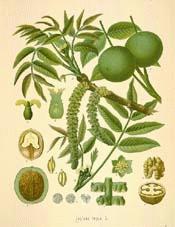
The illustration of the walnut comes from Mrs. Grieve’s site:
http://www.botanical.com/botanical/mgmh/w/walnut06.html

Wednesday, August 30, 2006

Barberry


The plant for Fructidor 13 (August 30) is the barberry or berberis vulgaris. Mrs. Grieve says Berberis comes from the Arabic name for the fruit, and is derived from the word for a shell, referring to the glossiness of the leaves. It has yellow flowers and produces red berries. Grieve gives one common name for Barberry in England, where it is often used as a hedge plant, as the Pipperidge Bush, from 'pepon,' a pip, and 'rouge,' red, as descriptive of the scarlet, juiceless fruit. In Italy, it is sometimes called the Holy Thorn, because it was believed to be the plant used to make the Crown of Thorns.

There are many different species of barberry. See the article at Wikipedia for an amazing list:
http://en.wikipedia.org/wiki/Berberis

In the Northwest, we have several barberry plants, the most famous being the Oregon Grape (Mahonia (berberis) aquifolia). It has glossy leaves that look a lot like holly, yellow flowers in March and April and produces bluish-purple pseudo-grapes.

As usual, Mrs. Grieve has a wonderful, long description of the barberry, how it is grown and how it is used medicinally, including recipes for making barberry drops and tartlets:
http://www.botanical.com/botanical/mgmh/b/barcom12.html

It is the fruit, I think, that earned this plant this position in the French Republican calendar.. Mrs. Grieve says the fruits are used to make a candy that Rouen is famous for: confitures d'epine vinette. I found a recipe for this in my Larousse Gastronomique. It involves putting clusters of barberries (still attached to the stem) into boiling sugar water and cooking until bubbles appear. The pan is removed from the stove and when the fruit it beginning to cool, it is left to drain on a cloth in a hot cupboard. The following day, it is transferred to white paper to continue draining. Then dust the berries with confectioners sugar and let them dry some more.

Barberries are also made into jam, used to flavor meats, cooked into tartlets, and pickled with vinegar. Mrs. Grieve relates that Simon Paulli was cured of a malignant fever by drinking an infusion of the berries sweetened with sugar and syrup of roses. At his great wine-making site, Jack Keller provides a recipe for making barberry wine:
http://winemaking.jackkeller.net/barberry.asp
This page provides several recipes for making barberry jam:
http://earthnotes.tripod.com/barberry.htm
Larousse Gastronomique also mentions pickling the green berries like capers.

The leaves and bark are used medicinally. Michael Moore recommends using Oregon grape for three conditions: a bitter tonic for impaired salivary and gastric secretions, a stimulant for the liver, and, applied directly to the skin, as a disinfectant and antimicrobial.

Paghat, as usual, has a wonderful article on dealing with barberry in the garden, at least in her Northwest garden, plus some attractive photographs:
http://www.paghat.com/barberry.html

References:
Montagné, Prosper, The New Larousse Gastronomique, Crown 1960
Moore, Michael, Medicinal Plants of the Pacific West, Red Crane Books 1993

Tuesday, August 29, 2006

Fennel


A savoury odour blown,
Grateful to appetite, more pleased my sense
Than smell of sweetest Fennel
Milton, Paradise Lost

The plant for Fructidor 12 is fennel, and I've been growing fennel in my garden for years, partly because it's a plant beloved by Venus. Also because I love the flavor of fennel bulbs and am always buying them at the store and sslicing them into my salads. I've never gotten a big bulb from the ones in my garden and prefer to grow them for seeds.

At this time of the year, the yellow flower heads are going to seed. I pluck off the seed heads, put them in paper bags and shake them to get the seeds loose, then store them in glass jars for use in cooking. I especially like adding them to lasagna.

The fennel stalks themselves were once used as weapons by the Benedanti, whose exploits are described by Carlo Ginzberg in Ecstasies, in which he traces back the imagery found in European witch trials to a shamanic cult prominent in northern Italy whose members believed they left their bodies (during sleep or dreams) and protected the crops from bad walkers (Maladanti). The Benedanti used fennel stalks, the Maldanti sorghum stalks. Because I like to use every part of my plants, I use my fennel stalks to make trellises and stakes for other plants.

For more on fennel see Gernot Katzer's web site:
http://www.uni-graz.at/~katzer/engl/Foen_vul.html
or Mrs. Grieve at
http://botanical.com/botanical/mgmh/f/fennel01.html

Monday, August 28, 2006

Watermelon Report

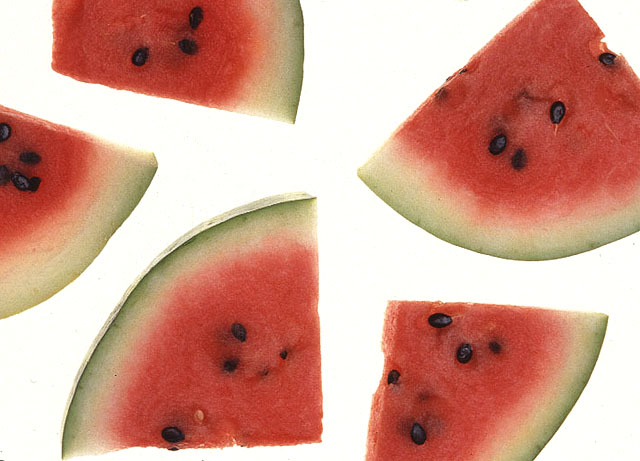
I'm trying to be a better blogger and that means giving you a glimpse of how I try to apply the tasks suggested by the "plant of the day" in my own life. Today, watermelon day, I waited until 8 PM to purchase a watermelon but then I used a tip from the Watermelon Promotion Board to choose one at my local natural foods grocery store, Rainbow Grocery: I picked one that had a prominent yellow spot, which indicates the place the melon was resting on the ground while ripening under the sun.

It was very heavy (I paid .69 a pound for it and it cost me $9.20) although it was the smallest watermelon in the bin. Watermelons are supposedly 92% water. That was pretty obvious once I started cutting it up. I had watermelon juice all over my counter and the floor.

I tried using my friend Bob's clever step technique but I hadn't observed him carefully enough and didn't bother to go back to the Watermelon Promotion Board's website for instructions. Instead I used a technique similar to the one I use on pineapples (cutting the fruit into wedges, then slicing close to the rind with one cut, and then making vertical cuts down and horizontal cuts across) to get cubes. I put some of the cubes in my food processor and made juice that I poured into an ice cube tray. We'll see how that goes tomorrow.

Meanwhile the stickiness of the watermelon juice all over my kitchen reminded me of my adventure yesterday. My daughter and I went to the last day of the Camlann Medieval Faire which is out near Carnation.
http://www.camlann.org/
It's one of our favorite summer time activities. We've been attending since Shaw was 14 when we worked at a feast for Roger Shell, the eccentric genius who created an authentic 13th century medieval village just an hour outside of Seattle (and he gets to live there year round). Shaw has been a serving wench in previous years at the Bors Hede Inn on the premises and we usually attend one of Camlann's Yule feasts during the Winter holildays.

Anyway it was not winter on August 27, the last day of the fair. The temperature was around 83 and we were both perspiring in our medieval gowns. Shaw was wearing a linen chemise which she had embroidered, and a homespun linen gown that she dyed red, with a blue band at the hem. She had on her knife, her belt and her leather bag. I was wearing a much less authentic polyester fabric green gown with blue sleeves so I rented a slate blue surcoat, made of corduroy, from the clothiers shop, to wear over it.

At one point, I needed more money (as the merchants at the fair did not have the equipment to use my ATM card) so I went down to the local store to get cash. I was feeling self-conscious and sweaty in my medieval attire, especially when I pulled into the parking lot and saw it was full of adolescent local boys who were flirting with a few local adolescent girls. I slunk sheepishly into the little store and purchased a Pepsi-Cola, thinking I would get cash back, but that wasn't an option. I had to use the ATM, and pay a $1.25 service fee.

I did that and took my Pepsi out to the Geo Metro (one of my favorite cars) I had borrowed from my friend Michael, took a quick guzzle of the Pepsi and got in. I made a rather abrupt turn out of the parking lot (still embarassed by my costume and trying to get out of there quickly) and the Pepsi flew out of the center divider, got shaken up and fizzed all over the passenger well of Michael's car. Naturally I was anxious to clean it up, which meant re-parking and repeated trips into the little store, still broiling in my double layers of medieval clothing (how did they get through summers?) and perceived humiliation (some truck drivers arrived next). It took me about six trips back and forth before I had done all I coud do.

And why this story to go with watermelons? Because the watermelon I cut up at home was as sticky as the Pepsi in the car. I went back to the watermelon site to try to get an idea of how much natural sugar is in a watermelon but couldn't find it. Instead I found this web site which lists many different kinds of watermelon varieties. Now I wonder which kind I got.
http://www.urbanext.uiuc.edu/veggies/watermelon1.html

Watermelon


The plant of the day for Fructidor 11 in the French Republican Calendar is the watermelon.
Did you know that it is a lycopene leader for fruit? More lycopene than tomatoes.

The National Watermelon Board provides instructions on how to choose, store and carve a watermelon:
http://www.watermelon.org/watermelon_selection.asp

They also provide directions and photographs of an amazing number of ways you can carve a watermelon including into a convertible bug, an airplane, a football helmet and the traditional basket. I particularly like the swan.
http://www.watermelon.org/watermelon_carvings.asp

As well as a long list of recipes, most of which sound singularly unappealing (watermelon pie?). I might try the watermelon smoothie (lemon yogurt, mint leaves and a dash of cinnamon) or the watermelon popsicles or ice cubes.
http://www.watermelon.org/watermelon_recipes-list.asp

Plus a link to watermelon festivals:
http://www.watermelon.org/watermelon_festivals.asp

Watermelon is a member of the Cucumber family (like the melon) and originated in South Africa, probably in the Kalahari desert, according to the Wikipedia article:
http://en.wikipedia.org/wiki/Watermelon
The first record of a watermelon harvest comes from ancient Egypt (5,000 years ago). By the tenth century it was being cultivated in China which is still the world’s largest producer of watermelons. All parts of the watermelon are eaten in China: the rind is often pickled, and the seeds are roasted and seasoned. The fruit is frequently depicted as being eaten by the dead in art for Days of the Dead in Mexico. And there are legends about vampire pumpkins and watermelons in the Balkans:
http://en.wikipedia.org/wiki/Vampire_watermelons

I am going out looking for a watermelon and will report on what I find later in the day.

Friday, August 25, 2006

Dogbane


The plant of the day for Fructidor 8 is dogbane (also Indian hemp). The Latin name is apocynum cannabinum which also means poisonous to dogs, according to this Wikipedia article:
http://en.wikipedia.org/wiki/Apocynum_cannabinum
I am surprised that it is featured on the French Republican calendar as one source says it’s not found in western Europe, but another source mentions a dissertation written in Italy on apocynum.

It is native to North American and was used by the natives to treat syphilis, rheumatism, intestinal worms, fever, asthma, and dysentery. Michael Moore says the dried root can be used in a tincture as a vaso-dilating diuretic for dry skin, constipation and water retention. It can be used topically to induce sweat the tea stimulates the scalp. Mrs. Grieve says it is a cardiac tonic, like digitalis, and equally poisonous:
http://botanical.com/botanical/mgmh/h/hemcan21.html

The best article I’ve found on the web is this one from Plants of the Future:
http://www.pfaf.org/database/plants.php?Apocynum+cannabinum
It mentions many uses for the plant. The seeds can be ground into a powder and used as meal. The sap, if left to harden overnight, can be chewed as gum. The milky sap is also a folk remedy for venereal warts. The herb was used by North American Indians to treat rheumatism, coughs, pox, whooping cough, asthma, internal parasites, diarrhea and to increase milk flow in lactating mothers. The root is the most active part of the plant medicinally. A weak tea made from the root has been used for cardiac diseases and also to get rid of worms. But it’s most useful as a fiber. For this purpose, it’s harvested in fall, after the seed pods form. The stems are steamed, then cooked for two hours with lye and pounded with mallets. Or the stems can be left to dry in the winter. The fiber is tough, does not shrink and retains its shape in water.

Chelsie VandaVeer, of Killerplants.com, has several articles on dogbane:
http://www.killerplants.com/herbal-folklore/20021209.asp
and this one:
http://www.killerplants.com/renfields-garden/20021211.asp
which talks about how the dogbanes trap (and thus kill) insects.

It doesn’t look like I’ll be able to find it my area, based on this map produced by the Burke Museum, our local natural history museum:
http://biology.burke.washington.edu/herbarium/imagecollection.php?Genus=Apocynum&Species=cannabinum

References:
Moore, Michael, Medicinal Plants of the Pacific West, Red Crane Books 1993

Illustration:
Photo taken by a USDA employee which means it’s in the public domain. I found it at Wikipedia at
http://en.wikipedia.org/wiki/Image:Apocynum_cannabinum.jpg

Thursday, August 24, 2006

Mystery Melon


The plant of the day for Fructidor 7 is the sugar melon or sucrion. It seems like it should be easy to figure out exactly what that is but all I learned from an hour of Internet searching was that the “sugar melon” is the name for a variety of cantaloupe. Then I found this fantastic web site (the true glory of the Internet) which lists names in every language for members of the melon family:
http://www.plantnames.unimelb.edu.au/Sorting/Cucumis.html#melo-inodorus

If I read this correctly, then the sucrion is a honeydew or a Crenshaw melon. So I went to the local high-class grocery store on my lunch break and found a plethora of melons: the usual honeydews, cantaloupes and watermelons plus Crenshaws and Canaris. I bought a nice 7 pound Crenshaw. It was ripe, based on the smell, the most accurate way to assess the ripeness of a melon according to my research. (I hold the stem portion up to my nose and sniff.) I would have done a taste test on several different melons but they were too heavy to carry back to work along with cupcakes for a co-worker’s birthday. The Crenshaw was interesting in flavor. More watery than a cantaloupe, and lighter in color too, but with a more cantaloupe-like flavor than a honeydew.

That reminded me of an article in Martha Stewart’s magazine on heritage melons. I went looking for it online at her web site and found this easy recipe for melon sorbet:
http://www.marthastewart.com/page.jhtml?type=content&id=channel191822&catid=cat19294&navLevel=3
Plus this interesting recipe for mix and match melon soup (warning: which comes with an annoying ad complete with music):
http://www.marthastewart.com/page.jhtml?type=content&id=recipe1800&catid=cat21329&navLevel=

I also found a link to Amy Goldman, who has a web site featuring heirloom melons
http://www.rareforms.com/
and a book about heirloom melons:
http://search.barnesandnoble.com/bookSearch/isbnInquiry.asp?r=1&isbn=1579652131


I’m still not sure which melon is a sucrion but this search has certainly opened my eyes (and my taste buds) to new possibilities.

Wednesday, August 23, 2006

Tuberose


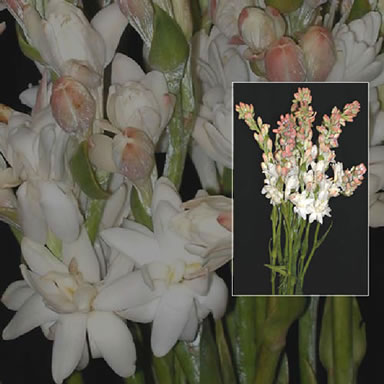
The plant of the day for Fructidor 6 is the tuberose (polianthos tuberose). It is a member of the Agave family, and blooms in July and August. The name tuberosa comes from the tubers from which it grows. The flowers appear on tall (3 to 4 foot) spikes; they look like waxy, white trumpets and have an intensely sweet fragrance. Like many night-blooming flowers, including its cousin the century plant, it is pollinated by moths. I was lucky enough to have a century plant blooming on my block last year at this time. It was heavenly. Maybe I will be so lucky as to find some tuberoses this year.

The tuberose was first grown in Mexico where it was known as omixochitl or bone-flower. It has always been cultivated. Chelsie Vandaveer features it in an interesting article under the title “What plant never grows in the wild?”
http://www.killerplants.com/weird-plants/20020321.asp
It was brought to Europe around the 16th century (VandaVeer says 1550; Elliott says 1629) and became popular because of its beauty and scent. Louis XIV placed an order for 10,000 to be grown in the flower beds at Trianon. In Italy, and in Grasse, France, they were grown in large quantities for the perfume industry. Tuberoses had been imported to the Philippines before Europe, which is why they are sometimes thought of as native to East India. Fashionable florist Shane Connolly features tuberoses threaded into garlands and laid on the tablecloth for the centerpiece of an Indian feast. In Hawaiian culture, the bride wears a wreath of tuberose and pikaki flowers around her head during the wedding. They have always been popular flowers for weddings and for leis.
Lisa Maliga has an interesting article on the tuberose at
http://www.chamomiletimes.com/articles/tuberose.htm

The scent of the tuberose, like the jasmine and other highly scented flowers, cannot be extracted through steam distillation like other scents. Instead the scent is captured using a technique called enfleurage, which was first developed in ancient Egypt but was used extensively in Grasse, France. It is explained at this web site
http://www.perfumes.com/eng/extraction.htm
A mixture of pork, lard and beef suet is smeared on a glass plate placed in a wooden frame. The fat absorbs the scent and the flowers are replaced with fresh until the fat is thoroughly saturated with the scent. Then the fragrant oil is extracted from the fat by dissolving it in an alcohol solvent. This mixture is chilled and filtered to remove all the fat. Then the alcohol is evaporated leaving the very expensive substance known as absolute of tuberose. Nowadays the scent is more likely to be extracted using a chemical solvent.

I found a wonderful blog about perfumes by Victoria who featured tuberose as the scent of the week in June of 2005. I love her description of the scent: “Solvent extracted tuberose absolute opens up with a faint green note before warming into a sweet jasmine-like scent underscored by a rubbery accord. It vacillates between assuming a mineral and a warm skin form, while the creamy layers of honeyed sweetness undulate slowly over this odd, but fascinating accord. It never remains at rest, however, and while the absolute remains on the skin, the radiant floral sweetness paired with the profound sensuality of the dark carnal base never ceases to mystify.”
See her site for more information and more comments:
http://boisdejasmin.typepad.com/_/2005/06/note_of_the_wee.html

For a chemical analysis of this scent, see this interesting site:
http://www.bojensen.net/EssentialOilsEng/EssentialOils30/EssentialOils30.htm

According to this website
http://www.olegcassini.com/mainwomensfragpg2.html
it takes 40,000 tuberoses to make one pound of tuberose enfluerage. (Of course, they are trying to sell their very expensive perfume.)

In the language of the flowers, the tuberose means voluptuousness, sentiment, dangerous pleasures, and le plus loin, le plus cher (the farther away, the dearer).

References:
Connolly, Shane, Table Flowers, Trafalgar Square Publishing 1996
Elliott, Brent, An Illustrated History of the Garden Flower, Royal Horticultural Society 2001
Seaton, Beverly, The Language of the Flowers: A History, University of Virginia Press 1995

Illustration:
The photograph of the tuberose comes from the web site of the Mellano family florists who will sell you tuberoses via the Internet:
http://www.mellano.com/cgi-bin/products.cgi?product_number=tbrs

Saturday, August 19, 2006

Puffball (Lycoperdon)


The plant of the day in the French Republican calendar is the puffball lycoperdon. I was surprised to find out that it’s a mushroom, the first one I've encountered in the French Republican calendar, but it makes sense to feature a mushroom as we slide into autumn.

It’s called a puffball because it releases its spores through a break in the top of the sphere-like body as seen in the top photograph on this web site which features other cool pictures of puffballs as well:
http://helios.bto.ed.ac.uk/bto/FungalBiology/puffball.htm

And what of lycoperdon?
In this web publication of The Life of the Fly by J Henri Fabre I found this charming description of this childhood discovery of mushrooms in a little spinny near his house:
http://www.globusz.com/ebooks/FabreFly/00000028.htm
Soon, I find others, differing in size, shape and color. It is a real treat for my prentice eyes. Some are fashioned like bells, like extinguishers, like cups; some are drawn out into spindles, hollowed into funnels, rounded into hemispheres. I come upon some that are broken and are weeping milky tears; I step on some that, instantly, become tinged with blue; I see some big ones that are crumbling into rot and swarming with worms. Others, shaped like pears, are dry and open at the top with a round hole, a sort of chimney whence a whiff of smoke escapes when I prod their under side with my finger. These are the most curious. I fill my pockets with them to make them smoke at my leisure, until I exhaust the contents, which are at last reduced to a kind of tinder.
And a little further on Fabre describes his research into the names of mushrooms:
The same books told me the name of the one that had amused me so much with its smoking chimney. It is called the puffball in English, but its French name is the vesse-de-loup. I disliked the expression, which to my mind smacked of bad company. Next to it was a more decent denomination: Lycoperdon; but this was only so in appearance, for Greek roots sooner or later taught me that Lycoperdon means vesse-de-loup and nothing else. The history of plants abounds in terms which it is not always desirable to translate. Bequeathed to us by earlier ages less reticent than ours, botany has often retained the brutal frankness of words that set propriety at defiance.
And what does vesse-de-loup mean? Apparently wolf-fart. See this lovely autumnal photograph of pear-shaped wolf-farts in Tannersville, New York:
http://www.pbase.com/gjdagis/image/34767869
Another common name for it is the devil’s snuffball according to this website:
http://www.hiddenforest.co.nz/fungi/family/lycoperdaceae/lycoperdaceae.htm
which also says that it is in season from late summer through late autumn and edible when young (before the white flesh of the mushroom turns brown).

This website explains where to find them and how to tell them apart from poisonous mushrooms that look similar when young:
http://explanation-guide.info/meaning/Puffball.html

But I will leave the final word for my favorite gardener, Paghat. She took the photograph above of the young puffballs in August (in my region). She also provides many interesting facts about puffballs, including warnings about when and how to pick them:
http://www.paghat.com/puffballs.html

Friday, August 18, 2006

Plums, Greengages and Damsons


The plant of the first day of Fructidor, the month of the French Republican calendar which derives its name from fruit, is appropriately enough the plum. I didn’t think I liked plums until I had one at the Farmer’s Market two weeks ago. It was sweet and firm, not at all the mushy, rather tasteless fruit that I was used to from supermarkets.

Of course, whenever I feature a fruit, the best place to look for information is Mark Rieger’s Fruit Crops website and so that’s where I will send you for all the details.
http://www.uga.edu/fruit/plum.html
But I’ll summarize some of the salient details below.

Plums are members of the Rose family, like other stone fruits (like peaches, cherries and apricots). There are several hybrids that cross apricots and plums including the plumcot (50% apricot, 50% plum), the aprium (75% apricot and 25% plum) and the most popular, the pluot (75% plum, 25% apricot).

There is also a wild plum native to Europe called the damson.. Wikipedia has a special article on damsons:
http://en.wikipedia.org/wiki/Damson
They are named after the town of Damascus and are quite old. Archaeological digs of Roman sites in Britain have turned up remnants of damson plums. The skins were used to create purple dye. Because they are so acidic, they are used mostly for jellies, preserves and making damson wine. Patience Gray mentions that they make an “astonishingly delicious and perfumed jam,” but are not favored by her Italian neighbors because it's hard to separate the pit from the fruit. According to Isabella Beeton, these plums were brought to Italy, around 114 B..

Prunus domestica is indigenous to western Asia and was brought to America by Spanish missionaries. It is mostly grown in California where most of the plums grown are converted into prunes (that is, dried plums). There is also a plum native to China, prunus salicina, which was brought to Japan in the 1800's and then to the US (where it is sometimes called the Japanese plum). These include the Satsumas and Santa Rosas, the plum most often sold in grocery stores.

I’ve always loved the name greengage which is the name of a plum (also called reine-claude) according to Larousse Gastronomique which grows in France and ripens at the end of July, while the golden greengage (claude doree) ripes towards the end of August. Beeton says the name comes from the Gage family, who first brought it to England from the Chartreuse monastery in Paris. Another European plum, the Mirabelle, a small round plum, yellow in color streaked with red, also ripens at the end of August (and according to Grey is the ancestor of the damson). The LR also mentions a varieties called Saint Catherine, the early yellow, the quetshe (used to make the famous liqueur, slivovitz) and the ente or Agen plum, a medium-sized fruit, pinkish violet in color which ripens in Septemebr and is usually dried and turned into prunes.

This website lists several American plum cultivars
http://www.sallys-place.com/food/columns/ferray_fiszer/plums.htm
including Empresses, Yakimas, Casselmans and the Santa Rosa plum which was developed by Luther Burbank and named after the California city where it is grown. Plums with yellow flesh include Santa Rosa, Black Amber, Nubiana, Laroda, El Dorado, Kelsey and Friar. Plums with red flesh go by the names of Elephant Heart and Black Beauty. Freestone. Green-fleshed plums, like Italian and Standard, are usually used to make prunes (dried plums).

The more research I do the more I realize that the family history of plums could be a long and fascinating article all on its own. Patience Gray, writing about Italian foods, says (following Roach) that domestic plums are a cross between sloes (prunus spinosa) and cherry plums (prunus cerasfiera), a marriage which she believes took place in forests in the Caucasus where both species abound.

In Asia, plums are often dried or pickled and used in salty plum drinks and as toppings for shaved ice. Plums are known for their laxative qualities. The plum is used to make a colorless alcohol called slivovitz which is the national drink of Serbia:
http://en.wikipedia.org/wiki/Slivovitz
There’s a slivovitz festival in Two Harbors, Minnesota on September 9, 2006:
http://www.slivovitz.us/

References:
Beeton, Mrs. Isabella, The Book of Household Management, 1851, facsimile edition, Farrar, Straus and Giroux, 1969
Gray, Patience, Honey from a Weed, Harper and Row 1986
Montagné, Prosper, The New Larousse Gastronomique, Crown 1960
Roach, F.A., Cultivated Fruits of Britain, Oxford: Blackwell 1985

Illustration:
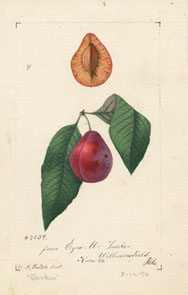
Plum (variety Tucker). Watercolor, 1894 from the National Agricultural Library of the United States of America Department of Agriculture found at Wikipedia
http://en.wikipedia.org/wiki/Plum

Thursday, August 17, 2006

Snapdragon, Toadflax and Butter & Eggs

It’s the 30th of Thermidor (the month whose name means hot) in the French Republican calendar and since the day ends in 0, instead of a plant, the calendar features a tool, in this case the Mill or Moulin. Where would we be without the mill, which for centuries has provided us with flour and the ability to make bread, pasta, even baby food?

But instead of mills, I’m featuring the plant associated with St Mamas, whose feast day this is, and whose flower, according to Pip Wilson is the snapdragon toadflax.
http://www.wilsonsalmanac.com/book_of_days.html

I don’t know much about St Mamas or why he would be associated with the snapdragon toadflax. He is a saint honored in the Byzantine culture who spent time in the wilderness. He is known as the Patron Saint of Animals according to this web site which also features a wonderful icon of him seated on a lion with a smaller white animal that looks like a unicorn in front of him:
http://www.byzantines.net/byzcathculture/stmamas.html
Here are some more great pictures of him including the mystery animal:
http://www.catholic-forum.com/saintS/stm31001.htm

I also found some wonderful pictures of the little wildflower: snapdragon toadflax at paghat’s marvelous garden site:
http://www.paghat.com/linaria.html
It’s called toadflax because it resembles a toad and flax. Its Latin name is linaria maroccana, linaria from the root word for flax and Maroccana because it’s native to Morocco. It’s a member of the Scrophulariaceae family.

Mrs. Grieve provides some information about a relative, Linaria vulgaris, also known as butter and eggs from her Modern Herbal (1931):
http://www.botanical.com/botanical/mgmh/t/toadfl19.html
You can’t miss butter and eggs—they really do look like eggs scrambled with lots of butter. According to an article published by the University of Washington, yellow toadflax (linaria vulgaris) is a Class C noxious weed in our state and “a principal weed for control” in King County.
http://uwnews.washington.edu/ni/article.asp?articleID=7637
I think that means I should be able to find it on my walk to work tomorrow. I’ll let you know.

If you want to learn how to play the Yule game, snapdragon, you can read the article at my web site:
http://www.schooloftheseasons.com/snapdragon.html
Or account published by Robert Chambers in his Book of Days (1869):
http://www.thebookofdays.com/months/dec/24.htm

Illustration of a snapdragon from
http://www.botanical.com/botanical/mgmh/s/snapdr58.html

Cool snapdragon pictures from the Department of Botany at the University of Wisconsin:
http://botit.botany.wisc.edu/images/130/Angiosperm/Flowers_used_in_lab/snapdragon/

Tuesday, August 15, 2006

Our Lady of the Grapes and Grain


Today is the Feast of the Assumption of Mary, in which the Christian goddess, Mary, assumes the role earlier played by Hecate and Artemis (who were honored on the full moon of August) as the protectress of plants, particularly grapes (it's almost time for the wine harvest) and grain.

Naogeorgus, a Protestant sceptic who wrote many scathing poems about Popish rituals, had this to say about the Assumption:

The blessed virgin Mary's feast, hath here his place and time
Wherein departing from the earth, she did the heavens climb:
Great bundles then of herbs to Church, the people fast do bear,
The which against all hurtful things, the Priest doth hallow there.
Thus kindle they and nourish still, the peoples' wickedness
And vainly make them to believe, whatever they express:
For sundry witchcrafts, by these herbs are wrought and diverse charms.
And cast into the fire, are thought to drive away all harms,
And ever painful grief from man, or beast for to expel
Far otherwise than nature, or the word of God does tell.

In central Europe, this was called Our Lady's Herb Day. Gertrud Mueller Nelson tells about how her mother kept the holiday alive by taking her daughters on walks, gathering wild grasses, a custom I've adopted in Seattle. It's amazing how many kinds of wild grass grow on my city block.

For more, see Pip Wilson's description of the holiday at his Book of Days:
http://www.wilsonsalmanac.com/book/aug15.html
which includes quotes from my article on the day at the calendar at my web site:
http://www.schooloftheseasons.com/augdays2.html#feast

References:
Nelson, Gertrud Mueller, To Dance With God: Family Ritual and Community Celebration, Paulist Press 1986

Monday, August 14, 2006

Rapeseed


The plant of the day for Thermidor 27 (also known as August 14) is Rapeseed (Brassica napus). The common name is derived from the Old English word (rapum) for another member of the Brassica family, the turnip. Other plants in the Brassica family include mustard and broccoli.

Rapeseed oil has been used for centuries as lamp oil, and cooking oil. A particular cultivar, Canola, is used to make canola oil, the third leading vegetable oil in the world (after soybean and palm oil). Rapeseed oil is also used in the manufacture of biodiesel fuel. Rapeseed plants are primarily grown as fodder but the greens are edible and are similar to bok choy and kale.

I learned all of this from the great Wikipedia article which has much more information and great pictures:
http://en.wikipedia.org/wiki/Rapeseed
http://en.wikipedia.org/wiki/Canola

Although the appearance of rapeseed in the French Republican Calendar which was created in 1793 indicates that this plant has been used by humans for a long time, there are several controversies swirling round rapeseed. Monsanto created a genetically modified version of rapeseed that is resistant to Round-up, a pesticide used to kill noxious weeds. This genetically modified version cross-pollinated with other rapeseed and Monsanto then successfully sued Canadian farmers whose rapeseed crops were found to contain their patented modified version.


The picture of a field of rapeseed comes from this website which offers classes on making biodiesel fuel:
http://www.houstonbiodiesel.com/

The closeup of the flower comes from the Centre for Research in Environmental Science at the University of the West of England at:
http://science.uwe.ac.uk/research/galleryImage.aspx?imageId=94

Thursday, August 10, 2006

Elecampane


Excellent herbs had our fathers of old
Excellent herbs to ease their pain
Alexanders & Marigold,
Eyebright, Orris, & Elecampane
Basil, Rocket, Valerian, Rue,
(Almost singing themselves they run)
Vervain, Dittany, Call-me-to-you
Cowslip, Melilot, Rose of the Sun.
Anything green that grew out of the mould
Was an excellent herb to our fathers of old.
-Rudyard Kipling(865-1936)

I've missed doing a flower a day so I'm back with the flower of the day according to the French Republican calendar: Yellow Starwort, which is also known as Elecampane, Horse Heal and Elf Dock.

Mrs. Grieve has a splendid long explanation of the history and medicinal uses of this herb:
http://botanical.com/botanical/mgmh/e/elecam07.html

Also see the Wikipedia article at:
http://en.wikipedia.org/wiki/Elecampane

I’m sad but it doesn’t look like this plant grows in my area. Rodale’s Illustrated Encyclopedia of Herbs says it grows from Nova Scotia to North Carolina and as far west as Missouri.

Thanks to paghat (http://www.paghat.com/) for the great quote from Kipling.

Illustration from Koehler’s Medicinal Plants (1887) found at Wikipedia

Saturday, August 05, 2006

Pilfered Roses

Although I went looking for flax yesterday, I didn't find any. However, I learned many interesting things about it at two websites.

Paghat's article on blue flax includes a gorgeous photograph
http://www.paghat.com/flax-blue.html
while her article on the scarlet flax
http://www.paghat.com/scarletflax.html
mentions that flax was sacred to both Ra, the Egyptian Sun-God and Isis. And that while
scarlet flax was a symbol for male virility and female fertility, blue flax represents "sacred
wisdom."

Chelsie VandaVeer also has wonderful articles on flax including "How Did Flax Preserve History?"
http://www.killerplants.com/plants-that-changed-history/20030429.asp
and "How Did Flax Revolutionize Clothing?"
http://www.killerplants.com/plants-that-changed-history/20030422.asp
which describes the very interesting process (wet-retting) by which flax fibers are extracted from the plant to be used in making linen. Another article, "What is Lint?" discusses the various names for flax and the derivation of the word lint (from the same root as linen):
http://www.killerplants.com/whats-in-a-name/20030425.asp

Meanwhile I wanted to let you know about my rose adventure. I asked my Summer Online class to adopt a plant ally and I adopted the rose. Then I realized that I don't own a rose. Which made it difficult to obtain unsprayed rose petals. I realized I could order them from a herb company, including my friends at Ravencroft Gardens (they offer rosa rugosa petals)
http://www.ravencroftgarden.com/specialflowers.html
but that would take a while to get and I was impatient. So I went out and bought a rose, at my local garden store, City Peoples, but most of its petals fell off in the transition between the garden store and my garden.

Then one day while walking Pepe, my grand-dog, I noticed a lovely red rose blooming behind the fence that encircles the lot on my block where once stood the green house which burnt down last year. The house was razed about six months after the fire and the basement filled in with dirt, then a big chain link fence was put up around the perimeter and the lot has been vacant ever since. There's a lovely rose plant with deep red, fragrant roses that is blooming valiantly right inside the fence. I tried to pick the ripe and ready rose petals by sticking my arm through the chain links but couldn't reach the most luscious blooms. So today I enlisted the aid of my daughter, who is always willing to break the law. After also being baffled by the constraints of the space in the chain links, she went up and over the fence and filled a cup full with rose petals for me. Then she found a break in the fence so she could get out easily and I will be able to get in more easily the next time I need roses.

I came home and made a rose simple syrup (1 cup water, 1/2 cup sugar and about a 1/2 cup rose petals (with the white cut out) boiled together, then left to sit for about a half hour). It's not as fragrant or as strong as the lavender simple syrup I've been enjoying but it's an exquisite color and it has a faint flavor of rose. I think I will wait a few days, gather more roses, and try again, using double the roses this time.

Last weekend I was in Victoria, British Columbia, with my niece (it was her first trip out of the country) and we went looking for rose-flavored Turkish Delight which we found at a British Candy Shop on Yates Street. Apparently we are not the only Americans to go seeking Turkish Delight after watching Chronicles of Narnia (I haven't seen the movie--just read the books). This article describes the jump in popularity and provides a recipe:
http://www.christianitytoday.com/ct/2005/149/53.0.html
But we are unusual in that we both loved the rose-flavored version (we also bought the lemon-flavored kind but it was no more interesting than a lemon drop). According to Susan Reilly in this article "Turkish Delight Sales Jump After Chronicles of Narnia," sales have increased but most Americans find the rose flavor too subtle or floral for their tastes. I'm with Edmund, however, in thinking that it's one of the most delicious candies I've ever tasted (although I did find the sweetness and gooiness (it's like a squishy gumdrop) rather disconcerting).
http://www.nhpr.org/node/10325

Off to look for some almond oil...

Friday, August 04, 2006

Flower List for August

I’ve been missing from my blog for a while because I spent the last month writing a Flower a Day entry for a select subscription mailing list. Then I got an invitation to go to Ireland during the month of August. By the time my trip was postponed I was so looking forward to a break from the relentless pace, that I decided to return to my blog.

But this time I’d like to do it a little differently. So far I’ve been treating the blog like an article: I find the good sources, do all the research and then distill it down into something to share with readers. I haven’t yet explored the truly personal, soul-baring aspect of blogging. Nor have I invited my readers to collaborate with me the way a good blogger should.

So I thought I would begin by letting you know the flowers for the week and hoping that you will go out and experiment with these plants and let me know what you find, either on the Web or in your garden. I will do the same and report on what I learn.

I take my plant recommendations from the French Republican Calendar
http://en.wikipedia.org/wiki/French_Republican_Calendar
in which the months are named after their seasonal qualities (we’re in the middle of Thermidor which means Hot) and each day has a plant, animal or tool assigned to it.
The plants are usually seasonal and useful.

I also sometimes look at Flora’s Dial,
http://www.earthlypursuits.com/FlwrsPer/FlowerYear/Floweryear.htm
a calendar compiled by J Wesley Hanson in 1853 which assigns a flower to every day of the year. I find it annoying and arbitrary. It looks like he chose flowers at random from an alphabetical list, because so often the flowers appear in runs of similar flowers or initials, with little relationship to the season.

And sometimes when neither list really gets me excited, I find a flower associated with the saint of the day at Pip Wilson’s almanac:
http://www.wilsonsalmanac.com/book/

Here’s a list of the plant possibilities for the next few days:
Aug 4 // Thermidor 17 Fri
Flax (lin)
Morning glory

Aug 5 // Thermidor 18 Sat
Almond (amande)
100-leaved rose
St Mary of Snows, the Egyptian water lily (Nelumbo nilotica)

Aug 6 // Thermidor 19 Sun
Gentian (gentiane)
Sardony
Transfiguration, Meadow saffron (colchicum autumniae)

Aug 7 //Thermidor 20 Mon
Lock (ecluse), a tool since this is a day that ends in 0
Saintfoin
St Cajetan, common amaranth

I'm going to look for flax, eat almonds, wander down the block to see if the autumn crocuses are up yet (they look like ghosts springing out of the dead earth but I think it may be too early for them) and write about/eat amaranth. I'll let you know about my adventures--you let me know about yours.

Saturday, July 22, 2006

Mary Magdalene's Flower: Agapanthus


In honor of the feast day of MaryMagdalene, I've chosen the flower associated with her:
the agapanthus umbellatus, also known as African Lily and Lily of the Nile.

The plant originates in South Africa, so it’s doubtful that Mary Magdalene ever came in contact with it, but it does have fragrance, and, of course, she has long been associated with perfume, along with other sensual pleasures. It is also blooming on her holiday.


I remember this plant fondly from my southern California childhood but it prefers warm climates and I rarely see it in Seattle.

Illustration:
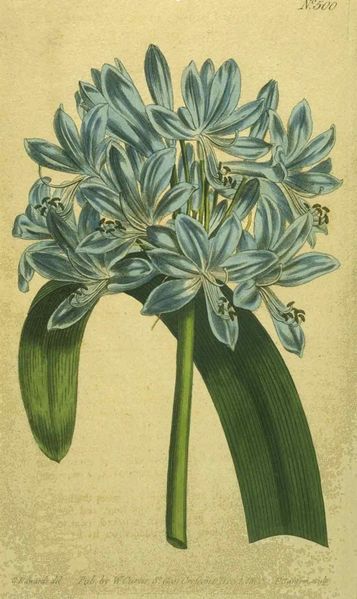
From Curtis’s Botanical Magazine (1800). reproduced with permission from the National Agricultural Library, ARS, USDA, found at Wikipedia

http://www.nal.usda.gov/curtis/500jpg/shtml

Wednesday, July 19, 2006

Einkorn Wheat


Today is the first day of Thermidor (from thermos meaning heat) in the French Republican calendar. The creators of the calendar sought to do away with the old religious and political associations of the calendar by assigning each day a plant, animal or tool. Today's plant is Einkorn Wheat, one of the ancestors of wheat, a wild grass that was partly responsible for the development of civilization as we know it

Here are a few of the interesting facts I learned while researching Einkorn:

  • Einkorn was the first cultivated grain.
  • The oldest evidence for the cultivation of this type of wheat comes from the slopes of a volcano in southeast Turkey, although it may have been developed in other places in the Fertile Crescent, including Syria, Palestine or Jordan.
  • Civilizations first arose in these areas where people began cultivating wheat and other crops.
  • Einkorn has more nutritional value than our modern varieties of wheat. However, it doesn't make good bread. It has the advantage of storing well (the husk is tough and prevents insect damage) but needs to be milled (to get rid of the husk) to be used in cooking.
Here are some interesting facts about wheat from an article on Wheat and Population Growth by Paul Ehrlich in the Economist:
http://www.economist.com/science/displaystory.cfm?story_id=5323362

Most wheat has six copies of each gene, where most creatures have two. Thus its 21 chromosomes contain 16 billion base pairs of DNA, 40 times as much as rice, six times as much as maize and five times as much as people.

Wheat is incapable of sowing itself and must rely on people to sow it.

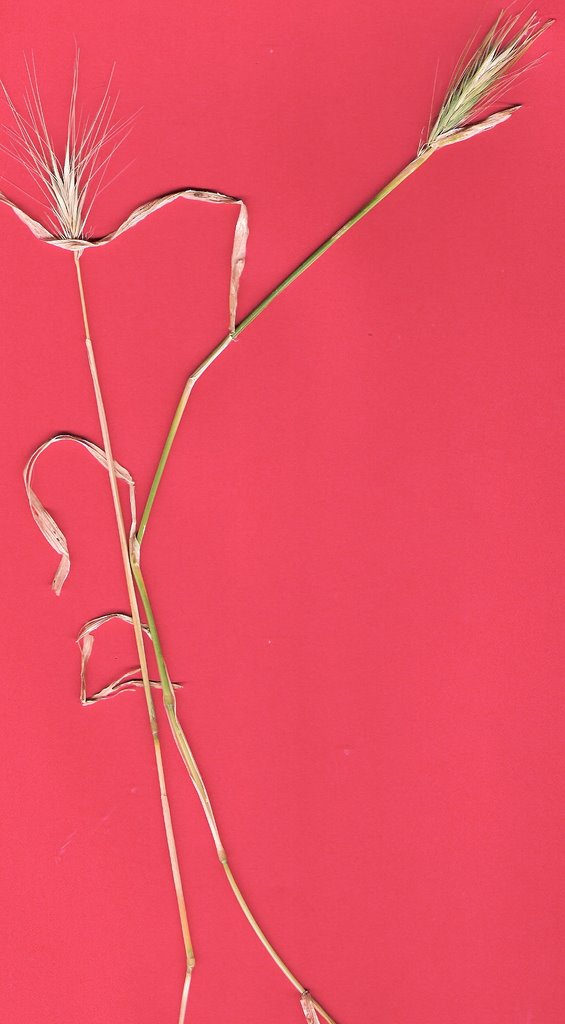
All day today I've been admiring the wild wheat on my block which has sown itself quite capably and offering it praise for the many gifts it has given us. I scanned a picture of the plants I found on my morning walk.

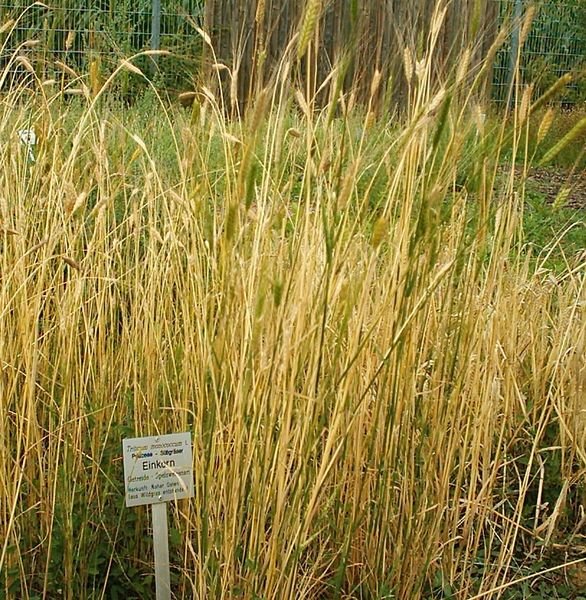
The top picture of Einkorn Wheat comes from Thomas Springer and was released by him into the public domain. I found it in on Wikipedia
http://en.wikipedia.org/wiki/Einkorn_wheat

Sunday, July 16, 2006

Wild Flowers

I don’t think I realized how much this Flower of the Day plant blog has taken over my life until I went on a yoga retreat led by my yoga teacher, Denise Benitez, at this wonderful place:
http://tierralearningcenter.org/

We spent most of our time doing yoga and eating delicious food but in my free time I wandered around through the grounds looking at wildflowers. I was surprised by how much more vibrant the wild flowers were in their presence than the tame flowers in my garden and around my block. They seemed to call out for my attention. It reminded me of the story Stephen Harrod Buhner told in his book on Sacred Plant Medicine about how plants called out to the people who needed them.

I found a field guide published by the Audubon Society that was supposed to help me identify wildflowers but in order to use the key, I had to learn many botanical terms, like corymb, calyx, pinnate, panicles, bilaterally symmetrical. I drew pictures of the plants I found. And every time I closed my eyes, in meditation, during savasana, or when I went to sleep at night, I saw parts of flowers.

On Sunday, I found a lovely moneywort (which I featured way back on June 8) growing next to the waterfall under the lodge. I also found chia (salvia columbaria) although it’s supposed to only grow in Southwestern deserts, but it’s possible it would grow in Leavenworth where the retreat center is located because I also found a California corn lily (very poisonous, but so pretty with its creamy panicles). I also found chicory and fireweed in the area around the cabin. But I’ve yet to identify the small plant with tiny purple blossoms that smells so sweet and I’m still looking for veronica. I know I will find it eventually. I think I've found everything I've written about so far.

Tuesday, July 11, 2006

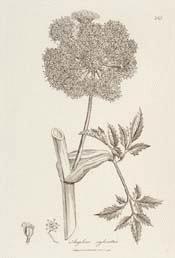
Angelica


Contagious air engendering pestilence,
Infects not those who in their mouth have taken
Angelica, that happy Counterbane.
Sent down from heaven by some Celestial scout
As well the name and nature both avowed.
DuBartas

The plant for the day in the French Republican Calendar is the lovely haricot (or green bean) and I certainly applaud you if you decide to celebrate the bean. But I have chosen to focus on the flower of the day from Flora’s Dial, angelica, inspired by Stephen Harrod Buhner’s description of his relationship with this herb.

In his wonderful book, Sacred Plant Medicine, Buhner describes how he became acquainted with the herbs, by spending time with them, listening to them, and studying the way indigenous healers learned about plants. Angelica was one of the first herbs that really made a strong impression on him and is one of his major plant healers. He writes: “Coming upon angelica, I am always struck by the feeling of femaleness and strong purity of spirit that the plant emanates….In sitting meditation with the spirit of angelica is it clear that the plant sits in balance between Heaven and Earth….Many shamans have carried the stem of angelica as a staff to help them maintain balance when traveling in spirit worlds. ….The spirit of angelica is strong and may offer help to women who have an empty place within them (like angelica’s stem). Go and sit with the plant and after making relationship with it ask (with the part of you that is empty) that it come into that place and reside there as an ally.”

I was particularly moved by Buhner’s devotion to angelica because there used to be an angelica plant in my garden. It was a magnificent plant, taller than most people and situated along the main garden path. Everyone who came into the garden remarked on it or asked about it. It has been gone for almost two years but I still think of it every time I pass that spot so I know how strong the spirit of the plant is.

Now that I've learned more about the plant I realize it disappeared after two years because it is a bienniel. The first year it puts up an amzaing stalk (up to six feet high) and it has a wonderful aroma (frequently described as complex) which is quite noticeable. The second year it will produce white flowers on umbels, then go to seed and die. If you cut down the blooming stems, you can keep it going for much longer.

The common names of angelica include high angel, archangel and masterwort, all indicating its powerful spiritual qualities. Its botanical name is Angelica archangelica and several experts claim this is because it blooms on May 8, the feast day of St Michael the Archangel, but that seems unlikely as most of my sources say it blooms in June and July. It is a herb of the Umbelliferae family which includes fennel, parsley, carrots, caraway, and chervil. It resemble the very poisonous water hemlock so be certain of identification before using any part of the plant.

It has many medicinal and culinary uses. Check out this website for some fascinating recipes, including one that requires a broth made of reindeer bones:
http://www.henriettesherbal.com/archives/best/1996/angelica.html

I also found this recipe for Niort angelica a la sybarite in The New Larousse Gastronomique:

Have ready a dozen or so best quality butter brioches (kept hot), a fruit dish filled with sticks of candied angelica, a bottle of angelica cream, a carafe of iced water, a packet of Egyptian cigarettes. Light a cigarette, sip the ice water, crunch a piece of angelica with a bite of hot brioche, sip, breathe and savor a few drops of angelica liqueur and then repeat the whole process.

Austin de Croze who created this recipe also recommends spraying the room with a fresh light perfume of verbena or southernwood. I think I published it because I still miss my clove cigarettes (it's been over 14 years since I smoked). Id' substitute croissants for the brioche. And I was never one to smoke and eat at the same time, but still it sounds quite sybaritic. The angelica liqueur seems easiest to produce. Simply put some angelica stems in brandy and let it sit for a month.

References:
Buhner, Stephen Harrod, Sacred Plant Medicine, Treasure Chest Books 1996
Montagné, Prosper, The New Larousse Gastronomique, Crown 1960
Preus, Mary, The Northwest Herb Lover’s Handbook, Sasquatch Books 2000
Simmons, Adelma Grenier, Herb Gardening in Five Seasons, Penguin 1990

Illustration is from Mrs Grieve’s Modern Herbal at
http://botanical.com/botanical/mgmh/a/anegl037.html

Saturday, July 08, 2006

the Park


My daughter took her dog to her boyfriend's apartment yesterday and so I woke up this morning for the first time without a dog in my house. Very strange, although the cat did her best to pretend she was a dog. She even rolled around and showed me her belly (but wouldn't let me pet it). Normally I am feeling the pressure of dog desires (and needs) to get outdoors and my day always starts with a walk around the block. Now I have no excuse to even go outdoors (where it is blazing hot).

In the French Republican Calendar, Messidor 20, like all days that end in 0, is associated with a tool, in this case: the park (parc). It seems like a strange concept for the French Revolutionaries to celebrate as the earliest parks were open spaces set aside by nobles for hunting. Later they came to mean spaces set aside by the public for recreation but this concept of the park was probably just beginning at the time of the development of the French Republican Calendar in late 1793.

The Parc Monceau, shown in this painting by Monet, is a case in point. It was established in 1768 by Philippe d’Orleans, Duke of Chartres, a cousin of the King, who wanted to create an English style garden in the middle of Paris. In 1793, the Duke was executed on the guillotine and the park was taken into public ownership.

Curious about my local park, Volunteer Park, I did some research online (Wikipedia was a better source than the Seattle parks department). I found out that it was named Volunteer Park for the Volunteers who fought in the Spanish-American war. I also learned something about the design philosophy of the Olmstead Brothers who designed the park in 1904-1909 (they also designed the University of Washington campus, Central Park, the White House and Capitol grounds and Yosemite, among others). Here's a photograph I took of Volunteer Park at Summer Solstice in 1998 when I was taking photographs on each of the seasonal holiday for my annual creative pledge.

I've spent a lot of time at this park with with Chester the Dog. When my daughter and I first adopted him, we promptly took him to the park for an outing and let him off his leash (this was his second leash—he had chewed through the first while we were waiting for the bus outside the animal shelter where we adopted him). Chester promptly ran over and bit a beige-colored terrier-dog walking byh with her owner. We were mortified but luckily no damage was done.

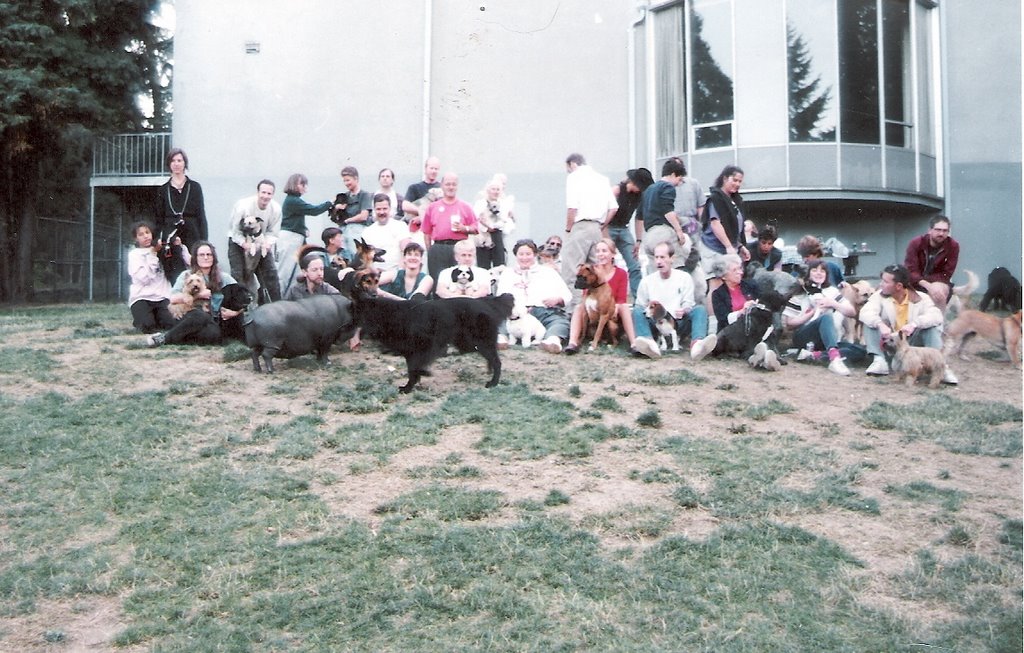
Chester was much better behaved, years later, when we started attending the Doggie Club, an informal meeting of dog owners which happened outside the Art Museum. The dogs loved to run and play with each other while their owners sat and talked. Here's a picture of the Doggie Club--I'm guessing this is around 1993. Shaw is over on the far left in a pink sweatshirt holding Chester on her lap--I'm standing behind her in a black jacket. Yes, there is a pot-bellied pig in the picture (to the left of the black dog in front).

Then an obnoxious woman who was afraid of dogs started complaining and the police started handing out $100 tickets to owners of dogs they found off-leash. A local group called COLA (Citizens for Off Leash Areas) formed and successfully lobbied to create special fenced dog areas in local parks. (http://www.coladog.org/)

Unfortunately, once the dogs were confined in a small area, it became a muddy, unsightly mess and eventually was removed from Volunteer Park (although creative spaces were found in other parks). Unfortunately, Chester hated being confined so much that he spent all his time trying to find a way to get out of the fence instead of playing, so we had to stop taking him to the Park.

I'm going to the park this weekend to honor Messidor 20 but it will be sad to be there without Chester.

Thursday, July 06, 2006

Hairy Vetchling


Today in the French Republican calendar is Messidor 18 and the plant of the day is the Gesse or Hairy Vetchling. In my quest to find a way to share my love of fllower folklore with others, I’ve thought of many methods of presentation, and one is the idea of a book of Birthday Flowers. But who wants to be born on the day of the Hairy Vetchling (as a blogger whose blog I ran across while googling hairy vetchling so poignantly asks)?

The hairy vetchling seems to be a rare wild relative of the garden Sweet Pea. It seems to be much appreciated and sought after in England (I’m not sure it exists in North America). Ralph Hollins in his Nature Diary (http://www.havnn.net/Diary.htm), describes it in an entry for June 16:
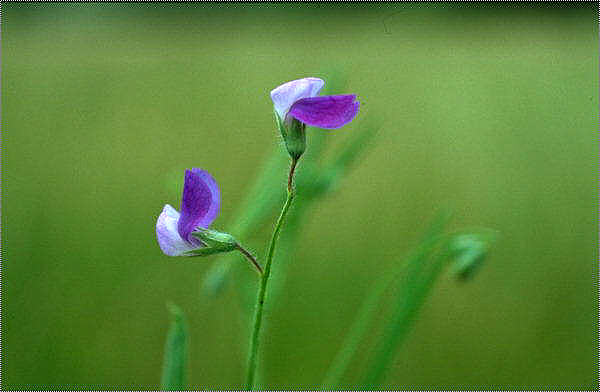
"The plant is a scrambler with very distinctive pairs of erect leaves looking somewhat like Hare’s ears, and with very long stalked flowers (two or three on each stem). The leaves are about 5 or 6 cms long but narrow and folded so that the sides almost meet above the central vein (or ‘keel’). The flowers are similar in size to those of Grass Vetchling but are distinctively two tone in colour with a reddish-purple standard and creamy wings and keel. "

Other common names for the hairy vetchling include Austrian winterpea, caley pea and singletary pea. According to the American Heritage Dictionary, the name vetch comes from the same root word as weak and wicker, and refers to the pliable, twining nature of the plant. Its Latin name Lathyrus, which applies to all members of the pea family, comes from an Akkadian word ladiru, which refers to a certain type of plant (presumably the pea). That’s a great pedigree.

Vetch has been grown as a food and forage crop for centuries in the Mediterranean and India, although some species (and hairy vetchling appears to be one) have a neurotoxin in their seeds which can cause paralysis in humans with heavy consumption.

The hairy vetchling reminds me a bit in looks of some of the wild sweet peas that grow in my neighborhood which are just now beginning to put forth their seed pods. I will take a closer look at them today on my way to work to see if they are hairy. According to my Northwest Weeds book, they are probably a naturalized sweet pea (lathyrus tingitanus) rather than the hairy vetchling.

The best known member of the lathyrus family is lathyrus odoratus (the sweet pea). They are just now beginning to bloom in my garden and I have some lovely old-fashioned, fragrant ones that are purple and pink. My Irish great-great-grandmother, Bridget Banks Fitzgerald, was famous for her sweet peas which grew along the fence all the way down the drive to the farmhouse in Hartland, Minnesota. I like to say that I grow my sweet peas in memory of her. They are also the quintessential summer solstice flower for me as we have used them to mark the edges of our circle for years of summer solstice bonfires at Golden Gardens.

If you can't find a hairy vetchling, or its close relative, in your neighborhood, find some sweet peas instead.

References:
Martin, Laura C., Garden Flower Folklore, Globe Pequot Press 1987
Taylor, Ronald J, Northwest Weeds, Mountain Press Publishing Company 1990

Photographs:
Of hairy vetchling flower
http://www.dijon.inra.fr/hyppa/hyppa-a/lthhi_ah.htm#Adult plant
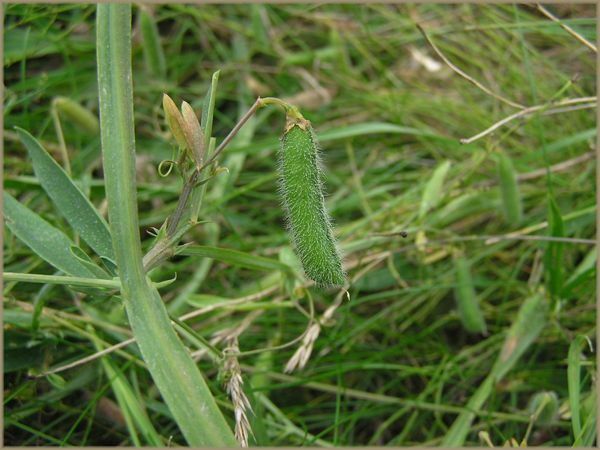
Of hairy vetchling seed pod
http://www.s-weeds.net/familjer/rosales/fabaceae/lathhirs.html

Tuesday, July 04, 2006

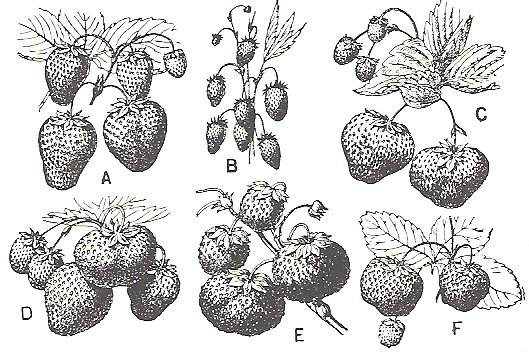
Strawberry


Strawberry

The flower of the day (Messidor 16) in the French Republican calendar is Tabac (tobacco) which does seem like a quintessentially American plant to feature on the Fourth of July.

However, I’ve decided to feature the strawberry, not the bloom but the fruit, as I always associate strawberries with Fourth of July. I have a wonderful strawberry plant in my garden, given to me by a friend last summer, which has been producing incredibly delicious fruit for the past three weeks. Larousse Gastronomique says “Strawberries must be eaten freshly gathered because they do not keep.” That is true—I have not managed to get any back to my house yet.

Strawberries are members of the rose family, and belong to the genus Fragaria, from the same Latin word as fragrance, for its wonderful scent. The derivations of the common name strawberry seems fairly obvious. Mrs. Beeton says it was so called because straw was used as a mulch to keep the berries off the ground. But Mrs.M. Grieve, says it was originally the strew berry because of the way the plant grows (putting forth runners which tangle along the ground). The strawberry has an aggregate fruit, according to the American Heritage Dictionary, consisting of a red fleshy edible receptacle and numerous seed-like fruitlets (doesn’t make it sound quite so appealing, does it?)

Strawberry History
For everything you want to know about strawberry history, see this site:
http://www.vegparadise.com/highestperch45.html

Strawberry Medicine
The 17th century herbalist Culpeper says they are cool and dry when green, but cool and moist when ripe. He used them to cool the liver, blood and spleen, to calm an upset stomach and to refresh the spirit. Judging by the number of conditions for which he used them, they were associated with bright red problems, like inflamed red eyes and blisters of the skin. They could also bring rosiness back to the complexion of someone with jaundice.

Gerard, the Elizabethan herbalist says “the leaves boiled and applied in the manner of a poultice take away the burning heat in wounds.” Gerard also recommended “The distilled water drunk with white Wine” as “good against the passion of the heart, reviving the spirits and making the heart merry.” This use of strawberries coincides with that of the Naragansett Indians who called it "wuttahimneash" which translated as heart-seed berry.

According to Mrs. Grieve a cut Strawberry rubbed over the face immediately after washing will whiten the skin and remove slight sunburn. For a badly sunburnt face she recommends rubbing the juice well into the skin, leaving it on for a half hour, then washing it off with warm water to which a few drops of simple tincture of benzoin have been added; no soap should be used. This recipe may come in useful if you are out in the sun all day on Fourth of July.

Strawberry Folklore
According to Funk and Wagnalls, the strawberry was sacred to Frigga, who concealed children who died as infants in strawberries and smuggled them into heaven. Culpeper calls it a plant of Venus. It was later associated with the Virgin Mary.

I haven’t seen a reference for this bit of folklore but it makes sense to me. Sharing a double strawberry with someone else means you will fall in love. Also according to this website (http://strawberry.ifas.ufl.edu/Productioncosts.htm) in France, newlyweds were served a soup of thinned sour cream, strawberries, borage (a European herb whose flavor is reminiscent of cucumber) and powdered sugar as an aphrodisiac.

Strawberry Recipes
Here's my favorite strawberry recipe: cut strawberries into halves (or quarters if large) and toss lightly with rosewater and a hint of sugar. Allow to marinate for two to four hours, stirring occasionally (perhaps once an hour). The rosewater adds an interesting flavor and dimension to the strawberries. I got this idea from Aroma, a wonderful resource on using essential oils in aromatherapy and cooking by Mandy Aftel and Daniel Patterson.

References:
Aftel, Mandy, and Daniel Patterson, Aroma: The Magic of Essential Oils in Food and Fragrance, Artisan 2004
Beeton, Mrs. Isabella, Book of Household Management, London 1861, First Edition Facsimile, Farrar, Straus & Giroux 1977
Funk & Wagnalls Standard Dictionary of Folklore, Mythology and Legend, edited by Maria Leach, Harper & Row 1972
Grieve, Mrs. M, Modern Herbal, 1931 www.botanical.com
Montagne, Prosper, The New Larousse Gastronomique, Crown 1977

Illustration is from Larousse Gastronomique

Monday, July 03, 2006

Cherries


Cherry

in honor of the abundance of ripe cherries that I got to sample at my local farmer's market yesterday, I decided to make this the day of the cherry. It also seems like a quintessential Fourth of July food. And to my surprise, I found out that my choice coincides with the National Cherry Festival held in Traverse City, Michigan on the first weekend in July.

The wild cherry originated in Persia and Armenia and provides the rootstock for most of the flowering cherries which need to be grafted. The fruits are called drupes, which is the name for any fleshy fruit with a hard stone enclosing a seed, like peaches and apricots. Here’s a web site that shows pictures of several cherry varieties:
http://www.calcherry.com/consumer.cfm?varieties=1
This web site has a great history of cherries, explaining the many varieties that flourish in various parts of the United States and how they got their names:
http://www.cherrymkt.org/media/background_info.html

Culpeper makes the cherry a tree of Venus. He recommends tart and sweet cherries for various medicinal purposes. According to nutritional writer, Mark Anthony, scientists are discovering that cherries are high in both antioxidants and anthocyanins, which help reduce inflammation and thus recommended for treating arthritis.
http://www.foodprocessing.com/articles/2006/083.html

Culpeper also recommends using the gum of the tree to ease coughs. Scottish children used to chew it like chewing gum. Funk and Wagnalls says cherry gum in wine is still used for treating coughs (think Ludens Cherry-flavored cough drops). Mrs. Grieve recommends using cherry bark for treeating coughs:
http://www.botanical.com/botanical/mgmh/c/chewil56.html

The Cherry Tree Carol is a famous English ballad carol based on an Apocryphal story from the Gospel of Pseudo-Matthew. Mary and Joseph were walking through a garden or orchard of cherry tress when Mary was pregnant and Mary asked Joseph to pluck her a cherry. He refused whereupon the unborn Christ Child in her womb bade the tree to bend down before his mother, which it did. In other European countries the same story exists but often told about other fruits, for instance, dates, figs, apples, etc., depending on the country. There is a similar story in the Kalevala about Marjatta, a maiden who notices some scarlet berries growing on a tree as she is walking out to milk the cows. The tree invites her to gather the fruit but she can’t reach it. At her command, a berry jumps down into her lap, and then into her mouth. She later became the mother of Ilmori, the Air. So it seems that cherry fruit has something to do with pregnancy. Could it be related to the idea that swallowing a cherry stone means it will sprout in your stomach?

In Switzerland, according to Funk and Wagnalls, the first fruit of a cherry tree is given to a young mother to eat, preferably one who has just given birth to her first child. This will insure an abundance of fruit. In some parts of France, cherry orchards are wassailed the way apple orchards are in England.

References:
Anthony, Mark, “Nutrition Beyond the Trends: Pie in the Sky,” http://www.foodprocessing.com/articles/2006/083.html
Funk and Wagnalls Standard Dictionary of Folklore, Mythology and Legend, edited by Maria Leach, Harper and Row 1972
Hageneder, Fred, The Meaning of Trees, Chronicle Books 2005

And in case you’re still hungry for more, this website has everything you ever wanted to know about cherries:
http://www.vegparadise.com/highestperch56.html
including the lyrics to Life Is Just a Bowl of Cherries.

The photo comes from this website:
http://www.hort.purdue.edu/ext/senior/fruits/cherry1.htm

Sunday, July 02, 2006

Lavender


The flower for Messidor 14 in the French Republican calendar is Lavender, one of my favorite of all flowers. It was the plant ally I adopted many years ago during an herb course I took from EagleSong at Ravencroft garden and ever since, it has been a welcome friend. I could write about it forever and in fact, I often have. It was featured in my last newsletter
http://www.schooloftheseasons.com/news.html

Most writers explain the name of lavender as coming from Latin, lavare, to wash, explaining that the herb was used in washing. But the American Heritage Dictionary (my favorite) derives it from Latin lividus, meaning bluish, which comes from the Indo-European root, sleia—which also shows up in sloe, slivovitz and livid. This makes more sense to me.

Lavender is a member of the Labatiae or Mint family. This was the only web site I could find that offered pictures of the various lavender varieties for which I'm so grateful I'm planning to place an order with them:
http://www.mountainvalleygrowers.com/lavendercareandtips.htm

Lavender has been a popular element in cooking for centuries. On the web, I found a recipe for chicken with lavender, prepared by Anahita from a 13th century Andalusian recipe:
http://home.earthlink.net/~lilinah/Food/2002_Feasts/2002-thumiyya.html

For more contemporary interpretations of lavender, this web site has quite a list including grilled pork chops with lavender, lavender crème brulee and lavender jelly at:
http://whatscookingamerica.net/Lavender.htm

And my friend Kathy Gehrt’s blog features recipes for lavender nougat, lavender poached pears and bleu cheese and lavender honey on crackers:
http://discoverlavender.blogspot.com/

For the past two weeks, I’ve been enjoying lavender vodka tonics, made from a recipe from this web site:
http://www.npr.org/templates/story/story.php?storyId=4754257

For instructions on making lavender wands, see the supplemental pages for my Lammas packet which can be downloaded and printed:
www.schooloftheseasons.com/pdfdocs/lammassample.pdf

In the Middle Ages, lavender was considered a herb of love. Kate Greenaway in Language of the Flowers says it means distrust. But another source (from before the days when I became scrupulous about writing down bibliographic information) says it means constancy and loyalty, sweetness and undying love, "fervent but silent heart," and good luck. That's how I feel about it.

References:
Greenaway, Kate, Language of Flowers, Averill Books

Illustration from Mrs. Grieve’s Herbal
http://botanical.com/botanical/mgmh/l/lavend13.html