Wednesday, November 07, 2007

Pumpkin Art

I've spent years studying and writing about holidays and I thought I knew a lot about the reasons people celebrate: to experience the timelessness of ritual, the warmth of community and the magic of aligning with the natural world . But as I walked around my neighborhood, the day after Halloween, I recognized a new and important ingredient: the opportunity to practice creativity.
Almost every porch had a pumpkin and every pumpkin was unique. The artists had obviously put a great deal of thought into their pumpkins and no one was afraid to display their artwork.
When I was young, my siblings and I had a contest every Halloween to see who could draw the best pumpkin face. Because we wanted to conserve the actual pumpkins, we drew our designs on little cut out paper pumpkins, then colored them in with crayons to consider the effect. The design which was most popular was then carved into the actual pumpkin (no doubt by my father wielding one of the kitchen knives). The paper pumpkins were taped to the wall above my brother's bed where they stayed for at least a month; every year the old pumpkins came out like Christmas ornaments and new ones were added. It was one of those peculiar family traditions which evolved out of a few factors (the eternal competition between me and my sister, my brother's birthday a few days before Halloween, and the orange paint on his bedroom wall).


Here are a few of my favorite pumpkins from my neighborhood. I like the simplicity of this presentation, the white pumpkins and they way their shape is echoed by the croquet balls.


Another unique approach or what to do with a big, lumpy, flattish pumpkin.


These pumpkins win my prize for most unique use of materials. Note the one where the face is carved in the top of the pumpkin using the stem for a nose.


This display highlights the importance of having your own pumpkin. Here's a triplex with three doors to three units and each person apparently carved their own pumpkin.

Wednesday, October 10, 2007

A Leaf With All the Colors of Autumn In It


Found on the street and scanned on my scanner.


Well, maybe it needs a bit more of brown.


I like the decay and the brokenness.

Monday, October 08, 2007

Our State Grass: Bluebunch Wheatgrass


You can pretty much bet that when I say I’m done with a subject (as I said in my last post that I was done with the topic of wild grasses), I will immediately find something fascinating to say about that topic.

Yesterday my daughter was reading a copy of the State of Washington Voter’s Pamphlet which has all the Washington symbols (bird, song, gem, boat, etc.) printed on the cover and I learned that we have a state grass: bluebunch wheatgrass.

Curious to know more about it, I went looking and found a website that features a good description and a photograph of bluebunch wheatgrass. The website features activities relating to bluebunch wheatgrass, including growing it in your garden. I realized that I’ve seen a lot of bluebunch wheatgrass while driving around eastern Washington.


Many years ago I wrote a story for my daughter called “Chester Chases Swallows in the Sagebrush,” about the time we let our dog out of the car on a deserted part of I-90 (the highway between Spokane and Seattle) and he took off running. I think the correct title for the story should probably be “Chester Chases Swallows in the Bluebunch Wheatgrass.”

Speaking of state anythings, did you realize that many states have state dances? Most of them that have a state dance, list “square dance” as their dance. Washington does. Boring. Some are obvious. Hawaii has the Hula. Louisiana the Second Line. Virginia has the Virginia Reel. Both Wisconsin and Pennsylvania list the Polka. Some are not. Ohio and the Charleston? And some are interesting. New York has Lindy Hop. California has West Coast Swing. The Carolinas claim the Shag. And Texas claims the Texas Two-Step (although I might also nominate the Texas Push). The most amazing thing is that I know most of these dances (except the Hula).
I found all of these on Wikipedia,
http://en.wikipedia.org/wiki/List_of_U.S._state_dances
which also has a list of the state grasses, in case you want to find the grass for your state:
http://en.wikipedia.org/wiki/List_of_U.S._state_grasses

Photograph: Loren St. John @ USDA-NRCS PLANTS Database

Saturday, October 06, 2007

Last Word in Grass


The other day I was browsing a website I love for its vintage patterns, and I found a photograph of a dress made out of grass. The designer is Robin Barcus, an artist who is currently doing a project which involves creating a dress for each of the fifties states.
This very beautiful grass dress is called Willow Creek Dress in Wyoming, 2006
It perfectly combines two topics I have been exploring in the last month: wild grasses and flower art.

Meanwhile, I found another blogger, the pseudonymously named Henry Thoreau, who has committed himself to a year-long project of identifying wild grasses in his hometown, San Francisco. He is doing exactly what I hoped to be doing and with much more skill and success. We share similar appreciations for the way wild grass prevails in the city landscape and our annoyance at the way modern landscapers plant ornamental grasses in straight rows of clumps.

Henry Thoreau also mentions another blog on wild grasses which is not quite as personal as his writing, but it does provide some awesome photographs and information about wild grasses.

Here are some books that Henry recommended for identifying wild grasses:
Lauren Brown's Grasses (best for the East Coast)
Manual of Grasses for North America, Utah State University Press
In Full View: Three Ways of Seeing California Plants by Glenn Keator and Linda Yamane, with illustrations by Ann Lewis

Because Henry is doing such a good job of finding, identifying and writing about wild grasses, I’ve decided to end my grass identification project (at least for this year, and with the option to take it up again if inspired by Henry’s posts) and focus on other topics. If you are fascinated by wild grasses, I suggest subscribing to Henry’s blog (I will be!).
http://thoreaugrass.blogspot.com/

Saturday, September 22, 2007

Crabgrass in my Garden

I love volunteers in the garden, those mystery plants that sprig up and only gradually reveal their character. I’ve got a magnificent mullein that was a volunteer—it always makes visitors gasp—and it’s now the matriarch of a thriving colony of mulleins, most of which I will root out (mainly because they take up so much room).

The woman who gardened in my plot before me planted a plant with red-trumpet-like flowers to attract humming birds. It is more invasive than mint or bamboo. It can't be killed, it sneaks around barriers of metal, and no matter how many times I ruthlessly rip it out, I never win the battle. We are in a struggle.

The newest volunteer in my garden is also in this unwelcome category. In the spring, I noticed a grass that was poking through the branches of my big lavender plant. It gradually spread through my garden in waves, slyly insinuating itself all through the herb and iris bed, then creeping around the back and entering the bed with the dog roses, strawberries, arugula and basil (it hasn’t reached the back bed yet whichis where I am doing battle with the red trumpet flower plant). This plant spreads underground, the white roots creeping through the earth before poking up green shoots in some new location. When I try to rip it up, I sometimes yank out the root, back to its last outpost, but I never seem to be able to track it back to its source. Trying to disentangle it from my small lavender bush, I had to dig up the plant, so inexorably were their roots entwined, and, as a result, the lavender died.

The mystery volunteer is a grass so I finally decided to make it the latest subject in my grass identification project. I plucked a fine mature specimen: tall stem, gay green ribbons of leaves and a seedhead with four horizontal grainy blades like a little heliocopter. Can you guess what it was?

Yes, crabgrass. Unremarkable, insidious, unloved, unquenchable crabgrass. When I googled crabgrass to learn about its name, the suggested combinations were “crabgrass control,” “crabgrass removal,” “crabgrass prevention,” “crabgrass herbicide,” “crabgrass treatment,” “crabgrass prevention,” and “crabgrass kill.” It seems no one wants it around.

My new favorite Northwest plant identification guide (known affectionately as Pojar’s) says that it is digitaria sanguinalis (an interesting name suggesting it has something to do with fingers and blood but I haven’t found an explanation for this name). The explanation for its common name, crabgrass, is that it creeps sideways like a crab, or the nodes look like crabs. The little whirligig at the top of the plant is the inflorescence—it flowers from August to September in our area.

The Plants for the Future website says that the seeds can be ground up into flour and the leaves used to make paper. So nice to know there is a positive use for this plant. I was curious to know how to make paper from grass so I did a little snooping around the internet. Apparently it can be quite a difficult process, involving caustic chemicals. The instructions from Akua at the Art Farm, seemed the simplest.

Resources:
Pojar, Jim and Andy MacKinnon, Revised Plants of the Pacific Northwest Coast, B C Ministry of Fores and Lone Pine Publishing, 2004

Monday, September 10, 2007

Scanned Flower Art?


I thought I was done with the topic of flower art--see below for posts on flower dogs and flower carpets—when I found an article at Human Flower Project about scanning flowers.

Truly amazing pieces of work, although skeptics ask: Is it Art? Is flower arranging art? Are photographs of flowers art? What about X-ray photographs of art?

Several years ago I saw an amazing show of x-ray photographs of flowers at a local jewelry store. Truly art. Unfortunately I can't prove it because I can't find the artist. Whiel searching for her, I did find x-ray photographs of flowers from Hong Pham, Judith McMillan, and Steven N Meyers.
Some of these I think qualify as art--there is artistry involved in the design. Others strike me as simply unique and intimate ways of looking at flowers more closely.

Thursday, September 06, 2007

Birthday Flowers

I've been championing the idea of a birthday flower, that is a flower that blossoms on your birthday. And here's the most recent picture of mine: the naked lady or autumn crocus.

These grow in the parkway a few blocks from my house. I love how they mysteriously appear and just as mysteriously disappear. I wanted to pick one but I know they are poisonous so I didn't (although I think maybe only the bulb is poisonous).

Linnaeus named the autumn crocus, colchicum, after Colchis, the island on which the poisoner and sorceress Medea lived. It has even more wonderful common names. I know it as a naked lady. It's a naked maiden in Germany (because it has no leaves, just a bare flower stalk). In France, they are called dog-killers and bare-bottoms. In England, Wilfrid Blunt (who gives this delightful list) mentions the names: upstarts, daggers, kite’s legs, naked boys and naked nannies. While the Arabs call them, he says, the lamps of the ghoul. That's my favorite. Do they look like the lamps of the ghoul? Maybe a little.

Monday, September 03, 2007

Foxtail Barley


I’m making progress on my grass identification project now that I’ve got a copy of Pojar’s Plants of the Pacific Northwest Coast. For instance, this grass that grows in the parkways all over my neighborhood. I think of it as foxtail. And according to Pojar’s, it’s common name is foxtail barley. The Latin name is hordeum jubatum.

Pojar's says it grows along roadsides which explains why I find it in the parkway. Once I brought my specimen inside, the little spikelets starting breaking off. They look like little satellites with their long tails (those are called awns) and their sharp points. Each bristle has barbs that point backwards and these can become lodged and work their way into the nose, mouth, ears, eyes or even intestines of animals that eat them. So right now I’m going to scoop them all up and throw them in the trash, before Pepe, the Chihuahua, finds them.

According to Plants for a Future, it is possible to make flour out of them by grinding up the seeds. The roasted seeds can also be used to make a substitute for coffee. But it’s hardly worth the effort.

On the other hand, when I went looking for references on the Internet to foxtail barley, I found a related plant in the University of Washington herbarium: hordeum pusillum. Now I’m not really sure what I found. Since they are related, perhaps it doesn’t matter.

Wikipedia’s article on barley mentions that barley was a staple cereal in ancient Egypt where it was used to make both bread and beer. The English word beer comes from barley. It is appropriate that I am featuring it in the month of September, for the initiates at the Eleusinian Mysteries, held in honor of Demeter (known as Barley-mother) during the full moon of September, drank a ritual drink (kykeon) made of barley and herbs.

Barley-water (made by steeping pearl barley in hot water) is a popular drink in England where it is often the first food offered to babies. The Victorian Martha Stewart, Mrs. Beeton, includes a recipe for her barley-water in her section on cooking for invalids. Pearl barley is washed in cold water, then boiled in 2 quarts of boiling water. Once the liquid is reduced to half, the barley is strained out. It can be flavored with lemon peel, either afterwards or while boiling.

References:
Beeton, Isabella, Beeton's Book of Household Management, first published London 1861, facsimile Farrar, Straus & Giroux 1977
Poajr, Jim & Andy MacKinnon, Plants of the Pacific Northwest Coast, Lone Pine Publishing 1994

Saturday, September 01, 2007

A Hairy Bentgrass?


I wrote in my newsletter about how I wanted to learn to identify grasses--I always like to collect a bouquet of all the wild grasses growing on my block on Assumption (August 15) in honor of Our Lady of the Grain. I went out and found a magnificent speciment in the vacant lot across the street--almost three feet high with some fine seed heads at the top--but then couldn't identify it.


The websites I found through a Google search were not helpful. They wanted details I couldn't provide. To my surprise (and dismay), we don't seem to have a single ruler in the house that measures centimeters. Also I can't see the fine detail of the grass--I don't have a hands len--though I am using the magnifying glass that came with my Oxford English Dicitonary.


Luckily one of my readers recommended Pojar's Plants of the Pacific Northwest Coast. It's amazing. The grass section begins with picture keys which break down the Grass family (Poaeceae) into Tribes: the Barley Tribe, the Millet tribe, etc. To distinguish between the 200 varieties of grasses that grow in my region, it helps to learn technical terms like panicle and glume and lemma. Grasses have their own vocabulary, quite distinct from flowers.

At first I thought my wild grass was a fescue but now I'm leaning towards Bentgrass, possibly Hair Bentgrass (Agrostis scabra). According to Pojar's, the name scabra means rough or scrufy, and refers to the way the grass feels. That's my main clue. When you run your fingertips along the stem and even the panicle branches of my specimen, it feels like sandpaper. I feel no certainty about this identification so if you have a better idea let me know.

Pojar, Jim and Andy MacKinnon, Revised Plants of the Pacific Northwest Coast, Lone Pine Publishing 2004

Autumn Crocus Revisited


Here they are two days later.

I'll check again on my birthday.

Wednesday, August 29, 2007

In Time for my Birthday


Last year, I wrote about how the amaryllis belladoonna is the flower my mother associates with my upcoming birthday (September 4) because it blooms around that date in Southern California where I was born (Burbank, to be exact). And about how the autumn crocus blooms on my birthday here in Seattle.


And here it is, a week before my birthday. I love how ghostly the flowers look as they emerge from the ground, almost more like mushrooms than flowers in their fleshiness which is probably why they are also known as naked ladies, just like the amaryllis belladonna.

Friday, August 17, 2007

Stone Roses in Bloom

A few months ago I was walking down Twelfth Street past the thrift store operated by an AIDs charity and noticed that the stone roses clustered on the rock wall were sprouting long, phallic protuberances. They seemed odd, emerging so emphatically from the center of those rose-like petals and even more strange when a few days later the top of the fleshy stalk burst forth in red flowers. It gave me a whole new perspective on male orgasm.

But of course, all flowers are in the business of procreation. Just this week, the plants on my balcony went through this same stirring process. I inherited these plants from a gardener at my p-patch who kept them in a stone vase. Very appropriate for their taste (they like to grow on stone) and texture.

The actual botanical name of the plant is sempervivum tectorum. I call them stone roses. Most people call them hens and chicks, a name which baffles me for they don’t at all resemble hens and chicks. Paghat, my authority on many gardening questions, says it is because the central rosette is surrounded by many small rosettes like a hen and her checks (another common name is Cat and Kittens). Other names for these plants include houseleek (they were grown on (slate?) roofs), Thor’s Eye and Jove’s Beard (especially when they are in their phallic mode). According to Paghat, they were called “Welcome Husband” in Dorset where they were grown near the front door so they would be the first thing the husband saw upon coming home from the fields, thus rejuvenating his own member with their exuberant uplift.
http://www.paghat.com/sempervivumalpha.htmlmpervivumalpha.html

They are also said to provide protection from lightning when planted on the roof. That might be because they are under the patronage of the lightning and thunder God, because their leaves (like those of most succulents contain a lot of water, thus preventing a fire) or because the lightning would surely strike the upraised stalk rather than the roof itself.

I went back to snap a few pictures of the plants on Twelfth Street and found the store had closed and the houseleeks had moved on to a new phase: the stalks and flowers had dried, after an enthusiastic proliferation. Apparently, after the bloom, the central rosette is often exhausted and dies back, but if it has produced many chicks, they will live on.

Dogs Made out of Flowers

If you type “flower art” into a search engine, these are the pictures you get (if you don’t count pictures and cards made with dried flowers pasted on paper, which I don’t).

I think they’re pretty cute (the white ones bear a certain resemblance to my daughter's chihuahua) but I haven’t been able to find out where these came from or how to create them (are those pompom mums or dahlias?). Somehow I suspect they’re from Japan. If you have a clue, let me know.

Tuesday, August 14, 2007

Flower Art

Last Sunday, I spotted the most amazing work of art on my way to my local coffee shop. Someone had created elaborate designs with flowers on the sidewalk outside Horizon Books, the used bookstore in my neighborhood. There were several central medallions, joined by a trail of petals, and a garland on the sidewalk around the bicycle rack.

I was curious about the purpose of the art. A friend suggested it might have something to do with the rumored closure of the bookstore (and if so could flowers ward off such a fate?) but the bookstore isn't closing. A woman apparently thought it was a memorial to the store's cat and rushed inside, only to discover the cat is very much alive. I asked Nick, who works at the bookstore, and he says it was a performance art project. Which reminded me of a homework assignment I once gave the students in an Artists Way class I was teaching.

Inspired by the art of Andy Goldsworthy, I asked the students to create a transitory work of art in nature. For all of us, it opened up new ways of thinking about art: as mystery (what is it? What does it mean?), as temporary (How long will it last?), as collaborative (created with free materials, provided by the earth). It was also for many of the students, the first time they had ever displayed their work to an unknown audience. One woman who constructed a sculpture of tree branches in a public park had an audience as she worked. Others imagined people coming upon their work and wondering about it.

I loved the piece I created. I used a piece of chalk to outline the shadow cast by a young tree on the sidewalk. As the sun shifted overhead, the shadow changed and I enjoyed watching the way the actual shadow overlaid the chalk traces of the former shadow. I also eagerly waited for the next day to see if the shadow would fill in the same chalk outlines, which lasted a surprisingly long time (several days) before they disappeared.

The flower art outside the bookstore also evoked the fabulous flower carpets created as part of Corpus Christi processions, primarily in Italy and Spain. An incredible amount of effort, design and labor goes into creating these gorgeous carpets, which are then walked upon by the procession carrying the sacred Host (the Body of Christ), so that all that is left behind is a blurry vision of what once was. And yet I find this design as beautiful as the original, and perhaps more evocative of the nature of flowers, processions and life.

Thursday, August 09, 2007

Eight Random Things

I was tagged by Lunaea and asked to share eight random things about me. Here they are.


1. My ancestress was a Welsh princess (or rather she was the daughter of the last king of South Wales, Rhys ap Tudor, but princess sounds so much better). Her name was Nesta and she married Gerald, a baron who was in charge of the castle the Normans had planted on her ancestral estate, Pembroke Their children were called the Fitzgeralds and later invaded Ireland but that’s another story. Nesta was sometimes called the "Helen of Wales." She was kidnapped by her cousin who was in love with her; she was also the mistress of Henry I who fought to get her back. I spent over 10 years researching Welsh history and made three trips to Wales because I wanted to write a historical novel based on her life and then found out someone else had already done so. The picture on the left represents my rather romantic picture of her and was created when I was participating in the Ancestor Deck.


2. The summer after I graduated from high school was the first summer the Hollywood Bowl hired female ushers. My sister and I were among the handful of girls working with about one hundred guys. Summer nights. Under the stars. Classical music playing. And lots of cute boys. It was a heavenly job, although I never enjoyed classical music (and still don't). My favorite concert featured the Jackson Five in 1970. Our supervisors were worried about crowd control and hired extra security but it was the best behaved audiencecrowd we ever had at the Bowl that summer and the show was fantastic. Michael was 12.

3. My most famous college professor was Angela Davis. I signed up for her class in Existentialism at UCLA during spring quarter 1970. The student strike began after the second class and so we never saw her again (we didn’t go to class and neither did she). I got an A in that class.

4. The worst grades I ever got in my life: a C in Handwriting in third grade. And a C in Balkan Dance at UCLA. I'm still miffed about both of them. Although the C in Handwriting was well deserved. I can't read my own writing.

5. I wrote my first novel when I was thirteen. It featured my best friend, my cousin, and me as orphans who escaped from a cruel orphanage. My second novel written the following year was called Pioneer Polly: it was a historical novel which focused on the life of a young girl with her parents and siblings in a mining town in the Sierra Nevada at the turn of the century. I sold my third novel, a Victorian historical romance called St. John’s Wood, as part of a three-book contract to Doubleday when I was 25. It was followed by Mayfair, Chelsea and Grover Square (published by Jove) under the name Nancy Fitzgerald. I now write female PI novels (three so far) but none have been published.

6. I’ve worked for two museums. I was a Membership Clerk for the Los Angeles County Art Museum and. And an Accounts Payable clerk for the Seattle Art Museum. Neither one of the jobs was very exciting (although my co-workers were great) but I loved wandering through the galleries when the museum was closed.

7. I’ve been a member of two collectives: The Brideswell Collective publishing the women’s spirituality The Beltane Papers in the early 1990s and the Red and Black Collective, running a feminist bookstore, Red & Black Books in Seattle, in the late 1990s. I've also lived in a collective house. Between 1985 and 1987, I lived at Prag House, along with 11 adults and five kids. Prag House just celebrated its 35th anniversary.

8. My not-so-secret ambitions include: taking a perfume class, writing a book about the origins of early Italian martyrs, living in a cottage in Wales, and creating collages that use pictures from travel magazines and brochuresto create new imaginary landscapes.


And now I tag Cate.

Wednesday, August 01, 2007

Coffee Shop Sketches

Because I'm most likely to be sitting with a pen in my hand in front of a blank page while at a coffee shop, my notebook is full of sketches that evoke my favorite coffee shops.


The sketch at the left, while not accurate (the table and chair are painfully out of proportion to the clock) still captures a bit of the European flavor of Pettirosso, which makes the world's best veggie BLT sandwiches.


Here's a cup of coffee and a lamp from Victrola, my home away from home:


And finally a bouquet of fading flowers at Cafe Argento, just around the corner from where I work.

This one started out as a spirit drawing but I looked at my page as I was sketching the stems in the vase. My pen gave out at the top of the floral arrangement but I thought that simply amplified the theme of fading so I didn't retrace the lines.

I like having these little reminders of my days tucked inside the pages of my notebook.

Tuesday, July 31, 2007

I Like Notebooks with Blank Pages


This year, because I wanted to practice drawing, I bought notebooks with blank pages, which has changed the way I write.

All of my pages, even those with no pictures on them, have more of a design quality. I'm much more likely to put things in columns, use white space, outline and embellish.

For instance, here's a scan of the notes I took in my last blog class:


Thursday, July 26, 2007

Spirit Drawing

Draw bamboos for ten years,
Become a bamboo,
Then forget all about bamboos when you are drawing
Susuki

I first learned about contour drawing in my high school art class. Betty Edwards also describes it in her seminal book, Drawing on the Right Side of the Brain. In blind contour drawing, you put your pen on the page but keep your eyes on the object you are drawing while you trace around its outlines without looking down at the page. It produces mysteriously satisfying results. I used it throughout high school and college classes to capture the likenesses of my teachers, other students in my classes, my shoes and my own hand drawing. Sometimes you get a undecipherable tangle of squiggles. But other times you end up with a lovely sketch that really captures the essence of the person.

Spirit drawing simply takes contour drawing to another level. Jude Siegel in A Pacific Northwest Nature Sketchbook says it's as if “what the eyes sees then travels through the heart (the emotional heart, which can recognize the spirit or essence of an object—something the mind cannot do), then continues down the arm and fingers, and finally through the pen or other tool and is then recorded onto the paper.”

Before beginning to draw, spend time simply taking in the subject as much as possible. Then take your pen (Siegel recommends a pen as it will force you to commit), choose a spot on the subject, and focus your eyes and attention there. Begin drawing, traveling along the lines of the object. If you are drawing a flower, Siegel suggests pretending you are a tiny bug traversing the edges of a petal. Or you can imagine tracing the edges of the object with your fingertip. After tracing the outline, you can being to trace some of the interior edges.

Siegel uses spirit drawing as a warm-up before a more studied attempt and I’ve used it this way. I have to admit that the first sketches are often more lively than the sketches I labor over. As the name implies, they capture more of the spirit of the plant.

For instance, here’s an attempt to analyze the way a plantain plant looks as it bursts into blossom.
And here is a spirit drawing I did of the same plant as it withered and shrunk. I think it has more life (though it’s clearly ebbing away).

Another example of a spirit drawing, this time of a peony, followed by a sketch of the same flower in which I actually looked at what I was doing. Both are appealing and certainly the second one is technically more accurate but there’s a certain peoniness about the spirit drawing.

Although I’ve been practicing spirit drawing on flowers, I’ve also started using it to capture glimpses of my everyday life. I have to admit these are my favorites. For instance, this picture of a dog I saw at Pettirosso one afternoon. It might be hard for you to tell what this is supposed to represent, but for me it vividly recalls that moment when the dog woke up to look at a customer.
If you've never tried contour drawing, try it and let me know what you think.

Tuesday, July 24, 2007

Can I Draw?

The answer to the question is: I wish.

During my high school years, while hanging out with the other nerdy girls (although we wouldn't have called ourselves that), I secretly longed to be one of the Artists. Those were the cool girls: they were beautiful and talented and oh so sophisticated.

Although I did make friends with a few of the arty girls, and even hung out with them for a few school lunches, I couldn’t fool our art teacher, Miss Gabrielle. I loved all the projects I did for her: a papier mache dog, a mosaic (of a peasant cottage), a tapestry (of a Spanish city). But she knew I wasn’t an artist. She acknowledged my art work with a nod of her head, while heaping praise upon her pets. And, I think she must have had a good aesthetic sense, because all of her favorite students, have gone on to become working artists. And that is amazing, considering how many people make a living as artists. Lisa Leone is an art director. Mary Heebner is a fine artist (also the subject of an entry in Wikipedia. I think this is my new goal!). Jane Bauman teaches art.

Despite Miss Gabrielle’s discouragement, I’ve always dreamed in design. It used to be that when I closed my eyes I would see designs for fabrics, for china, for wrapping paper, flashing behind my eyelids. These went away as I got older. Where did they go? Perhaps they atrophied out of misuse. But even now when I look at the plates from old herbals, the ones I like the most are the ones in which plants are “reduced to decoration” or “stylized beyond recognition” in the words of Wilfrid Blunt in his book The Illustrated Herbal.

William Morris is one of my heroes and my current wall calendar features his amazing floral patterns. Perhaps I was his wife, Janey Morris, in a former life and my visions of designs were simply etched into my brain because of all those hours spent embroidering them into curtains.

It’s with excitement and a great deal of trepidation that I began drawing again, using the simple technique of contour drawing I first learned from Miss Gabrielle to try to capture the flowers I’m studying. I’ll tell you more about that tomorrow. And even share a few drawings. If I get my courage up.

Wednesday, July 18, 2007

Fashions in Landscaping

At the start of the year, our landlord decided to redo the landscaping of our apartment building. In January, he instructed his henchman (that would be the handy man) to cut down the beautiful cherry tree that grew beside the front porch. I tried to rally my neighbors to save it but I was too late. A few months later, all the other plants followed: the tulips and daffodils my upstairs neighbors had planted and the woodruff and iris I planted in the beds next to the building, a strip of useless grass (useless because no one could ever get to it because of the juniper border) and finally the prickly, hideous junipers that lined the sidewalk. I have to say we were all happy to see them go.

But I am not happy with the new landscaping. There are two Italian cypresses, each planted about halfway between the front door and the ends of the building. There are also two Japanese maples close to the porch, one on each side. And then a scattering of rhododendrons, hebes, sweet box and mountain laurel, all drowning in a sea of brown mulch. It’s the kind of soulless landscaping you could find on any block in Seattle.

Just as flowers and architectural styles go in and out of fashion, so does landscaping. In my neighborhood—which has a mix of housing including brick apartment buildings from the turn of the century, apartments from the Fifties and Sixties that look more like motels, a few houses and some brand-new condos—the landscaping is equally diverse. Yet you can always tell which properties are rentals and thus which yards are maintained by gardening services. They tend to have a generic feel.

The popularity of junipers I suspect dates from the Fifties and Sixties, at least that’s when my dad planted them all around our house in Southern California. I believe the mountain laurels. viburnums and rhododendrons were the choice of the Seventies in Seattle. This is probably the same era responsible for the ornamental St. John’s Wort which shows up everywhere as a ground cover. Then there’s the more modern landscaping that uses drought-tolerant, indigenous plants like salal, covering the area with low ground covers. It’s easy to maintain and environmentally sound but not particularly interesting.

I prefer the yards on my block where I can see an individual aesthetic at play. I still call one house the rose lady’s house, though she sold it years ago. Her front yard was completely covered with rose bushes and she kept it free of other plants, except for a few stray violas. The current owner has kept most of the roses but let some other flowers spring up and it looks a bit softer. There’s an apartment building around the corner where someone went crazy with herbs and I can find rue and wormwood, plus the more usual rosemary and lavender. Another householder really loves the little ground-covers. He has all the sedums plus some sea thrift and other tiny plants surrounded by neat white gravel and stepping stones of concrete blocks. I suspect the inside of his house would display the same tendency towards fussy order and clean lines.

A few months ago I visited my brother in Ventura. He lives in a house built in the Fifties, probably around the same time as our childhood home (it has a similar look and feel). The landscaping seems to date from that era as well: the front lawn, the bottlebrush in the front yard, the bougainvillea spilling over the back fence, the citrus tree with its fragrant flowers. It was great to be back in the landscape of my childhood.

Tuesday, July 17, 2007

Star Jasmine

I wrote about Jasmine on June 14, 2006, when it was the flower of the day in the French Republican calendar. But I’m dreaming of it again this week, as every time I walk up the steps to my apartment building, I am cloaked in the sweet fragrance of jasmine.

A few years ago our upstairs neighbors, Beth and Julie, planted a jasmine that is twining up a pole on the right hand side of the porch of our brick apartment building on Capitol Hill. It's the only plant that survived our landlord's recent demolition of the old landscaping and installation of a new Mediterranean scheme e l(thanks to Beth and Julie’s advocacy). It began blooming a few weeks ago and now the plant is covered with small, white, fragrant stars.

I spent the last few days researching it but still couldn’t identify the flower and was just going to try making a tea out of it (bad idea! Never eat a plant you can’t identify) when I plucked a sprig, noticed the milky sap and tried googling “white fragrant flower milky sap.” That’s when I found out our jasmine is not a true jasmine but a star jasmine, aka Confederate jasmine.

True jasmine is in the olive family. The star jasmine is in the dogbane family (does that give you a clue as to its edibility?). Also in the dogbane family: oleander (the poisonous flower which grew all over Southern California where I grew up—we were always being warned about them with stories of kids who died after roasting hot dogs on oleander twigs) and a plant called the cockroach plant (the sap and/or dried leaves are mixed with molasses and used to kill cockroaches, flies and lice, and as a lotion to repel mosquitoes and fleas).

I’ve been trying to draw a picture of the flower for the same number of days but it’s hard to get right. The five white petals unfurl from around a pale green center into an absolutely symmetrical (there’s that word again) five-pointed star. They’re almost like little pinwheels. This photograph captures it perfectly:
http://www.flickr.com/photos/30268343@N00/135208660/

Monday, April 16, 2007

Flower Walk in April


After sending out my essay on learning the Names of Plants in my newsletter,
http://www.schooloftheseasons.com/news.html
I got an invitation from my friend Fred (of Frog Hospital)
http://froghospital911.blogspot.com/
to go on a plant walk. He knows a lot about plants from working as a landscaper, which is exactly the sort of expert advice I needed as most of the plants I observe are cultivated, not wild plants.

We wandered around my neighborhood for over an hour today, noticing all the plants that were blooming. He taught me the names of pieris japonica (tiny little white bells) and leatherleaf viburnum (white fragrant flowers on a shrub with dark green leathery leaves) and barberry (bright yellow berries on red thorny branches) and I introduced him to one of my favorites, daphne odora. We also observed the blossoms on the trees: the big leaf maples have white flowers that droop down (I learned that these trees only blossom after they’ve turned 20) and the candles on the horse-chestnuts (white blossoms that point up).

Fred cleared up one of my prevailing scent mysteries. In recent weeks, I’ve frequently been stopped in my tracks by an incredibly strong, slightly musty fragrance, but I can never find the source. Fred pointed out the cherry laurel flowers and I realized that’s the source of the scent. Generally the white spires of the blossoms are at the very top of tall hedges and I just wasn’t looking up. Sort of like my experience with sarcococcus humilis, which is always the first fragrance of spring for me, but in that case, I wasn’t looking down for the tiny white flowers on the undersides of the leaves.

Many of the flowers we saw are ones I associate with May eve (April 30) when I roam through the alleyways picking flowers to bring indoors, including lilacs (just beginning to open their buds), woodruff (ditto), pieris japonica and the flowers on what I call the snowball bush. I now believe that’s another species of viburnum. Everything seems to be blooming earlier than usual here in Seattle.

Illustration: Viburnum opulus (Guelder-rose) from Thome, Flora von Deutschland, Osterreich und der Schwiez 1885 (found at Wikipedia.org)

Saturday, April 07, 2007

Pollen

Yes, it's pollen season. After writing about pussy willow catkins (see my last blog below), I got into my car the following day to find the windshield was covered with green pollen. I had parked beneath a birch tree, which was also decked with catkins. I just find it fascinating that catkins are male flower, since I think of flowers as feminine. (Of course they're not.)

Joanna from Minneapolis sent me a comment on the last blog (which I accidentally deleted) saying that she thought I'd like to read The Tree by Colin Tudge. I just reserved it at my library.

Meanwhile, I'm reading Flower Confidential by Amy Stewart. She mentions pollen in the section on Breeding Flowers: "It wasn't until the late 1600s that botanists begin to speculate that pollen might be the equivalent of sperm, but even that notion had its detractors, including a scientist in the early eighteenth century named Johann Siegesbeck who believe that "sex in flowers was not only scientifically unconvincing but morally revolting as well.""

I'm not sure I believe this statement since I know that the 17th century botanist, Linneaus, based his taxonomy of flowers on their sexual characteristics. He often used terms for human sexuality when referring to plants: they were virgins, eunuchs, husbands. Petals became marriage beds and the flower head of the Calendula was described thus: “where the beds of the married occupy the disk and those of the concubines the circumference, the married females are barren and the concubines fertile.”

If you want a peek at the sex lives of flowers, check out this exhibit at the San Francisco Exploratorium:
http://www.exploratorium.edu/gardening/bloom/secret_life_of_flowers/

Friday, April 06, 2007

Pussy Willows for Easter


I just bought a book of old Easter postcards, and thanks to my new obsession with flowers, I found that I was flipping through the images noticing what flowers were depicted. The stores in my neighborhood are filled with those white lilies which I think of as Easter lilies, but only one of the postcards shows Easter lilies. Two feature tulips, one a hyacinth, one some speedwells (or maybe they’re forget-me-nots) and two display pussy willows.

You can see them most prominently in the one above with the train but I also like the card below with the pussy willows in a basket.

In parts of the world where palms are rare, pussy willows are the branches brought to church on Palm Sunday. And I also just learned about the Polish tradition called Dyngus Day (featured in my calendar http://www.schooloftheseasons.com/april.html): on the Monday after Easter the boys dump water on the girls and whip them with pussy willows. A fertility ritual, especially when one considers how profligate pussy willows are with their pollen. And why.

A few weeks ago on a windy morning, I was walking the dog around the block when a fluffy, yellow-tipped bundle, about the size and shape of a caterpillar, plopped onto the sidewalk at my feet. It made a splat as it sounded. I picked it up and carried it home where it dried into a flattish, cotton ball like lump.

I looked it up in my tree book and realized that these were catkins, that is the male flowers of certain tree families. The yellow color is the pollen which they are trying to spread via the wind. My specimen looked most like the catkins of the goat willow, also known as the pussy willow, so I went back the next morning.

Sure enough, the buds on this particular tree are the soft velvety grey buds I think of as pussy willows. As they develop, they puff up with yellow bristles. These are pollen-covered anthers. I don’t understand the mechanism which makes them drop off the tree (perhaps they want to be blown by the wind into the arms of a female willow). In pussy willows, the sexes are on different trees, so this is a male tree (searching for its mate). Like all wind-pollinated plants (grasses are the same), pussy willows have to produce a lot of pollen to make sure they are spread around enough to find a receptive partner.

Once my specimens had dried, I can still see the little node where the bud once joined the stem. It is fuzzy and fun to pet, and you can see the silky, grey cat-like fur, for which the pussy willow is named, underneath the yellow tips.

The goat willow (salix caprea) is so named because the earliest known engraving of this plant shows a goat eating it. The tree has lots of suckers and the one at the end of the block exemplifies this tendency. It has many sprouts about three to four feet long around its trunk. The bark is a pale grey in color. My tree book says in the open they grow into upright shrubs but on edges they turn into crooked-stemmed trees. Mine is in-between, bigger than a shrub, scrubbier than a tree. The tree book also notes it “springs up rapidly on disturbed soil from seeds blown far with their fluffy coats.” Perhaps the rain in Seattle makes the coats sodden and thus they don’t get quite so far.


Here’s a photograph of the sidewalk in front of the tree, littered with spent catkins. Since I’ve never seen another pussy willow in the neighborhood, I’m not sure the longing of this tree is ever satisfied.

Wednesday, March 21, 2007

Hyacinths for Nawruz


Hyacinths for Nawruz


If, of thy mortal goods, thou art bereft,
And from thy slender store two loaves
alone to thee are left,
Sell one & from the dole,
Buy Hyacinths to feed the soul
Muslihuddin Sadi,
13th Century Persian Poet
When I went to the supermarket today to get supplies for our Nawruz dinner, I bought a pot of three hyacinths. Both the jeweled colors and the intense fragrance remind me of Persian New Year. Hyacinths were one of the chief decorations at the Nawruz concert I attended last year. And the hyacinth (or sonbol) is one of the seven S’s always present on the table at the Nawruz celebration.

My daughter and I were feeling too lazy to prepare a Persian feast so we reverted to our old tradition of eating seven foods that start with S in English: spaghetti, spinach frittata (as close as we got a Persian dish), smoked salmon, strawberries and shortbread with a few new additions: Sauvignon Blanc, Stilton cheese and pomegranate ice cream (sure, it doesn’t start with S but it seemed Persian).

After the meal, I tried drawing the hyacinths. It was difficult as they have so many blooms on a single stem. I tried to count them but gave up. My guess would be 49 flowers a stem (just to continue the theme of 7’s that’s part of Persian New Year).

Hyacinths have their own family: the Hyacinthaceae. The ones I bought at the store are Dutch hyacinths, so named because the Dutch developed over 2,000 varieties of this plant in the 18th century. Hyacinths are native to Turkey and Iran.

There are several myths that tell of the origin of the plant. In one, both Apollo and Zephyrus love a beautiful youth named Hyacinthus, who only returns the love of Apollo. Zephyrus kills him in jealousy and Apollo turns him into a flower. Another Greek myth says the flower was formed by Apollo from the blood of Ajax after he killed himself. Here is a version of the story from a classical Greek text that refers to other sources for Hyacinth myth:
http://www.perseus.tufts.edu/cgi-bin/ptext?doc=Perseus%3Aabo%3Atlg%2C0548%2C001&query=1%3A3%3A3

I got the wonderful quote above from the Persian poet, from my favorite garden writer, Paghat, who has lovely pictures of the hyacinths in her garden and recommendations of how and where to plant them:
http://www.paghat.com/hyacinthwhite.html
According to her, I should be able to plant my potted hyacinths and they will open up and become looser and more natural looking.

Chelsie VandeVeer writes about some of the medicinal uses that the English herbalist, Gerard, ascribed to hyacinths, but warns against trying any of them:
http://www.killerplants.com/herbal-folklore/20020422.asp

Apparently the new Chanel fragrance Chance uses hyacinth along with citron, amber, patchouli and jasmine to produce a sensual fragrance that constantly changes. Based on the glowing reviews of this perfume I read on various perfume web sites, I’m going to have to go find some to try.

Happy Spring Equinox!

Monday, March 19, 2007

Thoreau's Wild Fruits


I was at the University Bookstore today, buying my Ukrainian dyes for my annual Magical Egg Dyeing party, and I found on the bargain book table, a copy of Wild Fruits, by Henry David Thoreau. I remember reading about this book, I think in Michael Pollan's Botany of Desire. It was the last manuscript on which Thoreau worked, and I was amazed to discover that it sprang from the same impulse that drove me, nearly a year ago, to begin my blog, in which I hoped to learn about a plant a day.

It seems that after completing his first two books, A Week on the Concord and Merrimack Rivers, and Walden, Thoreau was casting about for something new to write. He became interested in botany, began gathering plant specimens and keeping a journal of his observations. He sometimes referred to his project as his "Kalendar."

He wrote:
I remember gazing with interest at the swamps . . . and wondering if I could ever attain to such familiarity with plants that I should know the species of every twig and leaf in them . . . Though I knew most of the flowers, and there were not in any particular swamp more than half a dozen shrubs that I did not know, yet these made it seem like a maze to me, of a thousand strange species, and I even thought of commencing at one end and looking at it faithfully and laboriously through till I knew it all.

It was this same sense of moving through green mysteries, as I was walking around my urban neighborhood, that started me on my plant-a-day project, that has become a flower-a-week project.
From what I have seen (I have just skimmed through it), Thoreau's entries are like my blog entries. He mentions a plant, makes a few notes about where he has seen it and on what dates, and fills in with any information he's gleaned about the plant.

Bradley Dean of the Thoreau Institute who wrote the Introduction calls Wild Fruits the final harvest of Thoreau's work, presenting his "sacramental vision of nature--a vision compelling in part because it grew out of an approach to the natural world at once scientific and mystical."

That's the integration I'm searching for in my own work. So I'm excited by the prospect of reading Thoreau's notes and following in his footsteps. I'm still trying to think of a clever title, like Julie and Julia (the blog which became a wonderful book chronicling the adventures of a young woman named Julie cooks every recipe from Julia Child's Art of French Cooking cookbook over one year) to herald this new collaboration between me and Thoreau. If you can think of one, let me know.


Thursday, March 01, 2007

Daffodils for St David's Day


Daffodil

Daffadowndilly has come to town
In a yellow petticoat and a green gown.

It’s March 1, and, as usual in Seattle, the daffodils are in bloom. For the past ten years, I can only recall one year when they weren’t blooming at this time. Lucky for me since I want to wear a daffodil today to show my allegiance to Wales (thanks to my ancestress, Nesta, the mother of the first Fitzgerald, who flourished around 1100).

The daffodil is the national flower of Wales which is why you should wear it on March 1, the feast day of St. David, the patron saint of Wales. Or you can eat a leek on this day and become an honorary Welshman (Cymru as the Welsh would say it). I try to do both.

The David Morgan site in its entry for St David’s Day
http://www.davidmorgan.com/stdavid.html
implies that the daffodil was imposed as a symbol of Wales by the English who wanted to downplay the political implications of the leek (worn by wild Welshmen in battle with the Saxons). Julie Ardery’s article at the wonderful Human Flower Project web site
http://humanflowerproject.com/index.php/weblog/comments/the_leek_and_the_daffodil/
mentions David Lloyd George, the Prime Minister of Britain during World War I, as the person who popularized this custom but he was Welsh himself so it seems more likely he was bringing to the forefront an authentic Welsh custom. The creators of the French Revolutionary calendar must have known of the association of the daffodil with St David’s Day back in 1792 when they designed the calendar and assigned the “narcisse” to this day (the 11th day of Ventose, or Windy).

Daffodil is a common name for a narcissus. It may be derived from the plant name asphodel, known to the Romans. Pliny wrote that it grew on the banks of the Acheron, delighting the spirits of the dead. The Romans planted it on tombs, perhaps because it was said to grow in the Elysian Fields. It was the sight of a daffodil that lured Persephone into the Underworld.

Perhaps it is the way they droop that evokes death. It also gave rise to the myth of the beautiful boy, Narcissus, who fell in love with his own reflection. I will let my favorite garden writer, Paghat, tell you all about the Narcissus myth and the secret rites of Echo practiced during the Eleusinian mysteries
http://www.paghat.com/narcissusmyth1.html

The narcissus common in Greece, Narcissus tazetta, is called Little Tear Drops. In Germany, daffodils are called Osterglocken, Easter bells. They are also called Lent Lilies in England. They are favorite decorations for Easter tables, for Nawruz (Persian new year) celebrations and for Chinese New Year.

Gabi Grieve of the World Kigo database
http://europasaijiki.blogspot.com/2005/04/daffodil-and-narcissus.html
mentions a new holiday in Ireland, Daffodil Day, March 24 which is sponsored by the Irish Cancer Society. Resonating as it does with connotations of both death and hope, the daffodil is used as a symbol by cancer societies around the world.

All daffodils have a central trumpet-shaped corona surrounded by a ring of petals. The traditional color is yellow but hybridizers have bred all sorts of fanciful variations, including daffodils with multiple layers of petals or frilled petals and daffodils with contrasting coronas and petals, or elongated or compressed coronas.

Daffodils come from the Mediterranean but there is one particular daffodil, Narcissus obvallaris, which grows only in a small area around Tenby in Wales. The Narcissus pseudonarcissus is also native to Wales. Julie Ardery writes about the way the winter daffodils bloom in January at Quarrelton in Wales, possibly due to the fires still smoldering beneath the surface in the abandoned tunnels of the mines there:
http://humanflowerproject.com/index.php/weblog/comments/daffodils_for_the_miners/
She also describes how Welsh scientists are cultivating daffodils because they contain galanthamine, which is used in the treatment of Alzheimers.
http://humanflowerproject.com/index.php/weblog/comments/the_mind_of_a_daffodil/

However don’t try this at home. Daffodil bulbs are poisonous. Mrs. Grieve says they are a powerful emetic. Even the flowers are slightly poisonous. However, both bulbs and petals have been used medicinally. The Arabs used an oil of daffodil to cure baldness and as an aphrodisiac.

The oil of Narcissus jonquilla and Narcissus Campernella are used to make a sweet-smelling oil used in perfumes, but Mrs. Grieve warns against being in a closed room as the Narcissus poeticus, or Poet’s Narcissus, as the scent of these daffodils has been known to cause headache and vomiting.

The daffodil is also called the goose leek. In the Isle of Man it is considered unlucky to bring them into the house until the goslings are hatched. In Maine, they say that if you point at a daffodil it will not bloom. And in Wales, if you find the first bloom of the season, you will have more gold than silver this year.

May you find the first bloom of the season.

References:
Wikipedia article:
http://en.wikipedia.org/wiki/Daffodil
Mrs. Grieve’s Modern Herbal:
http://www.botanical.com/botanical/mgmh/n/narcis01.html
Leach, Maria, editor, Funk & Wagnall’s Dictionary of Folklore, Mythology and Legend, Harper & Row 1972

Thursday, February 08, 2007

The Sign of Spring: Snowdrops


Deep sleeps the winter,
Cold, wet, and grey;
Surely all the world is dead;
Spring is far away.
Wait! The world shall waken;
It is not dead, for lo,
The fair maids of February
Stand in the snow!

In my neighborhood, the snowdrops are finally blooming (they're actually a bit late this year). I found a patch outside the Daphne Apartments, down the block from my house. On Saturday, February 3, they were still closed up tight. I took this picture of them.

Two days later, when I picked one on my way to work so I could draw it, they were opening. And the snowdrop I carried in my pocket to a cafe at lunch, was wide open when I drew it. If you have never looked closely at a snowdrop, you should. The inside petals have beautiful green stripes.

The Latin name for the snow drop is Galanthus, which means "milk flower" in Greek. I like the milky connotation for the flower of Candlemas. The species name, Nivalis, is also Greek and means "near the snow line." The snow drop, is also known as perce-neige (French for "piercing the snow"), Candlemas Bells and Mary's Tapers, the latter due to its arrival around Candlemas.

According to Laura Martin, some British churches remove the statue of Mary in early spring and scatter snowdrop blossoms in its place, a pretty conceit that might make a pagan scholar suspect that Mary is here standing in for Kore who emerges from the Underworld as the blossoms of spring.

The association of the snowdrop with Candlemas is quite old. A poem from An Early Calendar of English Flowers begins:

The Snowdrop, in purest white array,
First rears her head on Candlemas day.

In the language of the flowers, the snowdrop represents hope.

In some English counties, it is considered bad luck to bring snow drop blossoms into the house when they first begin to bloom (the same taboo applies to primroses and violets) as the snow drop was seen as a death token.

Sources:
Martin, Laura, Garden Flower Folklore, Globe Pequot Press 1987

Friday, February 02, 2007

The Scent of Spring: Sweet Box


I’ve been looking forward to reviving my Blog and musing about what I would feature as the first flower of spring. I always think of Snowdrops as the flower of Candlemas (Feb 2) but I have not yet seen one this year. The plant which has been bringing me the most joy is the lovely sweet box, also known as Sarcococca hookerana, var. humilis, and sometimes as Sarcococca humilis.

This is the plant that always bring me my first whiff of spring. It happened again this year, as it does every year. I’m walking along and suddenly I'm stopped in my tracks by an incredible fragrance, but I can't find the source.

This happened for several days in a row last week, every time I went out the front door of my workplace, Richard HugoHouse, in Seattle. Finally the third time, I stopped and searched for the source of the scent. Even though I knew about sweet box, I didn’t spot it at first. It’s so unassuming. Just a low-lying shrub with glossy green oval leaves, slightly curled around the edges. The flowers are small and white and grow on the undersides of the stems, as if they were hiding. But the scene is divine, both piercing and elusive.

This link has a great picture of it and a good description of how it grows:
http://www.carrollgardens.com/eNewsletter/2005/03/050303-lib.asp

But as usual my favorite gardener Paghat has the best pictures of both Sarcococca humilis, which she says is also called Christmas box and Himalayan box., and a taller version, Sarcococca ruscifolia:
http://www.paghat.com/saracococca.html
http://www.paghat.com/sarcococcahumilis.html

In fact, looking at her pictures, I suspect the plant at work is S. ruscifolia and not humils. She’s also the only person who provided a translation of the genus name: from Sarco (fruit) and Cocca (berry). It does have lovely berries in the fall which turn red, then shiny dark black.

Most writers describe the scent as vanilla. My boss thought it smelled like lavender. I think it’s closer to jasmine. Intense and sweet. It’s more interesting when you drift through it unexpectedly than if you pick a sprig and sniff it. There’s some kind of important lesson for life there.

As recommended by all the gardening sites I visited, the sweet box outside my work is planted near the entrance, against a wall which shelters it from the southern winds and the southern sun. It's also underneath a larger tree which provides shade.

Apparently sarcococca only grows in Zones 6 through 8, so I’m lucky. I can never remember what Zone I live in but apparently I live in the right Zone. It seems like the perfect flower to announce spring, a small, unassuming plant that hints at the pleasures to come.

The wonderful photograph of sweet box above comes from this web site
http://www.biblio.tu-bs.de/geobot/virt-exkursion/virtex_200603.html
which also features photographs of many other early flowering plants. As far as I can tell (my German is not good), these photographs are of plants blooming in March in a botanical garden in Braunschweig.

May you enjoy the first fragrance of spring where you live.

Wednesday, January 10, 2007

Juniper


I was planning to write about one evergreen every week during the Winter and thought I'd start with the most ubiquitous evergreen in my neighborhood: the juniper.

Every old apartment building and many of the older homes in my neighborhood are surrounded by these scraggly, prickly bushes. Mine is no exception. For years, I plotted with my neighbors to tear them out, but none of us ever had enough nerve to tackle the job. Junipers are painfully prickly and that's what they're good for: protection. Then just a few months ago, the apartment building handyman pruned them back severely and suddenly they look like bonsai (in fact, juniper is the preferred bonsai plant). They're actually quite beautiful.

So now that I've come to appreciate them, I wanted to be able to identify them. And here, I ran into trouble again. All junipers are members of the Cypress family. They are all evergreens with scale-like leaves. In fact, if you look at a juniper branch closely, you will see that it seems very primitive, like the horsetail, with its overlapping scales.

According to Wikipedia, which has some wonderful photographs of junipers,
http://en.wikipedia.org/wiki/Juniper
there are between 50 and 67 varieties of junipers. The ones in front of my apartment
building are probably Chinese junipers, which seem to have been the favorite hedge plants many years ago. I know my father planted some around my childhood home in the Fifties, but the ones in my neighborhood are mostly in front of buildings that go back to 1905 and 1910, so who knows how old they are?

Chinese junipers have juvenile shoots that are spiky and as sharp as needles. The mature shoots have rounded tips, and some of the ones in my neighborhood are showing hints of yellow male flowers at the tips. Winter is when they typically flower; they throw their pollen in spring. My tree identification book says that Chinese junipers have a sour, resinous, catty scent. Another reason for my positive identification. I took some snippets of juniper to work with me and when I opened the envelope in which I had placed them, the scent was distinctly catbox.

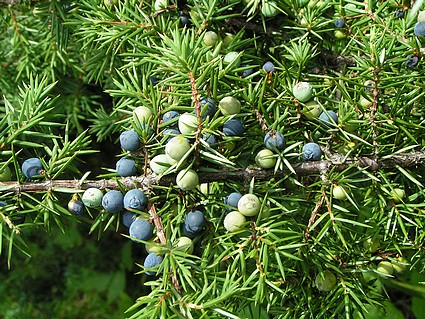
But what of all the other juniper-like trees in my neighborhood? I found some wonderful trees outside the Safeway at John and 15th. They are twisted into marvelous shapes and peppered with the bluish berries that I think of as juniper berries, those berries that give the distinctive flavor to gin. If I felt confident they hadn't been sprayed (I'm not), I could gather them and use them to make schnapps using this recipe from my favorite schnapps website:
http://www.danish-schnapps-recipes.com/juniper.html

My tree book tries to distinguish between the different varieties of junipers, cypresses, cedars and thujas (all members of the Cypress family), all of which have similar foliage, by describing the scent of the leaves when crushed. So now I am wandering around my neighborhood pinching juniper leaves and sniffing them.

Does it smell like turpentine? Then it may be an incense cedar or a Nootka cypress (which will also be harsh to the touch when rubbed the wrong way)
A warm sweet scent like pencils? That would be a Hinoki cedar
A warm gingery scent? White cedar
Scent of old seaweed? Formosan cypress
Lemony? Monterey cypress
Rich scent of thyme and lemons? Gowen cypress
Grapefruit? Smooth Arizona cypress
No distinctive scent? Italian cypress or Mexican cypress
An aroma like new-mown grass? Bhutan cypress
Apples? Common juniper
Paint or kitchen soap? Pencil cedar or drooping juniper (which will also rustle in the hand)
Pineapple? Western red cedar
Rich fruit cake with plenty of almonds and a trace of lemons? Korean thuja
Glorious scent of lemon and eucalyptus? Japanese thuja

And I think I did find one of these, right next to the berry-bearing junipers outside Safeway.
I'm still looking for ones that smell like fruit cake, almonds and lemons. I will continue to do research and let you know what I find out. I am becoming enamored of these prickly plants, especially now that I am paying attention to their scent.

Reference:
Mitchell, Alan, The Trees of Britain and Northern Europe, Collins 1982

Photograph of juniper from the Danish Schnapps web site:
http://www.danish-schnapps-recipes.com/juniper.html

Monday, January 08, 2007

New Year's Power Surges

New Year’s Power Surges

I’m behind on my blog entries. Trying to puzzle out the identity of the various kinds of juniper (cypress?) that appear in many different yards and planting strips in my neighborhood. Meanwhile I thought you would find this anecdote amusing.

For the past several years, on New Year’s Day, I will be sitting at my desk when I hear the sound of bagpipes, and rush to the window to see a procession of kilted bagpipers, drummers and folks waving Welsh, Scottish and Irish flags marching down the street. I think of them as the First-Footers and indeed, they go into various businesses and homes in my neighborhood as a way of bringing good luck for the new year.

This year they went into a neighboring house and while they were inside, a car parked on the street outside caught on fire. It was quite dramatic, with the car alarm going off incessantly and a fire truck arriving and the firemen popping open the hood, to reveal a jolly fire blazing on the engine block. They quickly extinguished the fire (the poor car was later towed away). I didn’t think too much of it, except that in all the excitement, I didn’t wave my Welsh flag out of my window as I had planned when the First-Footers emerged from the house and surrounded the fire truck to play for the firemen.

But a few days later I was in 22 Doors, my favorite local restaurant and bar, and learned that they had been closed for several days because their computer system went down. They were blaming it on a power surge. And it turned out that the power surge coincided with the entry into the establishment of the First Footers. Now I am wondering about that car fire. And it certainly makes me believe in the power of ritual.