Monday, April 16, 2007

Flower Walk in April


After sending out my essay on learning the Names of Plants in my newsletter,
http://www.schooloftheseasons.com/news.html
I got an invitation from my friend Fred (of Frog Hospital)
http://froghospital911.blogspot.com/
to go on a plant walk. He knows a lot about plants from working as a landscaper, which is exactly the sort of expert advice I needed as most of the plants I observe are cultivated, not wild plants.

We wandered around my neighborhood for over an hour today, noticing all the plants that were blooming. He taught me the names of pieris japonica (tiny little white bells) and leatherleaf viburnum (white fragrant flowers on a shrub with dark green leathery leaves) and barberry (bright yellow berries on red thorny branches) and I introduced him to one of my favorites, daphne odora. We also observed the blossoms on the trees: the big leaf maples have white flowers that droop down (I learned that these trees only blossom after they’ve turned 20) and the candles on the horse-chestnuts (white blossoms that point up).

Fred cleared up one of my prevailing scent mysteries. In recent weeks, I’ve frequently been stopped in my tracks by an incredibly strong, slightly musty fragrance, but I can never find the source. Fred pointed out the cherry laurel flowers and I realized that’s the source of the scent. Generally the white spires of the blossoms are at the very top of tall hedges and I just wasn’t looking up. Sort of like my experience with sarcococcus humilis, which is always the first fragrance of spring for me, but in that case, I wasn’t looking down for the tiny white flowers on the undersides of the leaves.

Many of the flowers we saw are ones I associate with May eve (April 30) when I roam through the alleyways picking flowers to bring indoors, including lilacs (just beginning to open their buds), woodruff (ditto), pieris japonica and the flowers on what I call the snowball bush. I now believe that’s another species of viburnum. Everything seems to be blooming earlier than usual here in Seattle.

Illustration: Viburnum opulus (Guelder-rose) from Thome, Flora von Deutschland, Osterreich und der Schwiez 1885 (found at Wikipedia.org)

Saturday, April 07, 2007

Pollen

Yes, it's pollen season. After writing about pussy willow catkins (see my last blog below), I got into my car the following day to find the windshield was covered with green pollen. I had parked beneath a birch tree, which was also decked with catkins. I just find it fascinating that catkins are male flower, since I think of flowers as feminine. (Of course they're not.)

Joanna from Minneapolis sent me a comment on the last blog (which I accidentally deleted) saying that she thought I'd like to read The Tree by Colin Tudge. I just reserved it at my library.

Meanwhile, I'm reading Flower Confidential by Amy Stewart. She mentions pollen in the section on Breeding Flowers: "It wasn't until the late 1600s that botanists begin to speculate that pollen might be the equivalent of sperm, but even that notion had its detractors, including a scientist in the early eighteenth century named Johann Siegesbeck who believe that "sex in flowers was not only scientifically unconvincing but morally revolting as well.""

I'm not sure I believe this statement since I know that the 17th century botanist, Linneaus, based his taxonomy of flowers on their sexual characteristics. He often used terms for human sexuality when referring to plants: they were virgins, eunuchs, husbands. Petals became marriage beds and the flower head of the Calendula was described thus: “where the beds of the married occupy the disk and those of the concubines the circumference, the married females are barren and the concubines fertile.”

If you want a peek at the sex lives of flowers, check out this exhibit at the San Francisco Exploratorium:
http://www.exploratorium.edu/gardening/bloom/secret_life_of_flowers/

Friday, April 06, 2007

Pussy Willows for Easter


I just bought a book of old Easter postcards, and thanks to my new obsession with flowers, I found that I was flipping through the images noticing what flowers were depicted. The stores in my neighborhood are filled with those white lilies which I think of as Easter lilies, but only one of the postcards shows Easter lilies. Two feature tulips, one a hyacinth, one some speedwells (or maybe they’re forget-me-nots) and two display pussy willows.

You can see them most prominently in the one above with the train but I also like the card below with the pussy willows in a basket.

In parts of the world where palms are rare, pussy willows are the branches brought to church on Palm Sunday. And I also just learned about the Polish tradition called Dyngus Day (featured in my calendar http://www.schooloftheseasons.com/april.html): on the Monday after Easter the boys dump water on the girls and whip them with pussy willows. A fertility ritual, especially when one considers how profligate pussy willows are with their pollen. And why.

A few weeks ago on a windy morning, I was walking the dog around the block when a fluffy, yellow-tipped bundle, about the size and shape of a caterpillar, plopped onto the sidewalk at my feet. It made a splat as it sounded. I picked it up and carried it home where it dried into a flattish, cotton ball like lump.

I looked it up in my tree book and realized that these were catkins, that is the male flowers of certain tree families. The yellow color is the pollen which they are trying to spread via the wind. My specimen looked most like the catkins of the goat willow, also known as the pussy willow, so I went back the next morning.

Sure enough, the buds on this particular tree are the soft velvety grey buds I think of as pussy willows. As they develop, they puff up with yellow bristles. These are pollen-covered anthers. I don’t understand the mechanism which makes them drop off the tree (perhaps they want to be blown by the wind into the arms of a female willow). In pussy willows, the sexes are on different trees, so this is a male tree (searching for its mate). Like all wind-pollinated plants (grasses are the same), pussy willows have to produce a lot of pollen to make sure they are spread around enough to find a receptive partner.

Once my specimens had dried, I can still see the little node where the bud once joined the stem. It is fuzzy and fun to pet, and you can see the silky, grey cat-like fur, for which the pussy willow is named, underneath the yellow tips.

The goat willow (salix caprea) is so named because the earliest known engraving of this plant shows a goat eating it. The tree has lots of suckers and the one at the end of the block exemplifies this tendency. It has many sprouts about three to four feet long around its trunk. The bark is a pale grey in color. My tree book says in the open they grow into upright shrubs but on edges they turn into crooked-stemmed trees. Mine is in-between, bigger than a shrub, scrubbier than a tree. The tree book also notes it “springs up rapidly on disturbed soil from seeds blown far with their fluffy coats.” Perhaps the rain in Seattle makes the coats sodden and thus they don’t get quite so far.


Here’s a photograph of the sidewalk in front of the tree, littered with spent catkins. Since I’ve never seen another pussy willow in the neighborhood, I’m not sure the longing of this tree is ever satisfied.

Wednesday, March 21, 2007

Hyacinths for Nawruz


Hyacinths for Nawruz


If, of thy mortal goods, thou art bereft,
And from thy slender store two loaves
alone to thee are left,
Sell one & from the dole,
Buy Hyacinths to feed the soul
Muslihuddin Sadi,
13th Century Persian Poet
When I went to the supermarket today to get supplies for our Nawruz dinner, I bought a pot of three hyacinths. Both the jeweled colors and the intense fragrance remind me of Persian New Year. Hyacinths were one of the chief decorations at the Nawruz concert I attended last year. And the hyacinth (or sonbol) is one of the seven S’s always present on the table at the Nawruz celebration.

My daughter and I were feeling too lazy to prepare a Persian feast so we reverted to our old tradition of eating seven foods that start with S in English: spaghetti, spinach frittata (as close as we got a Persian dish), smoked salmon, strawberries and shortbread with a few new additions: Sauvignon Blanc, Stilton cheese and pomegranate ice cream (sure, it doesn’t start with S but it seemed Persian).

After the meal, I tried drawing the hyacinths. It was difficult as they have so many blooms on a single stem. I tried to count them but gave up. My guess would be 49 flowers a stem (just to continue the theme of 7’s that’s part of Persian New Year).

Hyacinths have their own family: the Hyacinthaceae. The ones I bought at the store are Dutch hyacinths, so named because the Dutch developed over 2,000 varieties of this plant in the 18th century. Hyacinths are native to Turkey and Iran.

There are several myths that tell of the origin of the plant. In one, both Apollo and Zephyrus love a beautiful youth named Hyacinthus, who only returns the love of Apollo. Zephyrus kills him in jealousy and Apollo turns him into a flower. Another Greek myth says the flower was formed by Apollo from the blood of Ajax after he killed himself. Here is a version of the story from a classical Greek text that refers to other sources for Hyacinth myth:
http://www.perseus.tufts.edu/cgi-bin/ptext?doc=Perseus%3Aabo%3Atlg%2C0548%2C001&query=1%3A3%3A3

I got the wonderful quote above from the Persian poet, from my favorite garden writer, Paghat, who has lovely pictures of the hyacinths in her garden and recommendations of how and where to plant them:
http://www.paghat.com/hyacinthwhite.html
According to her, I should be able to plant my potted hyacinths and they will open up and become looser and more natural looking.

Chelsie VandeVeer writes about some of the medicinal uses that the English herbalist, Gerard, ascribed to hyacinths, but warns against trying any of them:
http://www.killerplants.com/herbal-folklore/20020422.asp

Apparently the new Chanel fragrance Chance uses hyacinth along with citron, amber, patchouli and jasmine to produce a sensual fragrance that constantly changes. Based on the glowing reviews of this perfume I read on various perfume web sites, I’m going to have to go find some to try.

Happy Spring Equinox!

Monday, March 19, 2007

Thoreau's Wild Fruits


I was at the University Bookstore today, buying my Ukrainian dyes for my annual Magical Egg Dyeing party, and I found on the bargain book table, a copy of Wild Fruits, by Henry David Thoreau. I remember reading about this book, I think in Michael Pollan's Botany of Desire. It was the last manuscript on which Thoreau worked, and I was amazed to discover that it sprang from the same impulse that drove me, nearly a year ago, to begin my blog, in which I hoped to learn about a plant a day.

It seems that after completing his first two books, A Week on the Concord and Merrimack Rivers, and Walden, Thoreau was casting about for something new to write. He became interested in botany, began gathering plant specimens and keeping a journal of his observations. He sometimes referred to his project as his "Kalendar."

He wrote:
I remember gazing with interest at the swamps . . . and wondering if I could ever attain to such familiarity with plants that I should know the species of every twig and leaf in them . . . Though I knew most of the flowers, and there were not in any particular swamp more than half a dozen shrubs that I did not know, yet these made it seem like a maze to me, of a thousand strange species, and I even thought of commencing at one end and looking at it faithfully and laboriously through till I knew it all.

It was this same sense of moving through green mysteries, as I was walking around my urban neighborhood, that started me on my plant-a-day project, that has become a flower-a-week project.
From what I have seen (I have just skimmed through it), Thoreau's entries are like my blog entries. He mentions a plant, makes a few notes about where he has seen it and on what dates, and fills in with any information he's gleaned about the plant.

Bradley Dean of the Thoreau Institute who wrote the Introduction calls Wild Fruits the final harvest of Thoreau's work, presenting his "sacramental vision of nature--a vision compelling in part because it grew out of an approach to the natural world at once scientific and mystical."

That's the integration I'm searching for in my own work. So I'm excited by the prospect of reading Thoreau's notes and following in his footsteps. I'm still trying to think of a clever title, like Julie and Julia (the blog which became a wonderful book chronicling the adventures of a young woman named Julie cooks every recipe from Julia Child's Art of French Cooking cookbook over one year) to herald this new collaboration between me and Thoreau. If you can think of one, let me know.


Thursday, March 01, 2007

Daffodils for St David's Day


Daffodil

Daffadowndilly has come to town
In a yellow petticoat and a green gown.

It’s March 1, and, as usual in Seattle, the daffodils are in bloom. For the past ten years, I can only recall one year when they weren’t blooming at this time. Lucky for me since I want to wear a daffodil today to show my allegiance to Wales (thanks to my ancestress, Nesta, the mother of the first Fitzgerald, who flourished around 1100).

The daffodil is the national flower of Wales which is why you should wear it on March 1, the feast day of St. David, the patron saint of Wales. Or you can eat a leek on this day and become an honorary Welshman (Cymru as the Welsh would say it). I try to do both.

The David Morgan site in its entry for St David’s Day
http://www.davidmorgan.com/stdavid.html
implies that the daffodil was imposed as a symbol of Wales by the English who wanted to downplay the political implications of the leek (worn by wild Welshmen in battle with the Saxons). Julie Ardery’s article at the wonderful Human Flower Project web site
http://humanflowerproject.com/index.php/weblog/comments/the_leek_and_the_daffodil/
mentions David Lloyd George, the Prime Minister of Britain during World War I, as the person who popularized this custom but he was Welsh himself so it seems more likely he was bringing to the forefront an authentic Welsh custom. The creators of the French Revolutionary calendar must have known of the association of the daffodil with St David’s Day back in 1792 when they designed the calendar and assigned the “narcisse” to this day (the 11th day of Ventose, or Windy).

Daffodil is a common name for a narcissus. It may be derived from the plant name asphodel, known to the Romans. Pliny wrote that it grew on the banks of the Acheron, delighting the spirits of the dead. The Romans planted it on tombs, perhaps because it was said to grow in the Elysian Fields. It was the sight of a daffodil that lured Persephone into the Underworld.

Perhaps it is the way they droop that evokes death. It also gave rise to the myth of the beautiful boy, Narcissus, who fell in love with his own reflection. I will let my favorite garden writer, Paghat, tell you all about the Narcissus myth and the secret rites of Echo practiced during the Eleusinian mysteries
http://www.paghat.com/narcissusmyth1.html

The narcissus common in Greece, Narcissus tazetta, is called Little Tear Drops. In Germany, daffodils are called Osterglocken, Easter bells. They are also called Lent Lilies in England. They are favorite decorations for Easter tables, for Nawruz (Persian new year) celebrations and for Chinese New Year.

Gabi Grieve of the World Kigo database
http://europasaijiki.blogspot.com/2005/04/daffodil-and-narcissus.html
mentions a new holiday in Ireland, Daffodil Day, March 24 which is sponsored by the Irish Cancer Society. Resonating as it does with connotations of both death and hope, the daffodil is used as a symbol by cancer societies around the world.

All daffodils have a central trumpet-shaped corona surrounded by a ring of petals. The traditional color is yellow but hybridizers have bred all sorts of fanciful variations, including daffodils with multiple layers of petals or frilled petals and daffodils with contrasting coronas and petals, or elongated or compressed coronas.

Daffodils come from the Mediterranean but there is one particular daffodil, Narcissus obvallaris, which grows only in a small area around Tenby in Wales. The Narcissus pseudonarcissus is also native to Wales. Julie Ardery writes about the way the winter daffodils bloom in January at Quarrelton in Wales, possibly due to the fires still smoldering beneath the surface in the abandoned tunnels of the mines there:
http://humanflowerproject.com/index.php/weblog/comments/daffodils_for_the_miners/
She also describes how Welsh scientists are cultivating daffodils because they contain galanthamine, which is used in the treatment of Alzheimers.
http://humanflowerproject.com/index.php/weblog/comments/the_mind_of_a_daffodil/

However don’t try this at home. Daffodil bulbs are poisonous. Mrs. Grieve says they are a powerful emetic. Even the flowers are slightly poisonous. However, both bulbs and petals have been used medicinally. The Arabs used an oil of daffodil to cure baldness and as an aphrodisiac.

The oil of Narcissus jonquilla and Narcissus Campernella are used to make a sweet-smelling oil used in perfumes, but Mrs. Grieve warns against being in a closed room as the Narcissus poeticus, or Poet’s Narcissus, as the scent of these daffodils has been known to cause headache and vomiting.

The daffodil is also called the goose leek. In the Isle of Man it is considered unlucky to bring them into the house until the goslings are hatched. In Maine, they say that if you point at a daffodil it will not bloom. And in Wales, if you find the first bloom of the season, you will have more gold than silver this year.

May you find the first bloom of the season.

References:
Wikipedia article:
http://en.wikipedia.org/wiki/Daffodil
Mrs. Grieve’s Modern Herbal:
http://www.botanical.com/botanical/mgmh/n/narcis01.html
Leach, Maria, editor, Funk & Wagnall’s Dictionary of Folklore, Mythology and Legend, Harper & Row 1972

Thursday, February 08, 2007

The Sign of Spring: Snowdrops


Deep sleeps the winter,
Cold, wet, and grey;
Surely all the world is dead;
Spring is far away.
Wait! The world shall waken;
It is not dead, for lo,
The fair maids of February
Stand in the snow!

In my neighborhood, the snowdrops are finally blooming (they're actually a bit late this year). I found a patch outside the Daphne Apartments, down the block from my house. On Saturday, February 3, they were still closed up tight. I took this picture of them.

Two days later, when I picked one on my way to work so I could draw it, they were opening. And the snowdrop I carried in my pocket to a cafe at lunch, was wide open when I drew it. If you have never looked closely at a snowdrop, you should. The inside petals have beautiful green stripes.

The Latin name for the snow drop is Galanthus, which means "milk flower" in Greek. I like the milky connotation for the flower of Candlemas. The species name, Nivalis, is also Greek and means "near the snow line." The snow drop, is also known as perce-neige (French for "piercing the snow"), Candlemas Bells and Mary's Tapers, the latter due to its arrival around Candlemas.

According to Laura Martin, some British churches remove the statue of Mary in early spring and scatter snowdrop blossoms in its place, a pretty conceit that might make a pagan scholar suspect that Mary is here standing in for Kore who emerges from the Underworld as the blossoms of spring.

The association of the snowdrop with Candlemas is quite old. A poem from An Early Calendar of English Flowers begins:

The Snowdrop, in purest white array,
First rears her head on Candlemas day.

In the language of the flowers, the snowdrop represents hope.

In some English counties, it is considered bad luck to bring snow drop blossoms into the house when they first begin to bloom (the same taboo applies to primroses and violets) as the snow drop was seen as a death token.

Sources:
Martin, Laura, Garden Flower Folklore, Globe Pequot Press 1987

Friday, February 02, 2007

The Scent of Spring: Sweet Box


I’ve been looking forward to reviving my Blog and musing about what I would feature as the first flower of spring. I always think of Snowdrops as the flower of Candlemas (Feb 2) but I have not yet seen one this year. The plant which has been bringing me the most joy is the lovely sweet box, also known as Sarcococca hookerana, var. humilis, and sometimes as Sarcococca humilis.

This is the plant that always bring me my first whiff of spring. It happened again this year, as it does every year. I’m walking along and suddenly I'm stopped in my tracks by an incredible fragrance, but I can't find the source.

This happened for several days in a row last week, every time I went out the front door of my workplace, Richard HugoHouse, in Seattle. Finally the third time, I stopped and searched for the source of the scent. Even though I knew about sweet box, I didn’t spot it at first. It’s so unassuming. Just a low-lying shrub with glossy green oval leaves, slightly curled around the edges. The flowers are small and white and grow on the undersides of the stems, as if they were hiding. But the scene is divine, both piercing and elusive.

This link has a great picture of it and a good description of how it grows:
http://www.carrollgardens.com/eNewsletter/2005/03/050303-lib.asp

But as usual my favorite gardener Paghat has the best pictures of both Sarcococca humilis, which she says is also called Christmas box and Himalayan box., and a taller version, Sarcococca ruscifolia:
http://www.paghat.com/saracococca.html
http://www.paghat.com/sarcococcahumilis.html

In fact, looking at her pictures, I suspect the plant at work is S. ruscifolia and not humils. She’s also the only person who provided a translation of the genus name: from Sarco (fruit) and Cocca (berry). It does have lovely berries in the fall which turn red, then shiny dark black.

Most writers describe the scent as vanilla. My boss thought it smelled like lavender. I think it’s closer to jasmine. Intense and sweet. It’s more interesting when you drift through it unexpectedly than if you pick a sprig and sniff it. There’s some kind of important lesson for life there.

As recommended by all the gardening sites I visited, the sweet box outside my work is planted near the entrance, against a wall which shelters it from the southern winds and the southern sun. It's also underneath a larger tree which provides shade.

Apparently sarcococca only grows in Zones 6 through 8, so I’m lucky. I can never remember what Zone I live in but apparently I live in the right Zone. It seems like the perfect flower to announce spring, a small, unassuming plant that hints at the pleasures to come.

The wonderful photograph of sweet box above comes from this web site
http://www.biblio.tu-bs.de/geobot/virt-exkursion/virtex_200603.html
which also features photographs of many other early flowering plants. As far as I can tell (my German is not good), these photographs are of plants blooming in March in a botanical garden in Braunschweig.

May you enjoy the first fragrance of spring where you live.

Wednesday, January 10, 2007

Juniper


I was planning to write about one evergreen every week during the Winter and thought I'd start with the most ubiquitous evergreen in my neighborhood: the juniper.

Every old apartment building and many of the older homes in my neighborhood are surrounded by these scraggly, prickly bushes. Mine is no exception. For years, I plotted with my neighbors to tear them out, but none of us ever had enough nerve to tackle the job. Junipers are painfully prickly and that's what they're good for: protection. Then just a few months ago, the apartment building handyman pruned them back severely and suddenly they look like bonsai (in fact, juniper is the preferred bonsai plant). They're actually quite beautiful.

So now that I've come to appreciate them, I wanted to be able to identify them. And here, I ran into trouble again. All junipers are members of the Cypress family. They are all evergreens with scale-like leaves. In fact, if you look at a juniper branch closely, you will see that it seems very primitive, like the horsetail, with its overlapping scales.

According to Wikipedia, which has some wonderful photographs of junipers,
http://en.wikipedia.org/wiki/Juniper
there are between 50 and 67 varieties of junipers. The ones in front of my apartment
building are probably Chinese junipers, which seem to have been the favorite hedge plants many years ago. I know my father planted some around my childhood home in the Fifties, but the ones in my neighborhood are mostly in front of buildings that go back to 1905 and 1910, so who knows how old they are?

Chinese junipers have juvenile shoots that are spiky and as sharp as needles. The mature shoots have rounded tips, and some of the ones in my neighborhood are showing hints of yellow male flowers at the tips. Winter is when they typically flower; they throw their pollen in spring. My tree identification book says that Chinese junipers have a sour, resinous, catty scent. Another reason for my positive identification. I took some snippets of juniper to work with me and when I opened the envelope in which I had placed them, the scent was distinctly catbox.

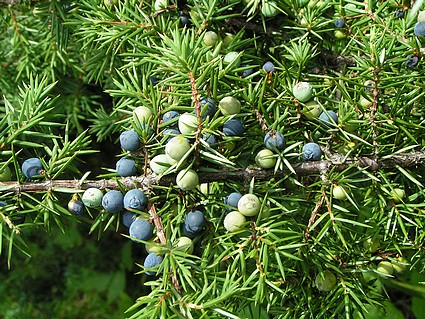
But what of all the other juniper-like trees in my neighborhood? I found some wonderful trees outside the Safeway at John and 15th. They are twisted into marvelous shapes and peppered with the bluish berries that I think of as juniper berries, those berries that give the distinctive flavor to gin. If I felt confident they hadn't been sprayed (I'm not), I could gather them and use them to make schnapps using this recipe from my favorite schnapps website:
http://www.danish-schnapps-recipes.com/juniper.html

My tree book tries to distinguish between the different varieties of junipers, cypresses, cedars and thujas (all members of the Cypress family), all of which have similar foliage, by describing the scent of the leaves when crushed. So now I am wandering around my neighborhood pinching juniper leaves and sniffing them.

Does it smell like turpentine? Then it may be an incense cedar or a Nootka cypress (which will also be harsh to the touch when rubbed the wrong way)
A warm sweet scent like pencils? That would be a Hinoki cedar
A warm gingery scent? White cedar
Scent of old seaweed? Formosan cypress
Lemony? Monterey cypress
Rich scent of thyme and lemons? Gowen cypress
Grapefruit? Smooth Arizona cypress
No distinctive scent? Italian cypress or Mexican cypress
An aroma like new-mown grass? Bhutan cypress
Apples? Common juniper
Paint or kitchen soap? Pencil cedar or drooping juniper (which will also rustle in the hand)
Pineapple? Western red cedar
Rich fruit cake with plenty of almonds and a trace of lemons? Korean thuja
Glorious scent of lemon and eucalyptus? Japanese thuja

And I think I did find one of these, right next to the berry-bearing junipers outside Safeway.
I'm still looking for ones that smell like fruit cake, almonds and lemons. I will continue to do research and let you know what I find out. I am becoming enamored of these prickly plants, especially now that I am paying attention to their scent.

Reference:
Mitchell, Alan, The Trees of Britain and Northern Europe, Collins 1982

Photograph of juniper from the Danish Schnapps web site:
http://www.danish-schnapps-recipes.com/juniper.html

Monday, January 08, 2007

New Year's Power Surges

New Year’s Power Surges

I’m behind on my blog entries. Trying to puzzle out the identity of the various kinds of juniper (cypress?) that appear in many different yards and planting strips in my neighborhood. Meanwhile I thought you would find this anecdote amusing.

For the past several years, on New Year’s Day, I will be sitting at my desk when I hear the sound of bagpipes, and rush to the window to see a procession of kilted bagpipers, drummers and folks waving Welsh, Scottish and Irish flags marching down the street. I think of them as the First-Footers and indeed, they go into various businesses and homes in my neighborhood as a way of bringing good luck for the new year.

This year they went into a neighboring house and while they were inside, a car parked on the street outside caught on fire. It was quite dramatic, with the car alarm going off incessantly and a fire truck arriving and the firemen popping open the hood, to reveal a jolly fire blazing on the engine block. They quickly extinguished the fire (the poor car was later towed away). I didn’t think too much of it, except that in all the excitement, I didn’t wave my Welsh flag out of my window as I had planned when the First-Footers emerged from the house and surrounded the fire truck to play for the firemen.

But a few days later I was in 22 Doors, my favorite local restaurant and bar, and learned that they had been closed for several days because their computer system went down. They were blaming it on a power surge. And it turned out that the power surge coincided with the entry into the establishment of the First Footers. Now I am wondering about that car fire. And it certainly makes me believe in the power of ritual.

Saturday, December 30, 2006

Yew, Tree of Winter Solstice


Yew

The yew is a tree with rough bark,
hard and fast in the earth, supported by its roots,
a guardian of flame and a joy upon an estate.

Anglo Saxon rune poem
From Wikipedia article on the rune Eihwaz
http://en.wikipedia.org/wiki/Eihwaz


I chose to write about the yew for Winter Solstice, standing as it does between the six weeks which I am calling the tide of the berries (Halloween to Yule) and the six weeks of evergreens (Yule to Candlemas), since the yew has both berries and evergreen foliage (although the berries are actually fruit and the yew is not a true conifer). It is a sacred tree, featured over centuries and cultures, in myth and folklore, and symbolizing both death and rebirth, thus resonating with the message of the Winter Solstice when in the midst of darkness the Sun is born again.

There is a great yew hedge over 14 feet high between two houses down the street from my apartment building on Capitol Hill. A few weeks ago it was dotted with red fruit and made the perfect Christmas statement. The fruit of the yew is called an aril. They look like soft, squashy red gumdrops with a hole in one end. Although many people believe they are poisonous (the foliage and bark of the yew are), the berries are edible, although the hard seed inside is not. Birds love the fruit and that’s how the yew is distributed, as the seed passes through their digestive tracts intact.

There’s a lively discussion about whether it’s safe to eat the arils on the Plants for a Future site but it seems that as long as you don’t eat the seed, you should be OK. The tastes is described as sweet, possibly sickly, and the texture as snotty (not totally appealing, is it?).
http://www.pfaf.org/database/plants.php?Taxus+baccata

Nevertheless, I had gotten up my nerve to try one and visited the yew hedge yesterday. Imagine my surprise when I discovered that every fruit was gone. I even peered inside the hedge to see if I could find one that had been protected, but they were all gone, except for a few dusty ones scattered on the ground underneath the yew. Either the birds or the high winds had beaten me to it.

The other yew in my neighborhood was in front of my apartment building, making an interesting trinity with a hawthorn and a holly (in my neighborhood, hollies are often planted beside hawthorns and I wonder why). At some point, someone cut down the yew but yews are hard to kill. It is now putting out many small branches, forming a low hedge all around the trunks of the other trees. I don’t recall ever seeing fruit on this yew, so it must be a male tree.

While I was researching for this article, I found so much information on yews, that I can’t possibly summarize it. In fact, there is a whole book on yews: The Sacred Yew by Anand Cheton and Diana Brueton which I was able to get out of my public library. It focuses on the work of Allen Meredith, who, spurred on by dreams, made it his life work to learn about and protect the ancient yews of England. Another big fan of yews, is one of my favorite tree writers, Fred Hageneder, who founded a society, Friends of the Trees, to save endangered yews in England. It seems to be that kind of tree.

Yews are members of the genus Taxus, which contains only eight species. It grows in temperate climates as far south as Sumatra and Central America. The common yew is Taxus baccata. Baccata means berry. Taxus comes from the Greek word for arrow, a word that also is the root of poison. There’s some speculation that arrows were poisoned and thus the connection but it seems just as likely to me that it refers to the toxicity of the plant itself. The leaves are so poisonous that eating as little as 50-100 grams of chopped leaves would be fatal to an adult. I found a website about poisonous plants and horses that mentioned that yew was so toxic that horses were frequently found dead with yew leaves still in their mouths.

The name yew itself has an interesting history that goes back to the Germanic iwe (iwa) which is related to ihhe, the word for first person singular. In Anglo Saxon ih means both I and the yew triee. Iwe is also related to ewi which means eternal. The 13th rune in the old Norse rune alphabet, the old futhark, is called ihwa or eiwaz meaning yew and it represents death and rebirth. There is also a rune, yr, associated with the yew in the younger Scandinavian rune set. It looks like the old Stone Age symbol for the Tree of Life and as a result, some scholars believe that Yggradasil, the tree on which Odin hung himself for four days and nights, before bringing back the runes, was a yew tree. His spear was made from a branch of the tree.

The needles of a yew tree are about ½ to 1 inch long, flat, dark green above and pale green below. The tree flowers in spring (mid-February to mid-March) and both male and female trees flower. Gilbert White complained about the ancient yew in the churchyard of his parish at Selborne in 1789 which had the habit of throwing out pollen in April (as male yews will) all over his parishioners.

The yew has an interesting growth pattern. It grows very slowly, at about half the rate of other trees, and thus lives a long time. The interior of the trunk often crumbles so the trunk becomes hollow. Thomas Pakenham, who photographed many beautiful old yews in his marvelous book, Meetings with Remarkable Trees, describes the hollow interior of the old yew at Crowhurst thus: “New wood in an old yew tree accumulates like coral. The old room now resembles a cave flowing with pink fretted rock.” Sometimes an aerial root grows down inside the hollow trunk and becomes a new trunk, thus the imagery of life in death. Yews also grow outward because branches sprout new roots when they hit the ground, thus creating tangles of branches and trunks.

There is much dispute about the age of yews since they cannot be dated like other trees (by counting rings because the oldest wood, in the interior of the tree, is missing). Instead scientists study records showing the girth of the tree at various historical periods and estimate the age by noting the slow rate of growth. Estimates range from 1,500 to 2,000 years old. This poem provides a glimpse of their great age:

The lives of three wattles, the life of a hound;
The lives of three hounds, the life of a steed;
The lives of three steeds, the life of a man;
The lives of three eagles, the life of a yew;
The life of a yew, the length of an age;
Seven ages from Creation to Doom.
Nennius, Seven Ages

Yew wood is fine-grained, water resistant and so hard it’s sometimes called ironwood. Thus the oldest wood artifact found is a yew spear, found at Clacton in Essex, which dates from 250,000 BC. To give you an idea of how long ago that was, a younger yew spear (from 200,000 BC) was found in lower Saxony lodged between the ribs of a straight-tusked elephant. The oldest musical instruments that have survived are made of yew, as are most of the runic talismans. According to Hageneder, when the wood foundations of buildings in Venice were replaced in the 1950’s the yew beams were still in such good shape they were sold for timber.

Yew was the favorite wood for making bows. Two yew bows were found in the Somerset Levels that date to about 2700 BC. A yew longbow was found with the Neolithic corpse, known as the Iceman, found on the Italian-Austrian border. His bow was 6 feet long, although he was only 5 feet, 2 inches tall. This bow may be even older, possibly dating back to 3,500 BC.

The yew longbow became famous in the 13th and 16th centuries when Welsh archers using yew bows won battles for the English against the Scots, and later the French. The bows were designed with the heartwood on the inside and the sapwood on the outside, so that the heartwood stands up to the compression while the sapwood allows the bow to stretch. During this time period, the English so depleted their own yew stands that they began importing yew, first from Spain, then from the Hanseatic towns of the North and Baltic Seas.

Yews have featured in history for centuries. Robert Graves says that the yew is a death tree, sacred to Hecate in Greece and Italy. When black bulls were sacrificed to Hecate, so ghosts could lap their blood, they were wreathed with yew.

Several Celtic tribes named themselves after the yew tree, including the Eurobones and Eburovices in Gaul. Possibly yew is the source of the word Iberia as in Iberian peninsula. Simon mentions a deity named Eburianus in the Iberian peninsula whose name, noted on a tombstone, derived from the same root as yew. There was a tribe of Celts called the Eburoni (the Yew People) in Portugal. Caesar in the Gallic wars wrote that the chief of the Eburones poisoned himself with yew rather than submit to Rome. It’s possible yew-worshipping Celts were the first invaders of Ireland and named it after the tree as Ierne, Yew Island.

The Yew of Ross is one of the Five Magical Trees of Ireland. Its qualities are described in the Rennes Dindshenchas:

Tree of Ross, a king’s wheel, a prince’s right, a wave’s noise, best of creatures, a straight firm tree, a firm strong god, door of heaven, strength of a building, the good of a crew, a word pure man, full great bounty, the Trinity’s mighty one, a measure’s house, a mother’s good, Mary’s son, a fruitful sea, beauty’s honor, a mind’s lord, diadem of angels, shout of the world, Banba’s renown, might of victory, judgement of origin, judicial doom, faggot of sages, noblest of trees, glory of Leinster, dearest of bushes, a bear’s defence, vigour of life, spell of knowledge, Tree of Ross!

Giraldus Cambrensis, the medieval historian (and my distant relative) noted the ubiquity of yew trees in Ireland in the 1100’s: “Yews are more frequently to be found in this country than in any other I have visited but you will find them principally in old cemeteries and sacred places, where they were planted in ancient times by the hands of holy men, to give them what ornament and beauty they could.”

Chetan and Brueton in their book, The Sacred Yew, hypothesize that yews were planted in neolithic times on sacred sites and on top of barrow graves as symbols of death and life. Early Christian missionaries recognized the sacred nature of the trees and built their churches near them. Monks and hermits were also said to live in the hollows of yew trees, again a recognition that yews marked sacred sites. In tenth-century Wales, the penalty for cutting down a consecrated yew (does that mean a yew growing in a churchyard?) was one pound, more than most people earned in a lifetime.

Yews are often found in growing in churchyards and cemeteries. Some ancient Welsh churches were ringed by circles of yews. After the Norman Conquest, cemeteries were more likely to be rectangular and marked with a yew in each of the four corners. Chetan and Brueton note that the oldest yews were usually male trees planted on the north side of churches. The north was considered the direction of death.

Yews were used in place of palms on Palm Sunday in Britain. Some folklore suggests that it is dangerous to bring yew into the house (it will bring death into the family) but it is also mentioned as an appropriate foliage for winter holiday decorations.

The association with yews and death is a strong one. Shakespeare called the tree the double fatal yew and made Hamlet’s uncle poison the king by pouring its juice (hebenon) into his ear. The 19th century English poets loved to use yews as symbols of melancholy and gloom, as in this poem, “Yew Trees,” by Wordsworth:

There is a yew, the pride of Lorton’s vale,
Which to this day stands single in the midst
Of its own darkness as it stood of yore …
Of vast circumference and gloom profound
This solitary tree! – a living thing
Produced too slowly ever to decay;
Of form and aspect too magnificent
To be destroyed.

Or in this reference in Keats’ “Ode on Melancholy,”

Make not your rosary of yew-berries,
Nor let the bettle, nor the death moth be
Your mournful Psyche, nor the downy owl
A partner in your sorrow’s mysteries.

Speaking of owls and yew trees, the Pacific yew is the habitat of the northern spotted owl, that little bird seen as the bane of loggers since logging was forbidden in areas where this endangered creature lived. Later it was discovered that the bark of the Pacific yew was a good source for taxol, a compound proved effective in combating cancer. The Pacific yews became as endangered as the owls until scientists learned they could synthesize the compound from the leaves. .

In Japan the yew tree (taxus cuspidate) is connected with the creator gods who live on mountain tops and is called ichii, the Tree of God. In the country of Georgia, the yew is called the Tree of Life.

References:
Chetan, Anand and Diana Brueton, The Sacred Yew, Penguin/Arkana 1994
Graves, Robert, The White Goddess
Pakenham, Thomas, Meetings with Remarkable Trees, Random House
Hageneder, Fred, The Meaning of Trees, Chronicle 2005
Fred’s website
http://www.spirit-of-trees.net/
Murray, Colin and Liz, Celtic Tree Oracle,
Simon, Francisco Marco, “According to Religion and Religious Practices of the Ancient Celts of the Iberian Peninsula,”
http://www.uwm.edu/Dept/celtic/ekeltoi/volumes/vol6/6_6/marco_simon_6_6.html
Wikipedia article on yew:
http://en.wikipedia.org/wiki/Taxus_baccata

Photograph of a Yew from the Ancient Yew Group which includes among its members Fred Hageneder
http://www.ancient-yew.org/home.shtml

Thursday, December 21, 2006

Hallowtide Berries

I'm reviving my blog after its long hibernation while I participated in National Novel Writing month for the fifth year in a row. I've never yet completed the 50,000 words (I got closest the first year when I wrote 45,000) but I did write 25,000 words and ended up with a detailed plot outline for my detective novel.

Meanwhile I've been thinking about a new structure for the blog. Although I love the idea of focusing on a plant each day, it's too much for me. I end up doing some rather superficial research and just dump a whole lot of raw writing onto the page. It's often days after I write about a plant before I find a representative or get a chance to try it out in a recipe.

So I've decided to feature a plant a week, rather than a plant a day. I'm partly inspired by noticing that Susun Weed has a new correspondence course featuring 52 herbs. Here's the link if you want to check it out:
http://www.susunweed.com/Correspondence-Course-ABC.htm

I started thinking about what plants I wanted to feature and realized I could choose whole categories of plants based on seasonality. Lately I've been really noticing and appreciating the berries in my neighborhood and I decided that's a good focus for Hallowtide, the six weeks between Halloween and Yule.

But I've been having a hard time finding sources to help me identify the berries in my neighborhood. The only site that listed some berries native to the Northwest was the poison center for the local Children's Hospital. As I was reading this list, I thought about the paper I wrote in eighth grade on poisonous plants (I learned the word alkaloid while writing that paper) and wondered what the nuns made of that. Did they wonder what deeds I might be planning?Or just recognize a nascent witch?

The berries that speak of the season most vividly to me are Snowberries or Doll's Eyes. I always think of them when I plan my Winter Solstice party as I first saw them in a vase at the Lucia Party given by my mentor and friend, Helen Farias. For years I've been finding them in my neighborhood, down the block, under a tree beside an old mansion but last year they dug up those plants to install a stone wall. This year, I found them growing alongside the parking lot of the Greek Orthodox church in my neighborhood.

For a great photograph and description of snowberries, I'm going to refer you to my favorite garden writer on the web, Paghat:
http://www.paghat.com/berries5.html

During the six weeks between Winter Solstice and Candlemas, I'm going to feature evergreens, one a week, starting with the yew tree which has berries and is evergreen.

Wednesday, October 04, 2006

Barbary Squash

I was fascinated to see the pumpkin show up twice in the French Republican calendar during the month of October: once for Vendemiaire 13 (October 4 to us) under the name potiron, and again on Vendemiaire 17 (Oct 8) under the name citrouille.

According to one website I found,
http://www.theworldwidegourmet.com/vegetables/squash/pumpkin.htm
the potiron is Cucurbita moschata or the European pumpkin, which is described as having a tender, springy cylindrical stem, flared at the joining and orange-yellow or green flesh, while the Citrouille is Cucurbita pepo, the familiar Halloween pumpkin, with a hard smooth orange skin, dry, sweet yellow-orange flesh and a hard fibrous, five-sided stem and no bulge at the joining.

This website
http://www.pumpkinnook.com/howto/variety.htm
which has a really annoying moving pop-up, says that Cucurbita moschata is an oblong pumpkin with a tan skin and is mostly used for canned pumpkin.

But when I type in Cucurbita moschata into Google Image search I get lots of different kinds of squashes, including what I consider butternut squash. Here’s a Danish (?) web site with pictures of many different varieties of Cucurbita:
http://www.bennyskaktus.dk/Pumpkin-pictures_DK_01.htm
According to the pictures at Louie’s Pumpkin Patch, the genus Cucurbita moschata includes butternut and many other types of squashes including a green one called Musque de Provence. I just love that name.

There are also many great pictures of Cucurbita moschata at this web sit:
http://www.worldcrops.org/crops/Calabaza.cfm
at which they are called Calabaza.

All pumpkins are members of the Cucurbitaceae family which also includes cucumbers, zucchini, squash and gourds. DeWit says that pumpkins (Cucurbita pepo) were unknown in Europe until the sixteenth century and that they originated in southwestern North America. Europeans took the plant seeds back home along with seeds for Cucurbita maxima (autumn and winter squash) and the “mushy” Cucurbita moschata which he calls Barbary squash.

There’s a great entry on pumpkins in Plants for a Future:
http://www.pfaf.org/database/plants.php?Cucurbita+pepo
They mention medicinal uses of pumpkin seeds by Native Americans who used a flour made of ground seeds to expel tapeworms. The seeds are also high in zinc.

Of course, pumpkin is best known for making delicious food. I found some links for recipes calling for Potiron at the French food section of About.com
Be warned: this is one of those web sites with nasty pop-ups.
http://frenchfood.about.com/library/weekly/aa111102a.htm

deWit, H.C. D., Plants of the World, The Higher Plants I, Dutton 1966

Wednesday, September 27, 2006

Maskal Daisies/Coreopsis


According to my holiday calendar,

http://www.schooloftheseasons.com/sept.html

in Ethiopia people celebrate Holy Cross on September 27 by building huge structures of logs, set up like teepees, decorated with yellow Maskal daisies and burnt at night. I found one web site which also refers to this festival and mentions the daisies:
http://my.ort.org.il/givatram/etiopia/TRGIL7.HTML

But what are they? A quick Google search produces only one reference to maskal daisies in a scientific paper called “Medicine in Ethiopia” by C. S. Leithead in which he says they are Coreopsis boraniana. I’ve not been able to find this species mentioned in any of the articles on Coreopsis but it seems likely that the daisies are Coreopsis which likes to grow in hot, dry climates and blooms through November, even in the soggy Northwest. The one thing that makes me wonder if this is the same plant is that most of my references say that Coreopsis is native to North America.

The name Coreopsis comes from the Greek word koris which means Bedbug because the seeds look like small black bugs. It’s also called Tickseed for the same reason. But the flowers look like cheerful yellow daisies, with toothed petals, and they are members of the Aster family. They are sometimes also called Calliopsis, according to Wikipedia.
http://en.wikipedia.org/wiki/Tickseed
Askwith says that Calliopsis is the name for the annual form while Coreopsis applies to the perennial version of this plant.

Paghat, as usual, has some lovely photographs of Coreopsis growing in her Northwest garden and useful accounts of how it grows
http://www.paghat.com/coreopsis.html

Chelsie VandaVeer has written a poetic description of Coreopsis which is illustrated with a lovely photograph of the flowers of Coreopsis leavenworthii which grows in damp places in Florida::
http://www.killerplants.com/plant-of-the-week/20011001.asp
Her description of coming upon a field of golden Coreopsis echoes the description about the Ethiopian festival when “the meadows are yellow with the brilliant Maskal daisy.”

References:
Askwith, Herbert, editor, The Complete Guide to Garden Flowers: An Encyclopedia of Garden Planning, A.S. Barnes and Company 1961
Levine, Donald, Wax and Gold: Tradition and Innovation in Ethiopian Culture, University of Chicago Press, 1965, p. 62
Perl, Lilia, Ethiopia: Land of the Lion, William Morrow 1972, pp.72-3

Photograph:
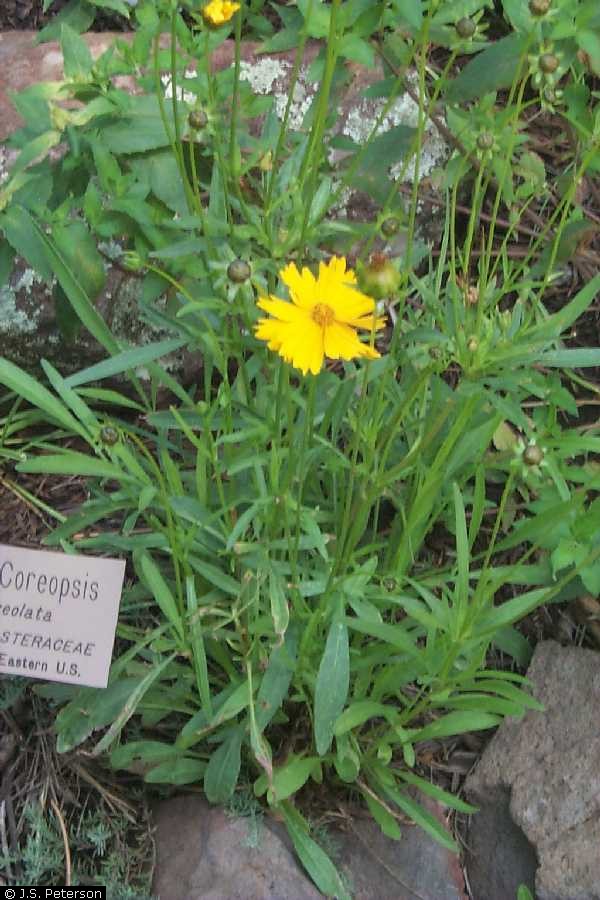
Coreopsis lanceolata from J.S. Peterson @ USDA-NRCS PLANTS Database

Tuesday, September 26, 2006

Dock


Since this is a day in the French Republican calendar that ends in a 5, the 5th of Vendimiare to be exact, there is an animal rather than a plant for today: the horse.

So I’m going to take my plant of the day from Flora’s Dial which lists the Dock as the flower for September 26. This seems appropriate as the dock in my neighborhood has reached a glorious stage of rusty redness. In my neighborhood, it grows in vacant lots and untended parkways and is considered a weed. But the roots have been used in medicine and the leaves consumed for centuries.

Dock is the common name for a plant (Rumex) in the Buckwheat family., which also contains buckwheat, sorrel and rhubarb. The name Rumex comes from the Latin for “to suck,” because the leaves of the plant were eaten to relieve thirst, according to Silverman. Mrs. Grieve says the plants were originally members of the Lapathum genus, from the Greek word meaning to cleanse. The name dock comes from the Anglo-Saxon docce.
Look at the Wikipedia article on dock for a staggering list of varieties:
http://en.wikipedia.org/wiki/Rumex

Docks generally grow three to four feet tall. Flowers bloom on spikes at least twelve inches tall from June through September in the eastern United States, according to Silverman. These spikes become rusty brown in the autumn. Silverman recommends looking at the flowers and seeds of Dock through a magnifying glass. She writes: “Each tiny flower dangles on a short stalk as thin and fragile as a thread. As the seed develops, the calyx, resembling a frilly miniature bonnet, encloses the seed much as an old-fashioned bonnet enclosed a person’s head.”

Paghat in one of her wonderful garden articles describes the conditions under which she grows Bloody Dock in the Northwest:
http://www.paghat.com/rumex.html
Paghat also grows Western Dock (Rumex occidentalis)::
http://www.paghat.com/westerndock.html

Eating Dock
Round-Leaved Dock (Rumex obtusifolius) was sometimes called Butter Dock because the broad leaves were used to wrap butter. Dock leaves have a sour or lemony flavor because of the presence of oxalic acid. Paghat uses the young leaves like chard or spinach. Silverman quotes Julia Morton in saying that dock is a favorite pot herb in the Southern United States, preferred over collard and turnip greens.Because oxalic acide can interfere with the absorption of minerals, it should not be eaten in large quantities or by people with rheumatism, arthritis, gout or kidney stones.

The oxalic acid is neutralized when cooked. Paghat recommends frying dock leaves in oil with dandelion leaves. The stems can be used as a substitute for rhubarb (to which it is closely related) and the seeds can be ground like buckwheat and used to make flour.

Healing with Dock
Perhaps because of the reddish color of the stems (and the veins in the leaves of Bloody Dock), dock was recommended for treating blood diseases and jaundice.

According to Paghat, Native Americans used Western Dock to treat rheumatism by steaming with it in a sweat lodge. Roots and leaves were roasted and mashed then applied as a poultice to treat wounds and sores. According to Silverman, the Pennsylvania Dutch made a tea from the root and drank it as a tonic and to treat liver problems. Dock was also an ingredient in a tenth-century Anglo-Saxon recipe for treating people afflicted with Elf Disease.

Dock leaves are often been recommended as a great way to relieve the sting of nettles, and fortunately, they often grow near each other. There is a little rhyme to say when applying it a nettle sting:
Nettle in, Dock out,
Dock in, Nettle out
Nettle in, Dock out,
Dock rub Nettle out

Chelsie Vandaveer in her article, “What was Green Sauce?” describes a herbal remedy, recommended by Gerard, the Elizabethan herbalist, made from dock or sorrel, vinegar and sugar, and used to soothe the stomach, quench thirst and cool a fever.
http://www.killerplants.com/herbal-folklore/20030602.asp

Mrs. Grieve says that Rumex Crispus (so named for the curliness of its leaves) is the one most often used medicinally.
http://botanical.com/botanical/mgmh/d/docks-15.html
The leaves should be dug up in spring. She suggests making a syrup by boiling ½ pound of crushed root in a pint of syrup and then taking this by the teaspoon. Alternatively, you can make an infusion by pouring boiling water over 1 ounce of the powdered root and taking this by the wineglassful. She also recommends a homeopathic remedy, made of the plant before it flowers, which is effective in treating tickling coughs. Michael Moore uses dock to treat sluggish digestion or constipation.

Other Uses:
The seedheads are attractive in dried flower arrangements and a yellow-gold to tan dye can be made from the roots. Silverman recommends leaving the seedheads on the plant as food for the birds during the winter (they do look like those long spikes of millet you buy in the store, except these are rusty red).

Plants of the Future has articles specific to many different varieties of dock:
http://www.pfaf.org/database/plants.php?Rumex+occidentalis

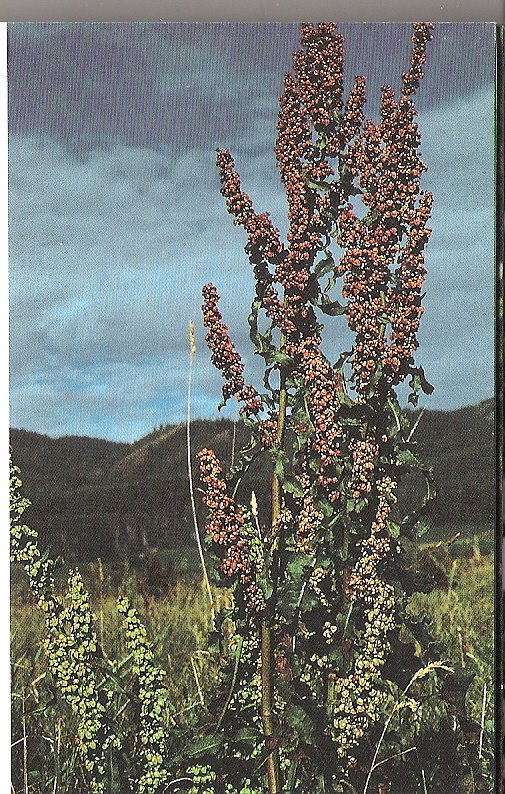
The great photograph of Rumex Crispus under a stormy Northwest sky was taken by Ronald Taylor for his book, Northwest Weeds.

References:
deWit, H.C. D., Plants of the World, The Higher Plants I, Dutton 1966
Moore, Michael, Medicinal Plants of the Pacific West, Red Crane Books 1993
Silverman, Maida, A City Herbal: Lore, Legend and Uses of Common Weeds, Ash Tree Publishing 1997
Taylor, Ronald J., Northwest Weeds, Mountain Press Publishing Company 1990

Monday, September 25, 2006

Autumn Crocus


The plant of the day for Vendemiaire 4 in the French Republican calendar is the autumn crocus or colchique. This is a plant I mentioned briefly in my article on naked ladies (amaryllis belladonna) in honor of my birthday on September 4.

The autumn crocus (colchicum autumnale) is also sometimes known as a naked lady because it has the same quality as the amaryllis belladonna of arising from the ground without any leaves. And although the amaryllis belladonna blooms on my birthday in Southern California where I was born (Burbank, to be exact), the autumn crocus blooms on my birthday here in Seattle where I live now. The autumn crocus is also known as meadow saffron and colchicum.

I really wouldn’t have known much about this plant, as it is not mentioned in any of my garden books, except that I did quite a bit of research (which I didn’t post) a few days ago on saffron which was the plant of the day for Vendemiaire 2. The saffron crocus (crocus sativa) is a member of the Iris family while the autumn crocus is a member of the Lily family. They look alike and bloom at the same time but the saffron crocus is highly valued as a spice while the autumn crocus is deadly.

The two websites I recommend for information on saffron, Gernot Katzer’s spice web site:
http://www.uni-graz.at/~katzer/engl/Croc_sat.html
and Paghat’s article on the many myths that swirl around the saffron crocus:
http://www.paghat.com/saffronmyth.html
both briefly mention the autumn crocus.

The autumn crocus grows from corms and puts forth long slender green leaves in the spring that can be mistaken for wild onions or garlic (which can be a fatal mistake—see below). It produces its fruit, a green pod in the center of the leaves, in spring. It blooms in autumn, coming directly out of the ground without any leaves. The flowers are pink and fragile, almost ghostly on their long tubular stems. Paghat in her interesting article suggests that the crocus was associated with Persephone and that they might mark the spot where she descended into the Underworld in fall just as they mark her emergence in spring. Chelsie VandaVeer in her article “What Plant was Named for the Homeland of a Sorceress,”
http://www.killerplants.com/whats-in-a-name/20020111.asp
says the autumn crocus was once called “mysteria,” possibly because they were used in the Eleusinian Mysteries. It’s hard to know if the flower she describes is the saffron crocus or the autumn crocus.

The genus name, colchicum, was given to it by Linneaus after Colchis, an ancient region on the Black Sea, south of the Caucausus Mountains. Jason of Greek legend went there looking for the Golden Fleece and met up with Medea, a famous sorceress and poisoner. She made an ointment for him to rub on his limbs, shield and spear which enabled him yoke two fire-breathing bulls. The autumn crocus was said to have sprung up from the blood of the crucified Prometheus.

The plant is highly toxic, with an effect similar to arsenic poisoning according to this website:
http://biotech.icmb.utexas.edu/botany/acrohst.html
This case study describes the death of an older man who ate autumn crocus believing it to be wild garlic and died three days later:
http://ccforum.com/content/8/1/R56

Yet the active alkaloid, colchicine, has been used to treat gout, and also as an anti-cancer treatment. Chelsie VandaVeer has an article, “What ancient medical treatment is still being used today?” explaining how this works:
http://www.killerplants.com/plants-that-changed-history/20020108.asp

Wikipedia has a very short article on the autumn crocus
http://en.wikipedia.org/wiki/Autumn_crocus

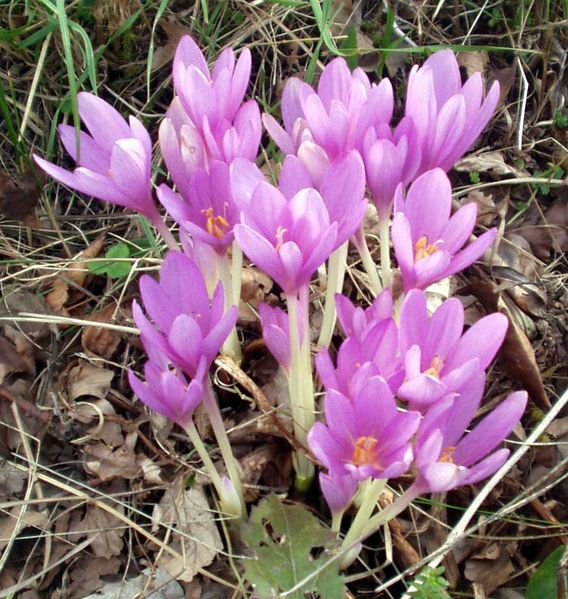
The glorious photograph comes from Wikipedia.

Saturday, September 23, 2006

Grape


The start of autumn equinox and the start of the month of Vendemiaire (the harvest) in the French Republican Calendar rightfully features the grape.

I grew up under a grapevine. When my parents moved into their new ranch house in Van Nuys, California, they had only a square concrete patio outside the brand new picture window of the living room. I was born about nine months later and pretty soon after that my father built a trellis over the patio and planted a grape vine. When I was young, I remember sitting under that leafy green shade; I also remember the purple stains the grapes made when they dropped on the patio. My mother probably protested about this and eventually the grapevine disappeared to be replaced by that corrugated green plastic which was so popular then.

I don’t remember that we ever made anything out of the grapes we grew but my Uncle Bob, in his back yard in Temple City, grew many plants which he made into wine. Whether this was just natural thriftiness (no plant shall go unused) or a fondness for fermented beverages, I’m not sure, but I suspect the former as Uncle Bob was Swiss (almost as thrifty as the Scotch) and the wine was not so attractive that one could guzzle it (I remember finding it quite repulsive as a child when offered a sip at Thanksgiving or Christmas dinner).

Still I believe I was at born at the tail end of these two trends: the growing of grapevines in home gardens (I’ve only seen two in the years since then—one is at my P-Patch garden but it’s purely decorative) and home wine-making. In the intervening years, the growing of grape vines and the making of wine have become big business.

In the past few years I got interested in wine and began studying it pretty seriously. It was my last passion before this new obsession with plants. I found many wine writers whose writing I admire, particularly Jay McInerney whose columns on wine for House and Garden are collected in a wonderful book of essays, Bacchus and Me, Jancis Robinson, one of the first female wine writers, and a true poet of wine, Terry Theise, who writes about German wines, mostly Reislings--his lyrical writing is available on the web at:
http://www.skurnikwines.com/msw/terry_theise.html

I’ve also attended many wine tastings and classes (I just love the vocabulary and ritual of wine) and read many books about the wine-making process. My favorites include A Cultivated Life by Joy Sterling about her family’s winery, and A Very Good Year by Mike Weiss, a journalist’s (somewhat cynical) view of the process by which a Las Vegas casino owner creates his own winery and a wine designed to win accolades.

But not until last year did it really sink in that wine is made from grapes. I was at my local Whole Foods and noticed a grape variety that I knew only as a wine varietal—I think it was probably Muscat of Alexandria. I took one bite and was amazed to recognize the flavor. The journey from grape to wine is such a complex and interesting one. I don’t believe there is any fruit that is so cosseted, processed, praised and transformed as the grape. And, of course, there is the magic of it all--the transformation mystery of harvest.

Here’s a web site that lists all the varieties of grapes used in making wine and shows pictures of most of them:
http://www.cookeryonline.com/mealexperience/Grapes/Index.htm

Wikipedia
http://en.wikipedia.org/wiki/Grape
(citing the Food and Agriculture Organization) reports that 71% of all grapes grown in the world are used to make wine. 27% are eaten as fresh fruit and 2% as dried fruit—raisin is just the French word for grape. Some grapes are used to make grape juice and sweeteners. Also the area dedicated to vineyards is increasing by about 2% every year.

This seems to be true where I live. Over the last few years several wineries have opened in Seattle itself, although the grapes they use are grown in eastern Washington. And every time I go to my favorite wine-growing region of Washington, the Klickitat, there are a few more wineries and lots more vineyards. Cascade Cliffs is one of my favorites:
http://www.cascadecliffs.com/page.aspx
Bob Lorkowski, who I first met when he was delivering wine to a customer on my block, grows Italian varieties which I enjoy, like Nebbiolo and Barbera.

I am still trying to take after my Uncle Bob and make wine from fruit that is closer at hand. But I have not yet succeeded in making anything drinkable.

If you want some recipes for making wine from a variety of fruits (and even vegetables and herbs), check out Jack Keller’s comprehensive web site:
http://www.cascadecliffs.com/page.aspx

The Vine is one of the trees (plants) featured in the Celtic tree calendar which Robert Graves proposed. It rules the month of August and has the power of prophecy, perhaps referring to the power of wine to inspire truth-telling (in vino veritas). Dionysus is the Greek god of the vine. But he was originally god of vegetation, ruling fruit trees and grapes. He supposedly traveled throughout Asida Minor, Egypt and India, spreding the use of the vine. The Roman goddess Venus was also associated with the vineyard, in her role as keeper of gardens and tilled fields.

References:
Funk & Wagnalls Standard Dictionary of Folklore, Mythology and Legend, edited by Maria Leach, Harper and Row 1971
Murray, Liz and Colin, The Celtic Tree Oracle: A System of Divination, illustrated by Vanessa Card, St. Martins 1988

Illustration
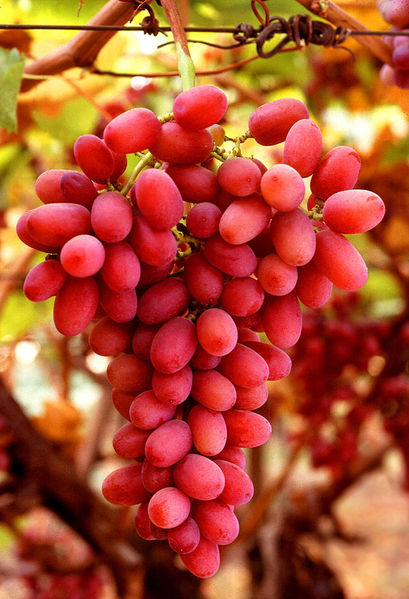
Crimson Seedless grapes taken by Bob Nichols. USDA Image Number K7721-3.

Thursday, September 21, 2006

stone roses

One of the things I love about this blog is the way it wakes me up to plants.

I wrote about sedums and then I drove my car to work (yes! shocking--one of the main reasons I took this job, besides the money and the mission statement of the organization (it's a writing center) is that it's within walking distance of my house). So it wasn't until this morning, when I walked my daughter's chihuahua, Pepe, around the block that I noticed all the sedums in my neighborhood. These plants have been here for years and I just noticed them today.

My favorites were the sempervivums, which were the members of the Crassulacaeae family that I didn't feature in yesterday's articles. Some of them go by the name of hen and chicks and I think that's what I saw this morning. Paghat, as usual, has a wonderful article on them:
http://www.paghat.com/sempervivumfuego.html

One of their other common names is "stone rose" and that's exactly what they look like. I love the idea of these growing all over the stone windowsills and slate roofs of old houses. I also saw some love links (these are members of the sedum family, which I recognized from Paghat's site:
http://www.paghat.com/sedumrupestra.html

Hope you find some sedums in your life.

Tuesday, September 19, 2006

Sedum (Stonecrop)


How bright atop the wall
The stonecrop's fire.
Robert Nichols (1893-1944)

On Sunday, I went to the Library Book Sale—I always go on half price day. Not that I need more books. I have ten nine-foot shelves of books, plus two huge bookcases, both of which hold about 200 books each and a bunch of brick and board shelves in the hall that hold my art books. I also have a table piled high with books and folders that has become my Flower of the Day headquarters. But I can’t resist half-price day at the book sale: paperbacks for a quarter, hardbacks for 50 cents.

Most of the books I bought were old gardening books. Each one had a different way of categorizing plants: one shows them by families, one by their country of origin, one by the seasons in which they flourish and another alphabetically by common name.

The one that organized plants by season is my favorite and it corresponds with many of the plants I saw on a tour of my friend Dan’s garden during his birthday party this weekend. I asked about a plant that I thought was a houseleek but everyone else knew it as stonecrop or sedum. In fact, the specimen in question, I believe is Sedum telephium, Autumn Joy which seems like a good plant to feature as we approach the equinox.

The sedums are members of the Crassulaceae family, from a Latin root word which means “thick or dense,” the same root which gives us Crass. (The plant I know as the houseleek comes from another genera in this family, the sempervivum). They come from subtropical Africa, the Mediterranean and temperate parts of Asia. The name sedum comes from Latin, meaning to sit, because they tend to creep along, low to the ground. Most of the members of this family are succulents: they like to live on rocks and mountains, hence the common name stone crop. When more people lived in stone houses, these plants often grew on slates roofs and even windowsills, as in these lines from a poem by Wordsworth:
The yellow stone-crop suffered to take root
Along the window's edge, profusely grew,
Blinding the lower panes.

There are many different kinds of sedums. My favorite garden writer, Paghat, has many wonderful articles on some of these varieties. I’ll summarize some of her comments in case you don’t want to click on all the links but then you’ll miss her gorgeous photos.

Sedum acre is called golden stonecrop or yellow wall pepper. It has yellow flowers and a peppery fragrance when crushed. Paghat lists many other names for it including Biting Stonecrop, Prick Madam, Wall Ginger, Mousetail, Bird's Bread, Jack-of-the-Buttery, Golden Carpet, Gold Chain, Small Houseleek, Mossy Stonecrop, & Creeping Tom. In England apparently it blooms in June and July so I might have to move it up in the flower calendar.
http://www.paghat.com/sedum_goldmoss.html

Sedum telephium is sometimes called orpine, midsummers men, long life or everlasting. I believe this is the plant that’s growing in my friend Dan’s garden. Mrs. Grieve says the species name comes from Telephus, the son of Hercules, who discovered its virtues.
http://botanical.com/botanical/mgmh/s/stonec91.html
It is taller than other sedums and has pink flowers. At midsummer in England it’s used in love divinations: two orpines are laid side by side and if they twine towards each other, that augurs well for the relationship.

Sedum sarmentosum is a stonecrop from Asia which is sometimes called Graveyard Moss because of the way it grows in old graveyards. It is also called Stringy or Trailing Stonecrop, because of the way it grows and Yellow Moss, Star Sedum or Gold Moss because of its yellow flowers.
http://www.paghat.com/sedumstringy.htm

The succulent leaves of sedums are edible. They can be added to salads to give them spice (they have a peppery flavor), fried with other vegetables or added to soup. The sedums with yellow flowers have mild toxicity, but when fried, they lose their toxicity. Paghat offers this recipe for a relish: fry sedum leaves with slivers of sweet bell peppers and onions at a high heat in olive oil until the onions are browned and bell peppers nearly translucent, then add pepper to taste and use as a relish on hotdogs or gardenburgers. Refrigerate for use as needed. Stonecrops with red flowers are fine to eat.

Sedums also have medicinal qualities. Mrs. Grieve writes that the leaves of White Stonecrop were often used in a soothing application for hemmorhoids while Biting Stonecrop taken internally got rid of worms. Sedum telephium is used as a remedy for diarrhea when the leaves are boiled in milk and taken three or four times a day: this is also good for the kidneys, piles and hemorrhages.

Paghat writes that Sedum acre (known by the name helluhnori) was recommended in a 1770 Icelandic herbal as a cure for jaundice, gallstones and respiratory illness. In China, Japan & Korea, sedum is sold as a medicinal herb under the name Chuipengcao or Chui pen cao. It is used as a general gastric & renal regulator. Sedum is a known source of herbal estrogen.

Here’s a great article on growing sedum in Texas:
http://home.att.net/~larvalbugbio/sedum.html

Reference (one of my new old books):
deWit, H.C.D., Plants of the World: The Higher Plants I, Dutton 1966

Illustration found at Wikipedia:
http://en.wikipedia.org/wiki/Image:Sedum_telephium_(Autumn_Joy)_in_bloom.jpg

Saturday, September 16, 2006

Chestnuts


Missed posting my entry last night because I didn’t have access to the Internet. Not sure whether this is a problem with AOL or with my cable service provider Comcast. It’s happened three times in September so I need to do some detective work.

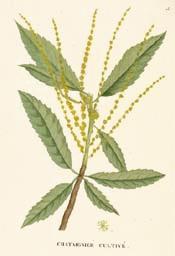
September 15 is the day of the chestnut in the French Republican calendar, and I did a bit of preliminary research. The chestnut in question is the sweet chestnut which is Castanea sativa. Sometimes known as the Spanish chestnut. There is also an American chestnut, Castanea dentata, which has been decimated by the chestnut blight. The name Catasnea comes from Catanis, a town in Thessaly (Greece) which was known for its chestnut trees. The ancient Greek name for the nut was Sardis glans, from the town in Turkey (the capital of Lydia) where the tree first grew. It’s a member of the Fagaceae or Beech family.

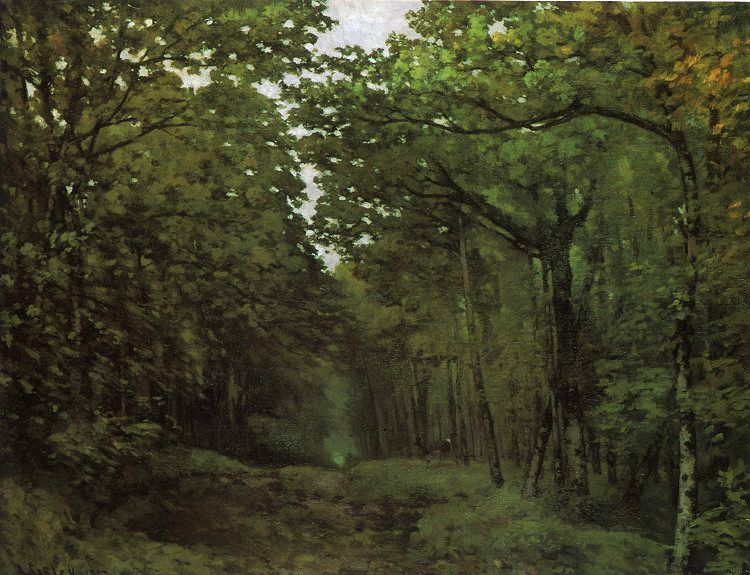
There is a famous chestnut tree in Sicily, known as the Tree of One Hundred Horses, under which Queen Joan of Aragon and her cavaliers sheltered during a storm in 1308. There is also an ancient chestnut tree in England which is said to have been planted in the time of King Egbert (800), although believes it probably dates from around 1100. The chestnut was probably brought to England by the Romans who ate the nuts. These old trees are magnificent, with trunks of quite impressive girth.

Of course the nuts are a great part of the appeal of the chestnut. To roast chestnuts,
Take a very sharp, small knife, and slit the chestnuts around the sides or slash with an X on the flat side. The slash should extend completely through the hard shell and the inner lining surrounding the meat. Place X-side up on a well-oiled cookie sheet and set in a pre-heated 400 oven. Bake until the shell pulls away from the tender inside, about 30 minutes. Roasted chestnuts are known as marrons glace in France. Marron is also the name of the free

The Wikipedia article says that if you want to preserve chestnuts through the winter you should cover them with sand. Any maggots in the chestnuts will work their way up through the sand to get air without disturbing any other chestnuts.
http://en.wikipedia.org/wiki/Chestnut

Roberta Sickler in her marvelous book, Rituals of the Hearth, provides the instructions above plus this recipe for Buttered Brussels Sprouts and Chestnuts:

1 lb chestnuts, roasted & peeled
1 lb small Brussels sprouts
4 T butter
1-1/2 t sugar
1/4 t paprika
salt

Scrub the Brussels sprouts and drop them, still dripping, into a dry, heavy enamel pot. Add butter, put the pot over a low flame and roast until the sprouts turn golden-green, about 30 minutes. Add the sugar, paprika and roasted chestnuts and toss lightly to coat with butter. Sprinkle with salt and serve.

Mrs.Grieve provides this recipe for chestnut soup:
Scald, peel and scrape 50 large chestnuts; put these into a stewpan with 2 OZ. of butter, an onion, 4 lumps of sugar, and a little pepper and salt, and simmer the whole over a slow fire for three-quarters of an hour; then bruise the chestnuts in a mortar; remove the pulp into a stewpan, add a quart of good brown gravy, and having rubbed the purée through a Tammy, pour it into a stewpan; make it hot and serve with fried crusts.
http://www.botanical.com/botanical/mgmh/c/cheswe59.html

For many more chestnut recipes, see this web site
http://www.chestnutsonline.com/recipes.htm

Roasted chestnuts are also ground into flour and used to make bread and a coffee-like drink. They are rich in vitamins and minerals, complex carbohydrates and starch but lower in fat than other nuts. The Tsalagi (Cherokee) and Iroquois tribes used the nuts to make cakes, breads, gravies, soups and drinks.

The tree is often coppiced, that is, cut down to the stem to grow many small stems which are split to produce fencing material or fed to cattle and sheep. Although chestnut wood is of good quality, it grows in the same climates as oak, and oak is preferable as timber. In Italy, the wood is used for small items like fencing and shingles and also barrels for aging balsamic vinegar.

Sweet chestnut leaves are sometimes used as food wraps. They also regulate the ripening process of soft cheese, although I only found one cheese on a quick Google search (St. Marcellin) that was wrapped in chestnut leaves.

Sweet chestnut leaf infusions are said to relieve coughs, including coughs due to whooping cough and bronchitis. They have astringent and antibacterial properties that mean they help heal wounds when used as poultices. The Bach Flower Remedy made from Sweet Chestnut is recommended for extreme mental anguish.

In Greece, chestnuts, like walnuts, were called the acorns of Zeus. In Christian symbolism, they represent triumph over temptation, chastity and goodness. Hageneder says it is common practice in Southern France to put pictures of the saints in sweet chestnut trees. He also writes that in ancient China, these trees were the homes of the gods of the west.

References:
Hageneder, Fred, The Meaning of Trees, Chronicle 2005
Mitchell, Alan and John Wilkinson, The Trees of Britain and Northern Europe, William Collins Sons and Company 1982
Pakenham, Thomas, Meetings with Remarkable Trees, Random House 1998